
AI Shopping Assistant Development: A Practical Guide for E-commerce
AI shopping assistants are rapidly becoming game changers for modern e-commerce success. With the increasing global competition and customer expectations, mid-sized and small businesses cannot afford manual or slow processes. Modern customers love speed, instant support, and personalization. And for this, virtual shopping assistants for retailers become a key option.
From solving customers’ queries to suggesting products in real-time, AI assistants are reshaping how businesses interact with their customers these days.
According to data sources, more than 85% of mid-sized and small businesses that are using virtual shopping assistants have experienced a boost in revenue.
In this blog, you will get to know how to simply shopping experience with generative AI. In addition, the advantages of using these tools and how to build an AI shopping assistant for an e-commerce business are also covered to help you understand easily.
What are Virtual Shopping Assistants for Retailers?
A virtual shopping assistant for ecommerce & retail is an AI-backed tool that is designed to guide customers throughout their shopping journey. These assistants use technologies like machine learning, natural language processing, and generative AI to make it similar to human-like conversations.
AI assistants can be trained according to the product data, which in turn makes them perfect for every item you offer. These assistants can also be trained on commerce data like customer reviews, inventory data, and purchasing trends. This information ensures that the virtual assistant for ecommerce & retail offers accurate information and genuine help. A virtual assistant for shopping can:
- Answer product-related questions
- Recommend products based on preferences
- Handle returns and FAQs
- Assist with order tracking
- Provide personalized shopping experiences
Unlike conventional chatbots, modern AI assistants are aware of the context and capable of learning from interactions.
Why Ecommerce Businesses Need AI Shopping Assistants?
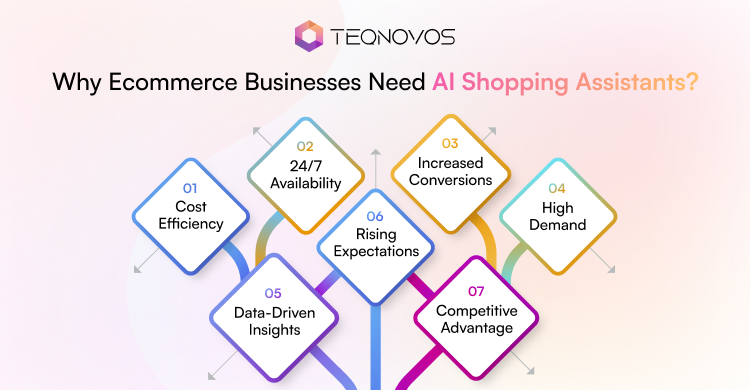
1. Rising Expectations
Customers these days are more impatient, informed, and experience-driven than ever before. With the rise of platforms like Amazon and eBay, customers have become familiar with quick response, seamless navigation, and personalized suggestions.
Buyers now expect:
- Real-time answers to their queries
- Product recommendation according to their preferences
- Smooth shopping journey
Even a slight delay in response can somehow frustrate customers and push them towards competitors. And that’s where virtual shopping assistants for retailers become a key player. They make sure that every response or interaction with the buyers will be fast, personalized, and relevant.
2. 24/7 Availability
Unlike humans, a virtual shopping assistant for e-commerce & retail operates continuously without any downtime or breaks. This ensures that buyers will receive support whenever they need it. Whether it’s late at night, early in the morning, or even across different time zones.
This is especially crucial for:
- Global ecommerce businesses
- High-traffic online stores
- Seasonal sales events and peak shopping periods
A virtual shopping assistant in ecommerce & retail can quickly respond to thousands of shoppers simultaneously, reducing wait times and improving overall user experience. 24/7 availability not only improves customer satisfaction but also helps in building trust and reliability.
3. Cost Efficiency
Managing a large customer support team can be costly, especially as your business scales. Expenses include salaries, training, infrastructure, and management overhead.
AI shopping assistants significantly reduce these costs by:
- Automating repetitive queries (FAQs, order tracking, returns)
- Handling multiple customers at once
- Reducing dependency on large support teams
While there may be an initial investment to build an AI shopping assistant, the long-term savings are substantial. Businesses can allocate resources more efficiently and focus human teams on complex, high-value interactions rather than routine tasks.
4. Increased Conversions
The ability to drive sales is one of the biggest benefits of using AI assistants. With personalized suggestions and guiding users throughout the shopping journey, a virtual assistant for ecommerce & retail helps convert visitors into paying customers.
AI assistants contribute to more conversions by:
- Suggesting similar products based on the user behaviour
- Providing quick answers that remove purchase hesitation
- Recommending upsells and cross-sells
- Helping customers during checkout to reduce drop-offs
This ability to simplify the shopping experience with generative AI makes sure that customers find what they are looking for quickly and confidently. As a result, businesses see reduced cart abandonment rates and improved overall profit.
5. High Demand
Ecommerce businesses generally face spikes in traffic during festivals or seasonal discounts. Scaling human support teams instantly can be expensive and challenging.
AI assistants can solve this issue by:
- Handling unlimited simultaneous interactions
- Maintaining consistent output under high load
- Ensuring every customer gets their answers
This scalability makes them a more practical and essential tool for a growing business.
6. Data-Driven Insights
AI shopping assistants don’t just interact; they learn and adapt. Each conversation with the buyer or customer provides valuable data about their behavior, preferences, and pain points.
With the help of this data, businesses can:
- Optimize marketing strategies
- Improve product offerings
- Enhance overall user experience
- Identify common issues throughout the purchase
With time, this makes a more efficient and smarter system, which keeps on improving regularly.
7. Competitive Advantage
In a crowded ecommerce marketplace, differentiation is key. Brands that use virtual shopping assistants early gain a crucial edge over their competitors that are still relying on conventional methods.
A well-implemented virtual shopping assistant for ecommerce & retail can:
- Deliver faster service
- Offer better personalization
- Create a memorable shopping experience
This not only attracts more customers but also builds long-term loyalty.
By using virtual shopping assistants for retailers, businesses can now transform their operations, deliver exceptional customer service, and reduce costs.
How Generative AI Simplifies the Shopping Experience
To simplify the shopping experience with generative AI, businesses must focus on personalization, real-time engagement, and automation.
Conversational Search
Instead of typing keywords, customers can ask questions like:
“Show me affordable running shoes under $100.”
The AI will understand the intent and showcase the exact results.
Personalized Recommendation
Generative AI analyzes the browsing behavior of the user and purchase history to suggest similar products.
Smart Content Generation
AI can generate product descriptions, comparisons, and reviews, helping users make informed decisions more quickly.
Voice and Visual Assistance
Advanced virtual assistants support image-based sources and voice commands. This makes shopping more accessible and interactive.
Key Features of a Virtual Shopping Assistant for E-commerce & Retail
A successful AI shopping assistant should include:
- Natural Language Understanding: Ability to understand user context and intent.
- Omnichannel Integration: Works across websites, messaging platforms, and mobile apps.
- Product Recommendation Engine: Uses AI to suggest similar products.
- Inventory Awareness: Provides accurate stock availability and delivers timelines.
- Secure Payment Assistance: Guides users through checkout securely.
- Multilingual Support: Caters to global audiences by supporting various languages.
How to Build an AI Shopping Assistant?
If you are looking to build an AI shopping assistant, follow these steps:
Step 1: Define Your Goals & Objectives
Identify what you want the virtual assistant to achieve:
- Customer support automation
- Sales enhancement
- Product recommendations
Step 2. Choose the Correct Technology Stack
You will need:
- NLP frameworks
- Machine learning models
- Generative AI tools
Step 3. Integrate with Ecommerce Platform
Ensure seamless integration with your CRM, CMS, and inventory management.
Step 4. Train the AI Model
Use FAQs, historical data, and product categorization to train your virtual assistant.
Step 5. Design Conversational Flows
Create user-friendly and intuitive interactions.
Step 6. Test and Optimization
Regularly monitor performance and improve it based on the feedback.
Most Used Platforms and Tools
These platforms make it easier to build and deploy an AI shopping assistant:
- Shopify: Integrates AI tools for online stores and ecommerce websites
- Salesforce Commerce Cloud: It offers AI-driven personalization
- OpenAI GPT – Powers generative AI conversations
- Google Dialogflow: For building assistants and chatbots
These platforms help businesses to use intelligent and scalable solutions without building everything from scratch.
Challenges and Considerations
Accuracy and Bias
Virtual shopping assistants for retailers must be trained carefully to avoid biased or incorrect recommendations.
Data and Security
Ensure compliance with regulations and protect users’ data.
Human Oversight
AI should complement, but not replace, human support teams.
Implementation Costs
Initial setup may need investment in expertise and technology.
Future Trends in AI Shopping Assistants
Hyper-Personalization
AI will deliver even more customized experiences that are based on real-time data.
Augmented Reality Integration
Customers can ‘try before they buy’ using an AR-powered assistant.
Voice Commerce Growth
Voice-enabled assistants are more prevalent when it comes to ecommerce.
Autonomous Shopping Agents
AI may soon make purchasing decisions based on users’ preferences.
Best Practices for Retailers
To maximize the overall output of virtual shopping assistants for retailers, follow these best practices:
- Keep interactions natural and simple
- Focus on solving customer problems quickly
- Regularly update product data
- Combine AI with human support
- Monitor and examine performance metrics
Measuring Success
You can track these metrics to evaluate the AI assistant:
- Conversion rate
- Customer satisfaction
- Customer retention
- Average response time
- Cart abandonment rate
Types Of Virtual Assistants for Ecommerce & Retail
There are various types of AI shopping assistants for Ecommerce that are made to address specific challenges. Let’s have a look at them:
Voice Assistants
Voice supporting platforms such as Google Assistant or Amazon Alexa enable users to interact easily with hands-free using their voice. These AI shopping assistants integrate with ecommerce platforms to manage tasks like checking delivery status, placing new orders, or adding any item to the cart.
For instance, a buyer gives a voice command like, “Order cat food,” and the AI assistant will pull up the past purchases to repeat the order with the correct quantity.
Chatbots
AI Chatbots appear on the website and provide an instant response to the customers’ queries. They also guide customers by answering FAQs and product discovery, and help them to track their orders. AI Chatbots can also transfer complex issues to human agents if needed.
A shopper visits a lifestyle retailer’s website and asks, “ Do you have a winter outfit under $200?” The chatbot filters the results and shows the exact results.
Recommendation Browsing
In order to recommend suitable products, these algorithms examine past browsing and purchase activity. They frequently work in the background on e-commerce websites, customizing cross-sells, upsells, and product carousels for every customer.
The likelihood of conversion is increased when a returning visitor sees a site full of recommendations based on their previous searches and purchases.
Virtual Sales Assistant
The experience of dealing with an in-store assistant is replicated by these advanced technologies. In order to create a more engaging shopping experience, they integrate live chat, recommendation algorithms, and occasionally graphic interfaces or avatars that offer interactive coaching and comprehensive product information.
A home goods business incorporates a virtual assistant that helps buyers finish purchases straight from chat, delivers styling advice, and makes customized product recommendations. The assistant can also provide real-time responses, product descriptions, and useful insights to help customers along their journey thanks to AI solutions like ChatGPT.
Step-by-Step Use Case Example
Let’s have a look at practical examples of how AI assistants work in a real ecommerce scenario.
Step 1: The user opens the website
The AI assistant greets the customer and offers help.
Step 2: User Query
User writes: “I need running shoes under $200.”
Step 3: AI Response
The assistant then filters the products and showcases relevant options.
Step 4: Recommendation
The assistant will suggest the top-rated shoes according to preference.
Step 5: Comparison
Users ask for a comparison between two products.
Step 6: Checkout Assistance
The assistant guides the user throughout the buying process.
Step 7: Post-Purchase Support
It gives delivery updates and order tracking information.
This hassle-free process shows how AI can simplify the shopping experience with the help of generative AI.
Customers may swiftly make well-informed purchasing decisions thanks to the tailored experiences provided by AI shopping assistants. Among the main advantages are:
Key Advantages of Virtual Shopping Assistants for Retailers
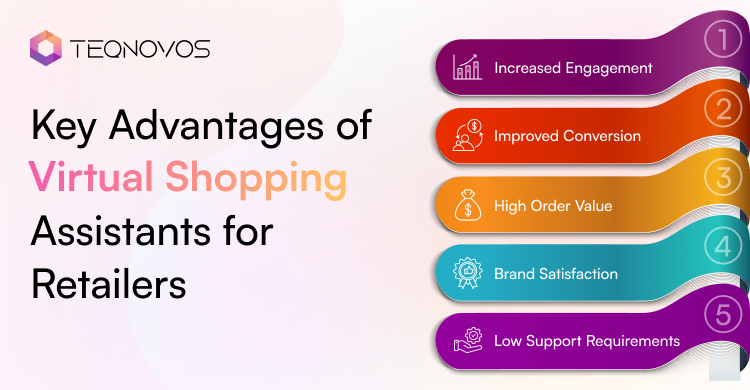
Increased Engagement: Customized answers and product suggestions produce interesting customer experiences that keep users on your website for longer.
Improved Conversion: Customers are more likely to finish a purchase if they can locate products with ease and receive thorough, pertinent specs.
Higher Order Value: AI assistants may easily upsell and provide tailored, strategic recommendations based on a customer’s past purchases or product trends.
Brand Satisfaction: An effective AI assistant can save a lot of time and make users feel more supported during purchases.
Low Support Requirements: Customers can receive prompt responses through dynamic, adaptable chat, which lowers the number of service inquiries your company gets.
Virtual Shopping Assistants for Retailers: Industry-Specific Applications
Every industry uses AI shopping assistants in different ways. Here are multiple fields that benefit from them:
Fashion and Apparel
AI assistants act as virtual stylists:
- Suggest sizes using past preferences
- Recommend outfits according to your preferences
- Provide similar options for a better selection
Beauty and Skincare
In this industry, personalization is a key thing and for that, AI assistants can:
- Recommend products according to your skin type
- Provide routines and tutorials
- Offer ingredient-based suggestions
Gadgets and Electronics
Buyers generally need comparisons in detail before buying. With AI assistance, they can:
- Comparing specifications
- Recommend alternatives
- Explaining technical features in a simple way
Grocery and FMCG
Convenience and speed are important; thus, an AI assistant can:
- Enable quick reordering
- Suggest weekly or monthly shopping lists
- Offer discounts or bundle deals
Home Decor and Furniture
Buyers need confidence while purchasing high-value items. AI assistants can:
- Provide suggestions for designs
- Recommend complementary products
- Assist with space planning
Security and Compliance Considerations
A virtual assistant for ecommerce & retail can easily manage customer data.
Key measures are:
- Data encryption
- Compliance with regulations
- Streamlined security alerts
Secure APIs
Transparency also plays a crucial role. Buyers must be familiar with the process they are interacting with.
Launch an AI shopping assistant for smarter selling and higher revenue.
Schedule a CallConclusion
As ecommerce platforms become more competitive, businesses must stay innovative to stay ahead and relevant. Using virtual shopping assistants for retailers is no longer just an option; it is a strategic requirement.
For better results:
- Focus on user experience
- Choose the right technology
- Regularly optimize the overall performance
By choosing to build an AI shopping assistant, you are surely investing in the advanced future of ecommerce. Which will be faster, smarter, personalized, and more effective?