
How to Build a Winning GCC Talent Strategy?
As we all know, Global Capability Centers (GCCs) are changing at a speed we never imagined. They have become more than just delivery agents today. Earlier, companies used to set up GCCs to save costs. But today they expect more than that. They not only expect innovation but ownership and impact as well. However, India plays a key role in this shift. The demand for GCC talent in India is growing rapidly. This makes it essential to set up a GCC in India for organizations to stay competitive in this fast-evolving market. More than a thousand GCCs are in India today, operating in a wide range of areas. They have been contributing strongly to global business growth as well as value creation.
But building a GCC is not the hardest part anymore. The real challenge arises when it comes to scaling the right talent. Many companies out there struggle to find skilled professionals. They face difficulties such as building leadership and retaining talent. This is where a strong talent strategy comes to the rescue and becomes one of the key aspects. However, it is no longer just an HR function. A well-defined GCC talent strategy can create a real advantage. It helps companies move faster and stay competitive. In today’s market, talent is not just a resource. It is the biggest differentiator for GCC success.
Today, through this blog, you will get to know everything about how you can build a winning GCC talent strategy.
The Reality Check: What No One Tells You About GCC Talent
There is a common belief. India has one of the vast talent pools, which is actually true. But it is only a part of the story. The real challenge is deeper. It is about quality, readiness, and mindset.
-
Talent Availability ≠ Talent Readiness
There is a large number of skilled professionals available in India. But not all are job-ready. Many of them lack exposure to real work problems. Niche skills are still limited. Companies today need talent that is skilled in domains like AI, cloud, and product roles. But the real problem is that there is not enough supply.
-
The “Execution vs Ownership” Talent Gap
Many GCCs still focus on execution work. They follow instructions from global teams. This limits their true potential as they just follow what has already been set or defined. Today, companies expect more. They want their GCCs to take full ownership. They want them to handle everything, not only just ideas, but delivery and improvement as well. But this shift is not as easy as it looks. It needs a different talent mindset. Teams must think, not just execute. They are expected to solve the actual issue rather than just completing the task.
-
The Leadership Bottleneck
Another major challenge that arises is leadership. There are not enough leaders with global exposure. This also highlights gaps in the GCC management layer. There are only a few who can actually handle and manage cross-border teams effectively. Being a strong GCC leader not only requires strategic thinking but also a cultural understanding. This creates a gap, and companies often look outside to fill it.
Today, many of the companies depend on third-party hiring providers to find the right talent. However, internal leadership pipelines remain weak. Industry reports highlight this issue clearly. Leadership gaps and skill mismatches are common across GCCs. Without strong leaders, growth slows down. And long-term success becomes difficult.
Decoding GCC Talent in India: Market Dynamics
The GCC ecosystem in India is changing rapidly. The demand for talent across industries is rising unexpectedly. But with the growing need, the market is also becoming very competitive, and every company needs to understand this shift.
Why India Continues to Lead
India remains a top destination for GCCs. However, there are several strong reasons behind this. Take a look at a few of them, which we have mentioned below:
- The very first reason is that the scale is unmatched. India has a vast and diverse talent base.
- Second, there is a clear cost advantage. Companies can build high-quality teams at lower costs.
- Third, India has strong digital talent. Engineers and tech professionals are widely available.
All these factors make GCC talent in India highly attractive.
The Demand Explosion
The demand for talent across different sectors is growing rapidly. Wondering what could be the main reason? The new technologies!
- AI is creating new job roles.
- Cloud computing is expanding quickly.
- And cybersecurity is now a top priority.
Companies need experts who are skilled in this space. As a result, hiring needs are significantly increasing. However, with time, GCC hiring in India is becoming more complex. There is also a rise in niche roles. Companies are looking for talent that is highly skilled in the above fields, making it more complex and competitive at the same time.
The Talent War is Real
The competition today between multiple organizations is very intense. GCCs are competing with startups and global firms. Everyone is targeting the same talent pool. This not only creates pressure on salaries but also on hiring timelines. Around 95% of GCCs say talent competition is a major challenge. And this clearly gives a reality check. Finding the right GCC talent in India is not an easy task. To succeed and do better than the rest, they must implement smarter hiring strategies.
Strengthen your GCC talent strategy in India to hire and retain top talent. Talk to our experts today!
Schedule a CallFrom Hiring to Strategy: Rethinking GCC Talent Strategy
To be honest, to win, hiring alone is not enough. GCCs need a long-term approach. A strong GCC talent strategy goes beyond just filling roles. It focuses on building future capabilities to improve GCC talent productivity across teams. Companies that think ahead significantly perform better. They not only scale faster but also create more value over time.
Why Traditional Hiring Models Fail
There are many companies that still follow old hiring methods. These methods are often reactive. They hire only when there is an urgent need. This not only creates delays but skill gaps as well. There are very few who actually believe in future planning. Workforce strategy is often missing. Another issue is overdependence on lateral hiring. Companies keep hiring from the market. This not only increases costs over time but also creates instability in teams.
What Makes a GCC Talent Strategy Successful?
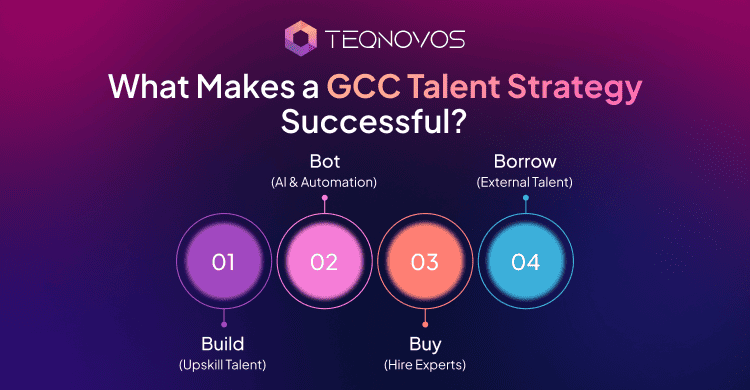
A strong strategy is balanced and focuses on multiple talent channels. It can be built on four key pillars:
Build
- Develop talent from within.
- Invest in training and upskilling.
Buy
- Hire skilled professionals from the market.
- Fill critical and niche roles quickly.
Borrow
- Use external partners or contract talent.
- Add flexibility to the workforce.
Bot
- Use automation and AI tools.
- Reduce manual work and improve efficiency.
This mix helps create a stable and scalable model while driving higher GCC talent productivity.
Aligning Talent with GCC Maturity Stage
Not all GCCs are at the same stage. Therefore, talent strategy should match the maturity level accordingly. Early-stage GCCs focus on hiring. They build teams quickly and prioritize scaling. On the other hand, mature GCCs have different goals. Their main focus is on building leadership and innovation, strengthening the GCC management layer. They invest more in capability building, and this shift is important. GCCs today are moving beyond execution and are becoming value creators. As a result, this makes a strong GCC talent strategy even more important.
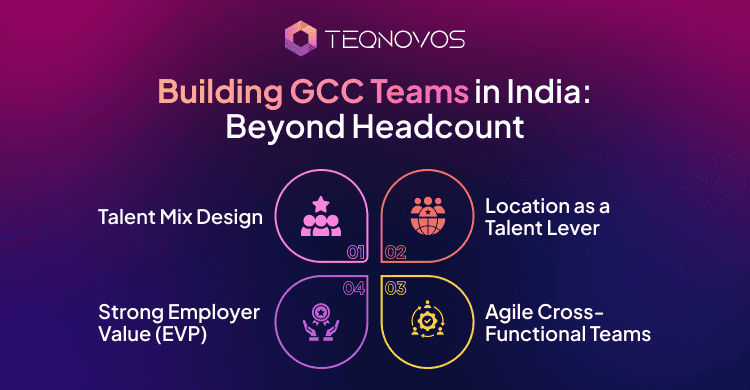
Building GCC Teams in India: Beyond Headcount
Building teams is not just about numbers. It is about quality and structure. There are a lot of companies that focus more on hiring faster. The focus on hiring quality talent is not given much priority. But that approach does not work for long-term growth. Building GCC teams in India requires clear planning. It needs the right mix of skills and mindset.
-
Designing the Right Talent Mix
Building a strong team needs balance. Not all roles are the same and require the same level of skillset. There should be the right mix of core roles. These bring specialized skills and innovation. Another major factor that needs to be considered is mindset. Some teams work in a service model and focus more on execution and support. But modern GCCs need a product mindset. Teams should think more about outcomes and impact. Moreover, they must take ownership of what they have built so far.
-
Location Strategy as a Talent Lever
Location plays a key role in hiring. For example, Tier 1 cities offer strong talent pools, but the cost is comparatively higher. On the other hand, tier 2 cities are now growing faster while providing talent at lower costs. Many companies are expanding into these cities. There is also a rise in distributed models. Teams are spread across multiple locations. This improves the flexibility and reduces dependency on one city.
-
Creating Agile, Cross-Functional Teams
Modern GCCs need agile teams because traditional structures are too slow. Many companies use squad-based models. Where each squad has different skills and expertise. The team of different skill sets works together, creating a more collaborative environment. This not only results in faster innovation but also produces better outcomes.
-
Creating a Strong Employer Value Proposition (EVP)
Attracting talent is not as easy as it looks. Companies must stand out. A strong EVP is important to show why people should join and stay. GCCs are not just competing with large firms but are also competing with startups. Startups offer speed, ownership, and growth. Therefore, GCCs must offer similar value. This includes providing learning opportunities and career growth. A strong EVP not only helps companies attract better talent but also improves the retention rate over time.
GCC Hiring in India: Winning the Talent War
Hiring in India has become one of the most challenging tasks. Over time, the market has become highly competitive. This makes it difficult for companies to find the right talent at the right time. Therefore, GCC hiring in India now requires smarter strategies.
-
Why Hiring is Getting Harder
There are many reasons behind this shift. And one of the major ones is that salary levels are rising quickly. Top talent expects higher pay. Another reason is that offer drop rates are also increasing. Because candidates often accept multiple offers. And many of them do not join after accepting. As startups and global firms are hiring aggressively. There are more job options available. As a result, this gives candidates more choices, making the overall hiring process slower and more uncertain.
-
Smart Hiring Approaches
With the evolving technologies, organizations should redesign their hiring approach as well. Skills must be given more importance than degrees. A candidate’s ability to do something should matter more than their background. This is called skill-based hiring. Moreover, one important thing to consider is that companies should hire for a candidate’s potential rather than their current experience. Because many candidates can grow better when given the right support. However, this approach helps companies build strong future teams.
-
Leveraging Data in Hiring
Utilizing data in the right manner helps improve hiring decisions. Talent analysts help in tracking the hiring trends. This helps in showing where gaps actually exist and measuring the hiring success. Some companies make use of predictive models to forecast hiring needs. With this, you can find out or identify the right talent at the right time. This not only reduces hiring risks but also improves the overall hiring efficiency.
Solve hiring and leadership gaps with a strong GCC talent strategy in India. Get expert guidance!
Schedule a Call
GCC Leadership Hiring: Building Global-Ready Leaders
Leadership in GCCs is no longer just about managing tasks. Nowadays, leaders are expected to create better strategies while driving innovation.
The New Definition of GCC Leadership
GCC leaders go beyond just operational management. They act as strategic drivers and take ownership of business outcomes. They play a major part in guiding the team and creating better strategies.
Key Traits to Look For
Take a look at the specific skills a strong GCC leader must hold:
- They need to manage global stakeholders effectively. This includes handling teams, clients, and leadership across regions.
- They should have an innovative mindset. They must think creatively and solve complex problems.
- A leader also needs to change their leadership skills.
- They guide teams through transitions and new ways of working.
Conclusion
GCC’s success heavily depends on the talent. Without the right people, growth is limited. Winning companies like Teqnovos invest in these three key areas, which are:
Leadership
They develop strong leaders not only for today but also for tomorrow as well.
Culture
They create environments where employees thrive.
Long-term capability building
The focus is more on skill development and innovation.
The key takeaway is clear. The future of GCCs in India will not be defined by size anymore. It will be defined by the quality of the talent strategy. Because smart talent strategies are what turn GCCs into competitive advantages.