How to Start a Foreign-Based Multinational Corporation for IT Services?
Expanding beyond borders is a strategic move in today’s digital-first economy. If you are aiming to create a global presence, knowing how to start a multinational corporation is the first step towards scaling your IT business internationally.
This blog will help you understand everything that you need to know, from understanding what a multinational corporation is to executing a successful multinational IT company setup.
Why Start a Multinational Corporation?
There are several benefits to starting a foreign-based multinational corporation that is situated abroad:
- Access to talent pools around the world
- More sources of income from a variety of markets
- Capacity to provide local services to clients from abroad
- Opportunities for tax optimisation (depending on jurisdiction)
- Increased credibility of the brand
A well-organised global IT services company can grow more quickly than a local company and withstand changes in the local economy.
Step-by-Step: How to Start a Multinational Company
If you are searching for guidance on how to start a multinational corporation step by step, here is a structured roadmap.
Step 1: Define Your Global Vision and Business Model
Before starting, it is important to understand what a multinational corporation is. This helps to define a clear global vision.
- What IT services are you going to provide? (such as software development, AI-based solutions, cloud services)
- What foreign markets are you interested in penetrating?
- Are you going to work under branches and subsidiaries or by partnership?
Such a vision and goal will assist you in the expansion and will become a strategic investment.
Step 2: Research The Market Deeply
Before setting up an IT company abroad, you must analyze:
- Demand for your services/products in target countries
- Local competition
- Regulatory environment
- Cost of operations
- Cultural and language differences
Focusing on markets where your services or products solve real-world problems can provide excellent opportunities to grow.
Step 3: Choosing the Right Country for Business Expansion
Not all countries offer similar advantages. When planning your multinational IT company setup, you should consider:
- Business facilitation
- Access to qualified IT specialists
- Taxation policies
- The infrastructure and internet connectivity
- Political and economic stability
The tech-friendly hubs are also popular options. Nevertheless, the choice must be in line with your business objectives and dreams.
Step 4: Decide Between Joint Venture, Subsidiary, or Branch
To establish a multinational corporation, you need a legal presence in foreign markets as well. Your options should include:
-
Subsidiary
If you go with the subsidiary, it should be a separate legal entity that can offer liability protection as well as be suitable for long-term expansion.
-
Branch Office
A branch office is an extension of the parent company or institution. It is easier to set up and has less legal separation.
-
Partnership or Joint Venture
When you are thinking about forming a partnership, you must work with a local company. In this way, you will be assisted in the process of going through the local regulations, and it will also minimize risks associated with entry.
The selection of the structure is a critical factor that is critical in the management of the global operations.
Step 5: Register Your Company Internationally
Each country has its own legal norms and regulations for setting up an IT company abroad. Common steps include:
- Business name registration
- Obtaining licences and permits
- Opening a local bank account
- Registering for taxes
You can work with local legal experts who can easily ensure compliance and speed up the whole process.
Step 6: Understand International Business Compliance
To completely understand this, businesses need to be clear about what a multinational corporation is. It is essential to understand how it operated across different systems. International business compliance is one of the most important aspects of running a multinational company. You must follow:
- Local labor laws
- Tax regulations in that country
- Data protection laws especially for IT services
- Intellectual property rights
Non-compliance can lead to legal issues, fines, or even a business shutdown.
Step 7: Create a Global Team
An effective global IT services company depends on its people. You must employ local talent to get a feel of the market. Flexibility The need to operate in varying circumstances can also be achieved by building a remote team. In conjunction with this, it is a requirement to have effective communication channels between time zones. Invest in distributed team support, leadership, and management systems.
Step 8: Set Up Technology and Infrastructure
Whether you are operating in a single country or more than one, your IT infrastructure should support global operations effectively and seamlessly. Key components include:
- Cloud-based system for better scalability
- Secure tools for communication
- Project management platforms
- Cybersecurity frameworks
Since you are providing IT services, your internal systems must reflect high standards.
Ready to take your IT business global? Partner with experts to build and scale your multinational company with confidence.
Schedule a CallStep 9: Develop a Global Marketing Strategy
Your marketing strategy and campaigns should be region-specific in order to appeal to global clients. And at that, start with the localization of your content and site. Additional strategies to depend on include region-specific SEO tactics, form partnerships within local markets, and participate in global tech events. This will cause you to establish an attachment to the local buyer and earn trust. That is, a well-established and consistent online presence matters to a multinational corporation in the field of IT.
Step 10: Manage Taxation Policies and Finances
Financial planning becomes more complex and hard to understand when you are operating internationally. Consider:
- Currency exchange risks
- Cross-border payments
- Transfer pricing regulations
- Double taxation treaties
Hiring international accounting experts can surely help optimize your financial structure.
Step 11: Establish Legal and Contractual Framework
When working with global clients, contracts must be enforceable and clear. Include:
- Service level agreements (SLAs)
- Data protection clauses
- Payment terms
- Dispute resolution mechanisms
Legal clarity not only protects your business but also gives you the reliability to work more progressively across jurisdictions.
Step 12: Focus on Growth and Stability
Once your foreign-based multinational corporation is operational, begin to pay attention to scaling by:
- Entering new markets
- Diversifying service offerings
- Investing in technology and innovation
- Building your brand on a global platform
The growth must be sustainable and must be in line with your long-term vision
Common Challenges in Setting Up a Multinational IT Company
Assembling a company is not as simple as it sounds. It brings various difficulties in terms of handling the company. Each of these issues impacts the growth and functions.
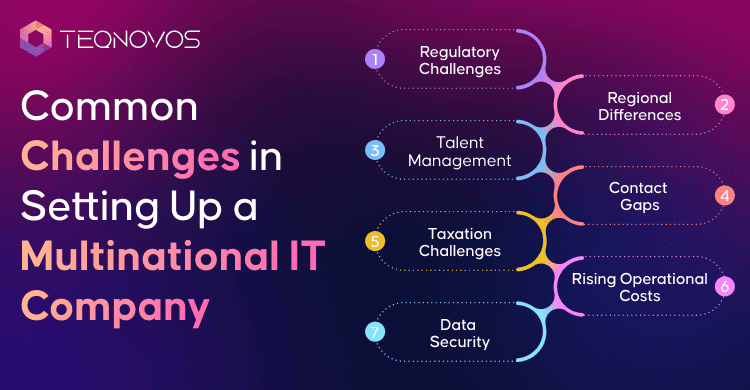
1. Regulatory Challenges
The legal system of every country is different and its regulations are not constant. The documentations vary in the regions. Companies have to keep abreast of threats. Expansion is hampered by legal delays. Professional leadership is required to facilitate smooth operations.
- Various laws of business within the countries
- Complicated license and registration procedures
- Frequent regulatory changes
- Possible penalties in case of failure to comply
2. Regional Differences
Countries have different work cultures depending on the variation in the ways of communication. The approach is different from the variance in making decisions. Such disparities cause misunderstandings in groups. It affects performance and cooperation. The importance here is that businesses need to develop cultural awareness at the at-the-outset stage.
- The relay is influenced by language barriers
- Various work ethics and expectations
- Varying management styles
- Lack of coordination within teams
3. Talent Management
It is much easier to hire global talent than to retain it. The workers require varying benefits in every location. The expectations of career development are also different. Companies need to develop powerful engagement strategies in order to be stable.
- The inability to retain talented workers
- Regional variations in salary requirements
- Localized HR policy requirement
- Challenges in performance management
4. Contact Gaps
Multinational companies operate at different times. This generates delays in communication and therefore missed information is important. These misconceptions affect the project delivery. There should be clear communication systems in order to keep everything on track.
- Response time is sluggish due to time zone differences
- Absence of real-time teamwork
- Miscommunication between teams
- Delays in decision-making
5. Taxation Challenges
Countries vary in terms of tax structure. Financial compliance is complicated. International transactions increase the level of challenge. Companies should budget their funds well to prevent losses.
- Various tax laws in both markets
- Difficulty in international transactions
- Possibility of taxation twice
- Requirement of professional financial planning
6. Rising Operational Costs
Operating in multiple countries increases expenses. Infrastructure costs vary by location. Hiring costs also differ. Hidden expenses can reduce profit margins. Businesses must manage budgets carefully.
- High setup and infrastructure costs
- Salary variations across regions
- Unexpected operational expenses
- Increased administrative costs
7. Data Security
IT companies handle sensitive data. Each country has strict data protection laws. Security breaches damage the reputation of the company. Compliance failures can lead to heavy penalties. Strong systems are required to protect data.
- Strict data protection regulations
- Risk of cyber threats
- Need for secure IT systems
- Compliance with international standards
These challenges are real. Businesses must prepare early. A strong strategy helps reduce these risks.
How to Overcome These Challenges
Global expansion needs a structured approach. Clear planning helps reduce friction. Businesses that act early handle complexity better.
Hire Local Experts
Local professionals bring market knowledge. They understand regulations and business practices. Their input reduces guesswork. It also improves execution speed in new regions.
- Understand regional legal requirements
- Navigate market entry with clarity
- Reduce dependency on trial and error
- Strengthen decisions at the local level
Use Global Tools
Distributed teams need strong coordination. Technology helps maintain alignment. It ensures tasks move without delay. Visibility across teams becomes easier.
- Centralize communication channels
- Enable instant updates across teams
- Maintain clear task ownership
- Improve cross-team coordination
Build Standard Processes
Consistency is critical in global operations. Defined processes reduce confusion. Teams follow the same structure across locations. This improves output quality.
- Create clear workflow structures
- Define roles and responsibilities
- Maintain uniform execution standards
- Reduce operational inconsistencies
Focus on Compliance Early
Early attention to regulations prevents issues later. Businesses must study local laws before expansion. This builds a stable foundation for operations.
- Identify country-specific requirements
- Align operations with legal frameworks
- Maintain documentation
- Reduce exposure to legal risks
Invest in Leadership
Global teams need strong direction. Leadership ensures clarity and alignment. It helps manage teams across different regions. This improves performance and stability.
- Build leaders for distributed teams
- Strengthen governing capability
- Maintain alignment across locations
- Improve team performance and accountability
Future of Multinational IT Companies
Technology is changing how businesses operate in the growing field. Companies need to stay competitive and relevant to stay ahead.
Remote Work Growth
Remote work is now a standard model. Teams no longer depend on physical offices. Businesses can operate across multiple regions without relocation. This increases flexibility and reduces dependency on location.
- Access talent without geographic limits
- Reduce infrastructure dependency
- Improve workforce flexibility
- Enable faster team scaling
AI Operations
Artificial Intelligence assists systems in performing tasks using data and automation. AI is transforming IT operations. It improves speed and accuracy. Businesses use it to automate repetitive tasks and enhance managerial tasks.
- Automate routine business processes
- Improve data-driven decisions
- Enhance customer support systems
- Increase operational efficiency
Global Talent Networks
Companies now build talent networks across countries. This model helps businesses access specialized skills. It also supports continuous operations across time zones. Talent is no longer limited to one region.
- Hire skilled professionals globally
- Build diverse and specialized teams
- Enable round-the-clock productivity
- Reduce hiring limitations
Decentralized Teams
Decentralized teams operate without a single central office. Teams work independently across locations. This structure increases agility. It allows faster execution and better adaptability.
- Improve business agility
- Reduce dependency on central offices
- Enable faster decision-making
- Support scalable operations
The future is dynamic. Businesses that adapt early gain an advantage. A strong global strategy ensures growth.
Tips for Success in International Markets
Success in international markets requires focus and clarity. Businesses must adapt to each region. A strong approach helps build growth.
Understand Local Markets
Each market behaves differently. Customer needs vary across regions. Businesses must study local demand before entry. This helps create relevant solutions.
- Research customer behavior and needs
- Study local competitors and trends
- Adapt services to market demand
- Identify gaps in the target market
Build Strong Partnerships
Local partnerships help businesses grow faster. They provide market access and insights. Partnerships also reduce entry risks.
- Collaborate with local businesses
- Leverage existing market networks
- Gain faster market access
- Improve trust in new regions
Adapt Strategies
Marketing must match local preferences. A single strategy does not work everywhere. Businesses must localize content and messaging. This improves engagement and conversions.
- Customize content for each region
- Use region-specific SEO strategies
- Align messaging with the local audience
- Build a strong digital presence
Customer Experience
Customer experience drives success. Businesses must deliver consistent service quality. Local expectations should guide service delivery.
- Provide responsive customer support
- Maintain service quality standards
- Understand local customer expectations
- Build relationships
Monitor Performance
Continuous tracking helps improve results. Businesses must analyze performance regularly. This helps identify gaps and opportunities.
- Track key business metrics
- Analyze market performance data
- Identify areas for improvement
- Adjust strategies based on insights
A focused strategy drives success. Businesses that adapt to markets grow faster. Strong execution ensures stability.
How to Open an IT Company in Another Country?
Opening an IT company in another country needs clear planning. Each market follows different rules. Businesses must prepare before entering a new region. A structured approach reduces risks and improves outcomes.
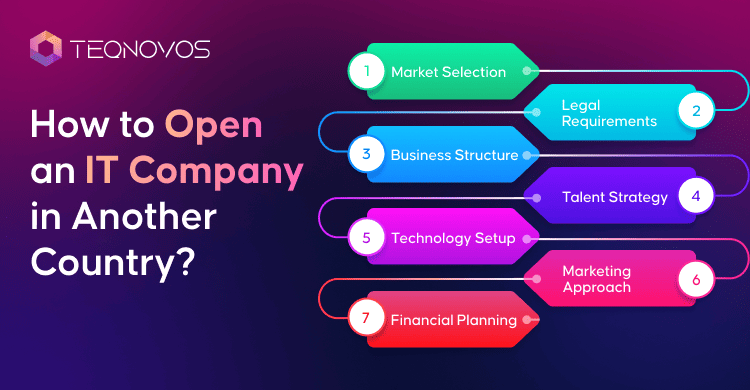
Market Selection
The right location defines the direction of growth. Demand and industry potential should guide the decision. A strong start depends on selecting the right market.
- Choose a country with a strong demand for IT services
- Evaluate the ease of doing business
- Review economic and political stability
- Identify industry growth opportunities
Legal Requirements
Every country has its own legal framework. Proper registration is essential. Following regulations avoids delays and penalties.
- Study local laws and compliance rules
- Complete registration and licensing steps
- Follow tax regulations from the start
- Maintain accurate legal records
Business Structure
The structure impacts control and operations. Businesses must choose a model that fits their expansion plan. The right structure supports smoother execution.
- Decide between a subsidiary branch or a partnership
- Understand control and liability differences
- Align structure with business strategy
- Keep flexibility for future expansion
Talent Strategy
A skilled team helps in adapting to new markets. Local hiring improves understanding of customer behavior. Strong teams drive better results.
- Hire professionals with regional expertise
- Build teams aligned with business needs
- Understand hiring trends in each market
- Focus on employee engagement
Technology Setup
Technology acts as the backbone of global operations. Systems must support scalability and security. Reliable infrastructure ensures smooth functioning.
- Use cloud systems for flexibility
- Implement secure communication tools
- Maintain strong cybersecurity practices
- Ensure system reliability across regions
Marketing Approach
Each market responds differently to messaging. Businesses must adjust their approach. Localized strategies improve reach and engagement.
- Adapt content for regional audiences
- Use local SEO techniques
- Build visibility in target markets
- Use digital channels effectively
Financial Planning
Managing finances across countries requires precision. Businesses must plan for multiple variables. A strong financial approach keeps operations stable.
- Plan for currency fluctuations
- Manage cross-border payments
- Maintain clear financial records
- Monitor overall costs
Turn your global vision into reality—connect with specialists to streamline your multinational IT company setup and expansion.
Schedule a CallConclusion
Global expansion offers strong growth prospects for IT companies. It enables access to new markets and talent. Clear planning and structured execution are essential. Each decision impacts business success. A clear understanding of what a multinational corporation is helps in adopting better strategies and expanding globally.
At Teqnovos, a focused strategy helps reduce risks and ensures stability while building a strong and scalable international business presence.