

How Next.js Development Helps Build SEO-Friendly Websites?
With digital transformation brewing up, getting websites noticed is no small feat. When competing with millions of other tech enthusiasts. Search engine optimization is significant in custom website development. It makes it easier to find a website online, helps rank it higher, and brings in more users.
Thinking about selecting the tools to build an SEO-friendly website? The answer is Next.js development. It is the most sought-after tech stack.
Next.js makes it easy for users to find sites, load websites faster, and feel smoother. It is a pool of features such as server-side rendering, dynamic routing, and more. Next.js helps with the custom web development of websites.
This blog will guide you on the practical ways to help build SEO-friendly websites. Businesses could use these methods to build a small or a large website or an e-commerce site. Let’s dive in to see how to combine the latest tools and techniques to develop a successful website.
Importance Of SEO In Custom Web Development
Before getting into the process of custom web development, let’s know the basics. Start by getting to know the relationship between SEO and web frameworks. SEO is an approach used to enhance website visibility in web crawlers’ result pages. A well-boosted website has a chance of getting discovered by users. Various components add value to the website:
- Fast loading speed
- Mobile-friendly
- Accessible and clean HTML
- Structured data and metadata
- Indexable content
- Internal linking & URL structure
Frameworks generating content dynamically often fail to meet these benchmarks. This occurs when the search engine fails to list the content. Thus, it impacts the ranking and performance metrics.
With Next.js development, businesses can conquer these hurdles. It provides answers parallel with the best practices for SEO.
How Does Next.js Development Impact Website SEO?
-
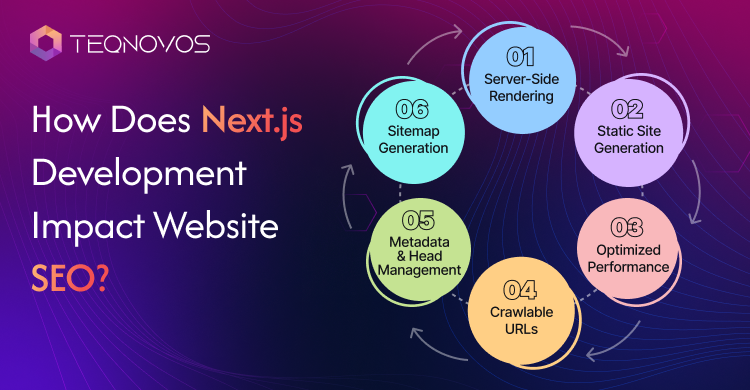
Server-Side Rendering
Next.js’s greatest advantage is the capability to pre-render content. It allows the rendering of the website content on the server unless it is sent over the web browser. This process is called SSR.
In this way, the crawlers will no longer have to reconstruct the DOM since they get the fully rendered HTML page. It makes it effortless for the web browsers to perceive and index the content. Hence, giving you a better chance of ranking for keywords that are most relevant. It also makes sure that the correct metadata is shown in the search results.
-
Static Site Generation
Next.js supports static site generation. During the build time, it pre-renders and stores the pages as static HTML. The load time of these pages is well refined. This helps with the website’s performance metrics. The search engines use these performance indicators to assess the user experience.
Following the right strategies to render pages could help the developers. They could build a balance between functioning and dynamic content. This flexibility in solutions is what makes Next.js the right choice.
-
Optimized Performance
Core Web Vitals of Google have become an essential factor in SEO. These include measurements such as
- Largest Contentful Paint: It estimates how much time it takes for informative content to load on the page. An excellent LCP should take about 2.5 seconds to load.
- First Input Delay: Analyzes the time taken for a web address to react to the user. An excellent FID needs to be 200 milliseconds or lower.
- Cumulative Layout Shift: Evaluates the unexpected shifts on the page as it loads. The value of CLS needs to be 0.1 or less.
Websites performing well in these aspects often rank higher in website results.
Next.js offers various features to optimize performance. Automatic code splitting guarantees that only the required JavaScript loads a certain page. Thus, reducing the load time. This way, the speed of loading a page increases, and the user can relate to the content.
Also, this framework includes built-in support to optimize images through the image component. This component automatically resizes, compresses, and delivers the image. The image is delivered in the format required for the user’s device and screen size. Focus on image loading duration to improve LCP score.
All these factors contribute to enhancements, ultimately translating to better Core Web Vitals. This ultimately leads to improved SEO services performance of the web page.
-
Crawlable URLs
Another aspect of SEO is the URL structure. The URL of the website needs to be readable, descriptive, and organized. It reflects the website’s content hierarchy. Search engines favor the URLs that make sense. It aligns with the informational architecture of the site.
A Next.js development company could help with this. As the language uses file-based routing. This leads to naturally clear and syntactic URLs. Next.js also supports dynamic routes. This is mostly beneficial to e-commerce websites or applications. Apps that need to generate pages for individual items or entries can use this. With dynamic paths and metadata, the website pages become easy to index and optimize.
-
Metadata & Head Management
Tags have a substantial effect on search engine optimization. Page titles, descriptions, and Open Graph are essential to show and rank pages. They influence how the content seems on the social media platforms.
Businesses could hire Next.js developers to get the simplest way to handle metadata. They could use the Head component available in the Next.js library. They could add customized tags for each page. This enables fine control over the content’s appearance in results and social previews.
Ensure every page has unique and relevant metadata to improve the ranking and click-through rates.
-
Sitemap Generation
Structured data supports internet browsers in knowing the framework of the content. JSON-LD facilitates improved search features, such as ratings, product information, and more.
Next.js development allows for the integration of structured data into every page. This enables us to extract more details about the content and display it in an improved format.
It assists web browsers in finding all pages on the website. With tools such as next-sitemap, Next.js developers could automatically generate sitemaps. Thus, ensuring that the complete website remains detectable and indexed.
Read our blog about why businesses should choose Next.js development services in 2025. How to boost business growth with custom web development tools.
Best Practices For SEO In Next.js Development
To leverage the most for SEO, businesses need to hire Next.js developers to follow the best practices. Below are some useful techniques that could be followed:
-
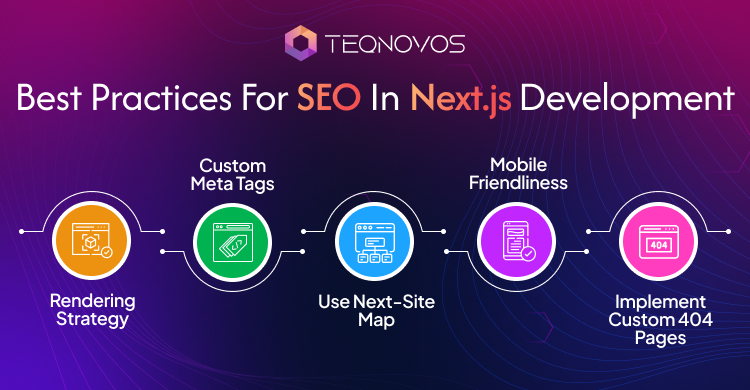
Rendering Strategy
Choosing the right rendering strategy is crucial for an SEO-optimized website. Select static site generation when the content does not change very often. But use server-side rendering for regular changes in the content. For authentication or API data at request time, switch to server-side rendering.
-
Custom Meta Tags
Avoid using similar titles and meta descriptions across every website page. Actively generate or change them using the next/head component with page-specific data. This approach enhances the site’s relevance to particular search inquiries.
-
Use Next-Site Map
Use automatic sitemap generation by installing the next-site-map. Thus, enables the engine to crawl and apprehend the website framework more effortlessly.
-
Mobile Friendliness
Ensure that the website is easy to access and friendly across devices. Although Next.js development apps are responsive. Still, the developers need to test them to ensure compatibility. Use responsive blueprint frameworks to maintain a fluid pattern.
-
Implement Custom 404 Pages
Build customized 404 files to help the user when they land on a broken link. Provide a better and user-friendly platform to improve user demands. This approach improves UX and lowers the bounce rate.
Conclusion
Next.js development provides businesses with an extensive toolbox to build SEO-optimized websites. Rendering pages or generating static content improves the discoverability and indexing. Next.js covers the essentials of modern SEO. It optimizes performance, clean URL routing, metadata management, and structured data support.
These services could help businesses and developers to build websites. Develop sites that rank better, perform faster, and offer a great experience.
Next.js is presenting businesses with a future-ready solution!
Search engines focus on speed, structure, and usability. Thus, Next.js is the smart choice for SEO-conscious web development.
Connect with us to get full-fledged SEO-related services for custom web development. Take the step towards a faster loading time and increased revenues. Get in touch with us today!
Frequently Asked Questions
Q1. How does Next.js improve SEO services compared to previously used React apps?
Next.js supports server-side rendering, which helps search engines crawl and index content. This process is more efficient than client-side rendered React apps.
Q2. Can Next.js create static pages for various SEO benefits?
Yes, with static site generation, Next.js pre-renders pages at build time. It results in faster load times and improved SEO services.
Q3. Does Next.js support dynamic meta tags for better SEO practices?
Absolutely. Next.js allows dynamic meta tags through built-in Head components. This helps tailor SEO for each page or route.
Q4. Is Next.js fast enough to impact SEO rankings?
Yes. Next.js development services enhance performance. It uses features such as image optimization and more to improve SEO. This contributes to better loading speed and SEO scores.