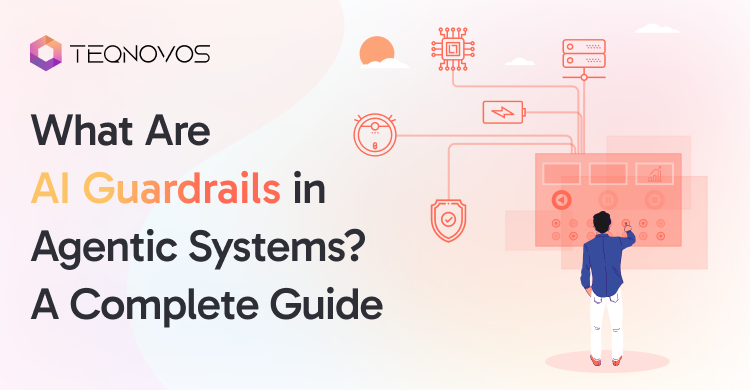
What Are AI Guardrails in Agentic Systems? A Complete Guide
Artificial intelligence is no longer just a tool. It has come a long way from being a tool to help businesses. It is becoming a decision-maker. Agentic systems are leading this shift towards the trend. These AI-powered agents act on objectives and adapt in real time. They are widely used in various industrial applications. You could find these services in customer care, finance, and healthcare.
But as AI continues to gain autonomy, the risk increases. A single mistake could lead to real-world consequences. It could expose users’ private data, mislead them, or take actions you might regret.
This is where the AI guardrail enters the process. Defining limits, protecting data, and keeping a check on AI agents.
Guardrails help AI behave as needed. They assist an AI software development company to stop from making rueful decisions. They ensure it follows the agreement’s safety guidelines and rules. Without them, autonomy could become messy.
This guide will help break it all down. You’ll learn about agentic systems and what the role of AI guardrails is, their types, and their benefits. We’ll cover the technologies backing guardrails and their future.
If your business is building or deploying agents, this is the foundation to start with. AI guardrails are not optional. They are essential to scale and build trust among users. Let’s get started!
What Are Agentic Systems?
Agentic systems are AI-powered setups. They pursue objectives autonomously. They combine many smart components to plan, adapt, and act.
Imagine having a toolkit of different AI tools. A manager usually handles the bigger picture of the project. It breaks the goals into steps, delegates tasks, and adapts as things change.
Just like a manager who oversees a project by breaking goals into steps, assigning tasks, and adjusting when circumstances change, agentic systems operate in a similar way. At the core, agentic systems work towards completing a goal. They perceive situations, reason about them, act through tools, and learn from outcomes. They use NPL, ML, reinforcement learning, and tool integration.
This plan offers them flexibility to manage different tasks. They adjust to strategies as data shifts and operate with human oversight. These tools are already in action. We can see them powering customer support. They steer self-driving cars and run logistics, healthcare, and other operations.
The AI agentic systems differ from simple bots. They don’t wait for human prompts. They take steps to coordinate and solve complex issues. These systems learn and develop over time.
What Is The Role Of AI Guardrails?
AI guardrails play an important part in artificial intelligence systems. They keep AI systems safe, ethical, and reliable. They control and guide how an AI behaves, particularly in high-risk scenarios.
They help artificial intelligence stay within boundaries. They ensure it doesn’t generate harmful or misleading content. For example, an AI chatbot development for a healthcare system without a guardrail could cause issues. It could respond in unsafe ways.
Businesses use AI guardrails to safeguard their users’ privacy and prevent policy violations. It keeps AI outputs compliant with laws and industry standards. They have become the core for different industries, such as finance and healthcare.
In short, they keep the systems safe, responsible, and focused on user goals. The goal is not to limit innovation but to ensure users trust AI.
Different Types Of AI Guardrails
Below are the different types of AI guardrails. Let’s understand them and see what each does to help build better AI outcomes.
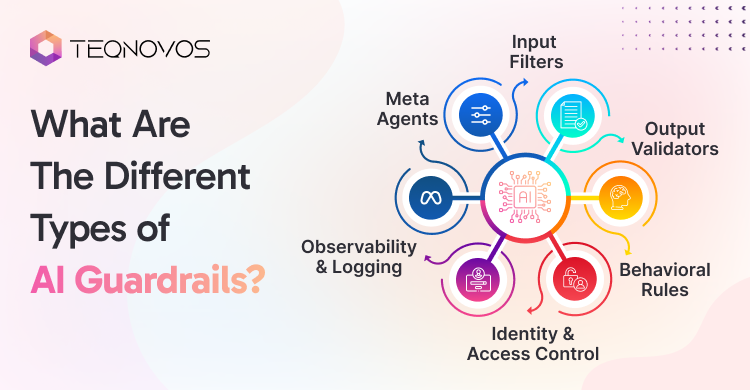
1. Input Filters
As its name suggests, these guardrails control the data input that goes into the AI system. They block harmful, irrelevant, or sensitive content to avoid issues. This prevents users from unsafe prompts and mitigates risks.
2. Output Validators
They check the AI response before it reaches the user. They scan for bias, toxicity, or factual inaccuracies in the content. If the output fails validation, it is rewritten, flagged, or blocked.
3. Behavioral Rules
They set clear boundaries on how an AI needs to act. They guide their tone, language, and decision-making process. The rules keep AI aligned with human values, brand voice, and compliance needs.
4. Identity & Access Control
The identity and access control ensure that only authorized users can have access to AI. Thus, protecting sensitive data. It enforces user permissions and prevents abuse of AI capabilities.
5. Observability & Logging
This guardrail tracks system activities. It logs user inputs, outputs, debugging, and reviews. It assists AI development teams in monitoring performance in real time.
6. Meta-Agents
Meta-agents monitor and guide other AIs. They detect any failed modes, override risky AI behavior, and enforce safety.
What Are The Different Technologies Powering AI Guardrails?
The technologies powering guardrails vary depending on specific applications. Below are some of the technologies leading this phase:
1. Natural Language Processing
Guardrails use NLP to get the gist of human language. It looks for hate words, lies, or some misinformation, analyzing sentiment and intent.
- Machine Learning
Machine learning enables guardrails to learn from past data and user interactions. Over time, this knowledge strengthens the system’s ability to detect risky behavior and adapt to new or evolving threats.
- Reinforcement Learning
RL is a tool that trains AI systems to optimize their behavior through feedback. Guardrails use RL to help AI make better decisions.
- Rule-Based Systems
These systems help define fixed boundaries. Reinforcing rules in business logic helps with defined and compliant AI outputs.
- Content Moderation APIs
Guardrails integrate third-party tools in the system to detect harmful speech or NSFW (Not Safe For Work) content.
- Prompt and Response Analysis Tools
These tools help analyze input prompts and output responses.
What Are The Benefits Of Using AI Guardrails?
AI guardrails work to protect user data and prevent misuse of AI. Below are some other benefits. Let’s have a look at them:
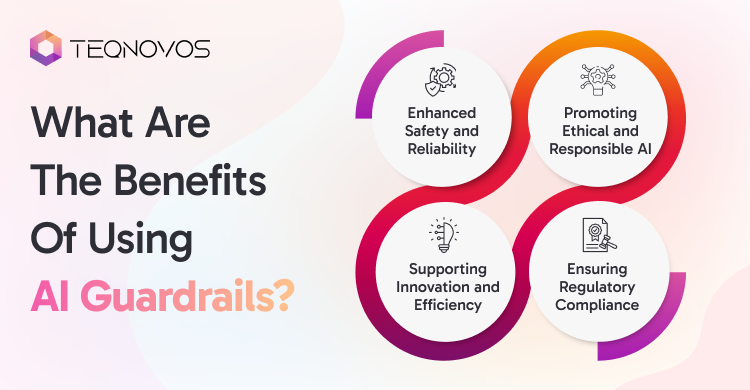
1. Enhanced Safety And Reliability
- Preventing Harmful Outcomes: Guardrails block unsafe prompts and outputs. AI development companies help to reduce the chance of obtaining offensive, false, or dangerous content.
- Mitigating Risks: They help neutralize any potential failure that may cause harm. They could prevent costly errors before causing any more damage.
- Ensuring Data Integrity: Guardrails protect against misuse or manipulation of data. It helps keep the input and output steady and truthful.
- Enabling Controlled Deployment: They allow teams to release AI features and monitor performance.
2. Promoting Ethical and Responsible AI
- Bias Mitigation: Guardrails detect and reduce biased outputs. It promotes integrity among different user groups.
- Upholding Ethical Standards: They enforce ethical values among the AI agents.
- Building Trust: Consistent, deferential, and fair responses bring user confidence and drive adoption.
- Facilitating Transparency and Accountability: They assist with audits, log decisions, and provide insight into the AI choices.
3. Ensuring Regulatory Compliance
- Adhering to Legal Standards: Ensure the AI follows rules such as HIPAA or any other specific guidelines.
- Reducing Legal Risks: Prevent unauthorized use and abuse of data. Reduce harmful outputs or exposure to lawsuits and penalties.
- Staying Updated: Updating guardrails could help businesses remain compliant over time.
- Ethical Alignment: They ensure the AI actions align with legal and corporate standards.
4. Supporting Innovation and Efficiency
- Enabling Responsible Innovation: Guardrails let teams experiment and deploy new features. Knowing this is a safe place helps innovate.
- Streamlining Operations: They automate checks and validations. Thus, saving time, user effort, and reducing the need for manual checks.
- Improving Performance: Monitor system performance and behavior. It optimizes model output and flags inefficiencies.
- Facilitating Scalability: Organizations can scale easily with strong safeguards.
The Future Of AI Guardrails
The future of AI guardrails involves adaptive and proactive systems. These systems will ensure safe and predictable use of AI as businesses grow. These guardrails will evolve from basic safeguarding to dynamic.
Below are some points showcasing what the future of AI guardrails holds:
1. Increased Sophistication and Adaptability
- Dynamic and Adaptive Systems: Guardrails will require adjusting in real time and more sophistication to handle the growing complexity of AI systems.
- Real-time Monitoring and Validation: They’ll track the AI behavior as it happens. It catches issues before the output reaches the user.
- Integration of Machine Learning: They need to use machine learning to improve continuously. Learning from past issues and new edge cases.
2. Enhanced Focus on Safety and Ethical Alignment
- Harmful Output Filtering: Smarter integrated filters will help detect subtle and complex risks. Thus, ensuring a safer user experience.
- Bias Detection and Mitigation: Modern tools will identify hidden vulnerabilities across languages.
- Protection of Sensitive Information: Strong safety rules will prevent data leakage, both personal and business-related.
3. Regulatory Frameworks and Compliance
- Mandatory Compliance: Guardrails won’t be just a best practice but will be implemented by law.
- Industry-Specific Standards: Custom compliance will align with different industries.
4. Collaborative Implementation and Global Standards
- Collaborative Approach: Government, businesses, and researchers will work together to build stronger guardrails.
- Global AI Ethics Standards: International cooperation will shape and release the rules on AI safety.
Deploy with confidence. Try our secure AI development services today!
Schedule a Call5. Tools and Frameworks for Guardrails
- Specialized Guardrail Tools: New modern platforms will let developers plug in modular guardrails for different use cases.
- Guardrails as a Service: Businesses will have access to scalable guardrail systems via APIs and the cloud.
6. Key Areas of Focus
- Hallucinations: Guardrails will focus on catching and correcting false AI information.
- Prompt Injection: Systems will block wrong and manipulated inputs, trying to bypass safety filters.
- Jailbreaks: Strong logic & reasoning checks to stop AI from being tricked into providing unsafe outputs.
- Adversarial Attacks: A robust defense system will guard against hostile, designed inputs that exploit the model.
Read our step-by-step guidance to develop AI software effectively.
Conclusion
Secure AI deployment requires guardrails. They help in the safe and reliable use of agentic systems. As AI continues to become autonomous, the risks associated increase.
Guardrails help businesses manage those risks. They set boundaries, ensure compliance, and protect user data. These are more than a safety tool. They build among users and support innovation through reliable AI systems.
Businesses developing AI agents need to treat guardrails as essential for deployment. With technology advancing, they will get smarter, more adaptive, and crucial to scale. The future of AI depends on it.
Collaborate with an AI development company to start your AI project. Join forces with us to build your team. Connect Now!