Low-Code/No-Code Meets Generative AI: A New Era of Development
Ever heard about the term vibe coding? A trend rising in software development. Describe your app idea in simple terms, and the system will interpret and act on it. It uses large language models to generate the code and build an app for you.
Sounds interesting? Well, this is not some science fiction. This is actually happening. How? The answer is simple: “Generative AI.”
It goes on transforming how we build digital tools using low-code and no-code platforms. This shift has led to what many experts call the AI low-code development boom. Businesses build applications faster with minimal technical effort.
So, what is a low-code development platform? Simply put, it’s a visual way to build applications without needing to write much code. Instead of dealing with complex syntax, you drag, drop, and connect components. This approach saves time, reduces technical hurdles, and allows businesses to create flexible apps more quickly.
Now, let’s talk about low-code with artificial intelligence. Users can now build workflows simply by describing what they need in plain language. It streamlines processes and opens up development to users with little or no technical background.
In this blog, we’ll explore how these platforms work and why generative AI development is taking them to the next level. Keep reading to find out more!
The Evolution of Low-Code/No-Code Development
The growing demand for applications is pushing businesses to seek faster and more innovative approaches. Traditional development methods often take months, which is not always feasible given today’s pace and limited resources. This is when businesses can use a low-code platform—a solution that enables faster development, reduces complexity, and delivers results more efficiently.
From Coding to Configuring
Earlier, these platforms emerged as a tool to accelerate app development. They were used to improve basic dashboards, processes, and forms. Over time, this evolved into a full-featured platform. Today, they also cover mobile applications designed for business systems.
Opening Doors to Non-Developers
One of its biggest advantages is accessibility. Low-code software opened up doors to non-technical users. This made it easy to test ideas, build prototypes, and adapt to changing market trends.
This answers the question: why a low-code platform? It enables broader team involvement, speeds up launch timelines, and shortens the overall development cycle. It encourages meaningful partnerships between businesses and companies specializing in generative AI solutions.
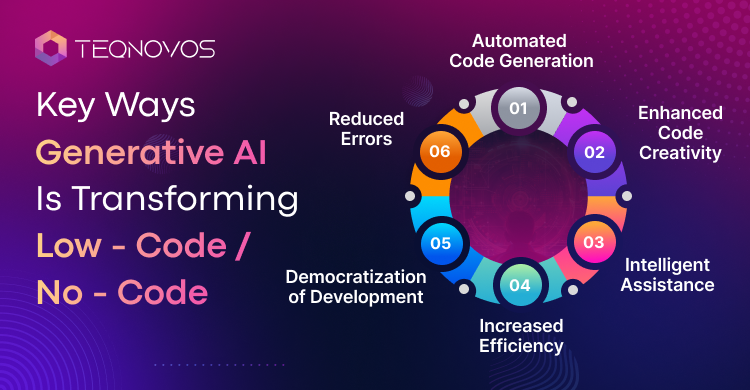
Key Ways Generative AI Is Transforming Low-Code/No-Code
The fusion of generative AI and low-code/no-code is transforming software development. This powerful combination blends accessibility with artificial intelligence. This transformation is driving the AI low-code development boom, enabling businesses to build smarter applications with less coding effort.
-
Automated Code Generation
One of the most valuable contributions of AI to low-code platforms is the ability to automate development tasks.
Businesses can automatically generate code instead of writing complex scripts or manually configuring. The system interprets the user input and builds the logic instantly. This is a strong example of how generative AI is used in low-code ecosystems. It understands instructions and turns them into usable code. This reduces development time and enables faster deployment.
-
Enhanced Code Creativity
Traditional low-code platforms often rely on predefined templates. While useful, these templates limited creative freedom. Generative AI works to provide dynamic suggestions and custom outputs. The system adapts to the user’s intent and builds solutions that match their exact needs.
This explains what generative artificial intelligence is. It is not only about automation. It is about generating unique and functional outputs. This way, the user has more options, control, and new possibilities.
-
Intelligent Assistance
Another key feature of AI-powered low-code tools is intelligent assistance. As users build, the AI monitors their actions and offers real-time guidance. It can recommend better logic structures, fill in missing pieces, or highlight issues.
This demonstrates how generative AI works inside modern development environments. The system uses past data, training models, and prototype recognition. This way, they could anticipate what the user needs next. Users could benefit from instant feedback and best practice suggestions. This makes the process intuitive and reliable.
This means users no longer need to be professionals. They can rely on the platform to guide them as they build complex workflows or data connections.
-
Increased Efficiency
Low-code platforms have consistently stood out for their ability to accelerate development cycles. Integrating it with AI increases the speed. Repetitive tasks could be handled easily in seconds. Developers and business users can focus on what matters most: solving real problems. Using generative AI helps drop unnecessary steps.
-
Democratization of Development
One of the most exciting outcomes is broad participation. Even those without a technical background can now participate in the software development process. They do not need to know languages. Users simply need to describe the functionality they require, and the system takes care of the rest.
This reflects the fundamental purpose of low-code platforms: simplifying development. With AI assisting the process, more people can take part in building solutions.
-
Reduced Errors
Errors could break or delay the launch of apps. Generative AI assists in finding and fixing issues. It can even simulate real-world scenarios to identify what might fail. This is the way generative AI works. It’s not just about being faster but better.
Read our blog about how generative AI development is changing tech services in modern business to understand more. Learn how to automate tasks and get creative with AI to develop desired solutions.
Advantages of Merging Generative AI with Low-Code/No-Code
The use of artificial intelligence enhances the benefits of low-code/no-code platforms. It modified how businesses design and deploy digital solutions. This marks a significant leap in speeding up development while aligning it with business goals.
Here are the most important benefits of this powerful merger:
-
Accelerated Development
Generative AI eliminates several manual tasks, streamlining the overall development process. It helps users create workflows, interfaces, and business logic using simple instructions. This shortens the journey from an initial idea to a fully functional application.
-
Reduced Costs
Building applications with traditional methods often requires large teams and long timelines. AI-supported visual tools could help cut development time and reduce technical resources. This leads to lower project overheads and faster returns on investment. Thus, businesses could divide their budget towards innovation rather than maintenance.
Drive innovation with Generative AI and low-code/no-code. Empower your business with AI today
Schedule a Call-
Increased Agility & Responsiveness
Businesses need to be vigilant towards the market trends and user demands. AI-enhanced low-code development offers advantages to induce rapid changes in the app. Teams can roll out updates, fix issues, and experiment with new ideas much more easily.
-
Improved Innovation
Low-code business applications make it workable for users to develop software. It empowers businesses with AI guidance. The user could describe the need, and the system will help build it. Thus, expanding the talent pool and reducing dependency on IT teams.
Allowing more and more people to generate solutions helps bring ideas to life faster. It also fosters a culture of problem-solving across departments.
-
Enhanced Innovation
Combining automation and simplicity makes it easy to test new ideas. Teams could explore solutions, build models, and gather feedback without much effort. This builds into a continuous innovative cycle. Here, ideas are validated quickly and are easy to scale with the successful ones.
It boosts creativity and experimentation among businesses. Instead of relying on a single team, everyone in the business could contribute.
-
Improved Reliability
AI can help detect errors and inconsistencies during development. As users build applications, the system offers real-time suggestions and validates their choices. This reduces the likelihood of logic errors, missing fields, or broken connections.
It also ensures that applications perform as expected before they are deployed. With fewer bugs and better performance, businesses can deliver reliable experiences to users.
-
Personalization
AI can learn from user behavior and suggest personalized features or workflows. Thus, it becomes possible to build a feel of tailored apps for individual users. This level of customization helps improve user engagement and satisfaction. Applications become smarter over time, adapting to real usage patterns and business goals.
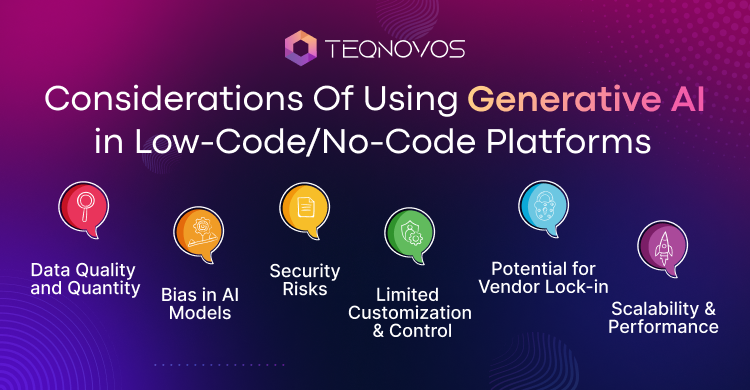
Considerations Of Using Generative AI in Low-Code/No-Code Platforms
Integrating AI in platforms is not without challenges. Below are some points businesses need to consider before diving deep into generative AI services.
-
Data Quality and Quantity
AI usually relies on a large quantity of quality data to get relevant and exact outputs. In low-code development platforms, users may input unstructured data. This may affect AI performance.
Inaccurate data leads to hallucinated outputs, weak predictions, or irrelevant suggestions. This undermines the utility of the application. Without any strong data governance, this issue could get worse. When nontech users are involved, they may not recognize data quality.
-
Bias in AI Models
Bias present in training data could affect AI-generated outputs. During low-code platform development, the user may ignore AI behavior. This results in bias persisting. This is important to note in the hiring, lending, and healthcare industries. To overcome this, transparent model documentation and tools are necessary.
-
Security Risks
Introducing gen AI brings in new security vulnerabilities, including exposing sensitive data. Low-code application platforms do not provide user visibility into backend processes. Thus, it makes it tough to find and protect against these issues. Effective protection, control, and monitoring are essential to secure data and maintain trust.
-
Limited Customization and Control
Simplify the development process with low code. But gen AI behavior could limit how much a user could customize. Gen AI models in this ecosystem may offer a few options to turn or adapt outputs to specific needs. This limits businesses looking for industry-specific accuracy. Integrating flexible settings could bring more control and ease of use.
-
Potential for Vendor Lock-in
Sometimes, low-code AI-enabled platforms come with proprietary tools. It becomes complex to move to other service providers. Thus, creating a form of dependency that limits flexibility and increases costs. Selecting a platform that supports open standards helps reduce these risks.
-
Scalability and Performance
As applications grow in difficulty, the demand on the AI infrastructure rises. Generative models can introduce latency, memory issues, or slower response times. These performance issues can reduce user satisfaction and confidence in the platform. Ensuring scalable architecture and real-time monitoring tools helps maintain consistent performance.
Boost efficiency with Generative AI and low-code/no-code. Unlock smarter development now
Schedule a CallThe Future Outlook For Generative AI-Powered Low-Code Platforms
The role of gen AI in low-code and no-code platforms is expected to grow rapidly, as the AI low-code development boom continues to reshape how modern applications are built. This combination is improving how software is built. Here is what the future may hold
1. Increased Automation and Efficiency:
- AI-powered code generation: AI will take over repetitive and complex tasks, introducing low-code automation. The user will be able to describe the need in simple language and get the desired solution in seconds.
- Intelligent code completion and suggestions: Development platforms will become more predictive. As users create apps, the system will offer suggestions for the next steps. It recommends better logic and guides toward optimal results based on best practices.
- Automated testing and deployment: Get automated testing and deployment via AI-generated inputs.
2. Enhanced User Experience:
- AI-generated UI/UX designs: The user interface will depend on user intent and goals. Generative AI development will help with designs and layouts to attract the user.
- Multimodal AI integration: Advanced platforms will support multiple inputs. The future of low-code development will allow the user to upload or describe ideas. The system will transform these inputs into functional applications.
- Voice-based development: Developing voice-based commands makes development more accessible.
3. Addressing Challenges and Ensuring Responsible AI:
- Guardrails and governance: AI systems will need built-in rules to ensure outputs follow company policies. Tools for explainability, review, and approval will become standard.
- Data management and security: The clarity of solutions will depend on clean and well-governed data. Introducing features could help protect personal information.
- Upskilling and reskilling: As development becomes more AI-driven. Businesses need programs to assist employees in moving forward.
4. Impact on Industries:
- Faster time-to-market: Various sectors with low-code development in the future will allow faster product launching. This allows businesses to remain competitive and adapt quickly to changing market demands.
- Personalized customer experiences: Applications built using AI will quickly adapt to user behavior. Thus, businesses could deliver relevant and tailored workflows to individual needs effectively.
- Specific industry solutions: Templates and prebuilt modules for industry-specific tasks will become more available. For example, healthcare apps for patient record systems will be easier to generate.
Conclusion
Generative AI is changing how apps are built using no-code generative AI tools. It helps create software faster, with fewer resources. More people can now take part in development.
The future of app development is faster and smarter.
Visit our website to learn more about generative AI development services. Collaborate with us to bring revolution to your business.