
How to Build Secure Web Applications with Python?
With new technologies and languages brewing up every day in the market. Choosing the one for your business could be a challenging task. The decision is tougher if your business is struggling.
Today, many developers prefer Python because it balances simplicity with flexibility. It’s simple enough for beginners but strong enough to handle demanding projects. That balance is why a lot of companies rely on it for custom web development.
It allows faster development, but speed isn’t everything. Without proper safeguards, even a tiny mistake can put data at risk or interrupt services. Python helps reduce those risks by supporting secure coding practices and giving developers practical tools to build safe, reliable applications.
Python offers powerful frameworks. Django and Flask in Python help speed up the operation.
Here you will learn how to handle user input, protect data, and manage user sessions. Implementing the best practices to write clean and secure code.
You do not need any expert guidance to initiate. Get into the right outlook, and take functional steps that work. Hire dedicated Python developers to start the development and grow your app. Get your app secure starting now!
Keep reading.
Why Security Matters in Web Applications
Today, security has become of utmost importance. More importantly, it works as the foundation of any web app. Without it, even the most well-featured apps fail.
People naturally assume that any application they use will keep their personal data safe. Breaking that may cause user loss and the entire app’s reputation.
Cyberthreats have become more frequent than ever, causing issues. Hackers are constantly searching for vulnerabilities in applications to gain access to user data. This could result in loss of data and control and disrupt services.
A breach in data could lead to legal and financial issues. That’s why security must be built into the development process from the very beginning.
Using the Python programming language for web development often simplifies the process compared to many other languages. Python’s frameworks come with security features already built in, protecting both the application code and the people who use it. And when users feel their data is safe, they stick around. Trust is what keeps a project strong in the long run.
Turn your idea into a secure Python-powered web application. Let’s get started!
Schedule a CallWhat Is Python & How to Choose the Right Framework
A question that comes up often is, Why is Python good for web development? To answer it, we need to step back and look at what Python really is.
Python has gained popularity thanks to its straightforward, readable syntax that developers find approachable. Beginners can start learning it without much struggle, while advanced teams trust it for building complex projects. Its simple structure also makes it easier for people without a deep coding background to follow along.
The right framework can assist in bringing success to a project. Every framework has its own set of strengths:
Django: A full-stack framework built for rapid development. It includes incorporated features for instant services. This has authentication, admin panels, and ORM support. Django helps with complicated applications, keeping them safe and profitable.
Flask: A lightweight framework that gives developers more freedom in how they build. It’s often picked for smaller apps, APIs, or projects that need to be created from scratch with detailed control.
FastAPI: A newer framework that has quickly grown in popularity. Developers value it for its speed and its ability to manage high-performance applications smoothly.
The framework you choose should match your project’s goals. If you require additional support, you can hire dedicated Python developers to lead the process and ensure smooth execution. Making the right choice here keeps development smooth and gives your app the ability to grow steadily as more users join.
The Current Scenario: Why Python Is Popular
Python is now the most broadly used language, and custom web development is one of the reasons. This works based on information and builds comparatively naturally. Thanks to Python’s most eminent frameworks, Django and Flask. Python is poised to dominate industries for the long term.
Another field Python explores is machine learning. Libraries such as TensorFlow are handy and easy to use. Its simple syntax adds to quick learning. Due to this, many companies adopt it.
Benefits Of Using Python For Custom Web Development
Python is becoming a web development language as the best pick for companies. Its rich ecosystem and versatility attract developers. Thus, making it an ideal choice for development. Below are some points stating why Python stands out in most web development:
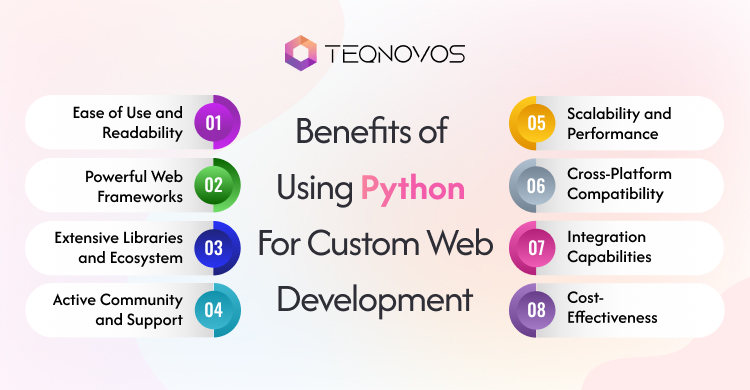
1. Ease of Use and Readability
The clean and readable syntax. It makes even non-techies able to understand, write, and maintain code. Thus, reduced development time and fewer errors.
2. Powerful Web Frameworks
Python’s strong frameworks simplify custom web development. Django, Flask, and FastAPI provide built-in tools. Make routing, templating, and authentication easier with these. They promote security and adaptability among apps.
3. Extensive Libraries and Ecosystem
It has a vast collection of libraries, from database access to machine learning. Integrate advanced features into these libraries and start building your app.
4. Active Community and Support
Having a global community means staying updated. Python’s large community provides businesses with the latest trends and updates. Get reliable documentation and quick help whenever required. You are never alone on the path to development.
5. Scalability and Performance
Python supports modular development. It is known to handle high-traffic loads effectively. It offers the right tools and architecture to optimize. Choosing to hire dedicated Python developers can help applications grow and scale effectively.
6. Cross-Platform Compatibility
Python applications run smoothly on various operating systems. This makes the deployment of an app easy and convenient.
7. Integration Capabilities
Python web development languages are easy to integrate with third parties. Easily integrate the customized app with various technologies.
8. Cost-Effectiveness
Faster development and open-source tools help minimize overall project costs without compromising features.
Core Security Practices in Python Web Development
The security at every level should be an intrinsic characteristic of your Python web app. The following essential activities prevent vulnerabilities and safely protect your users and data. Below are the main security principles that you need to implement:
1. Input Validation and Sanitization
Always validate and sanitize user input to ensure data remains protected. Protect data from SQL injections and other issues. Use dependable libraries for secure data handling.
2. Secure Authentication and Authorization
Start a password policy of maximum security, hashed storage, and multi-factor authentication. The Python programming language for web development provides a wide range of reliable libraries that developers can count on. They securely handle sessions and user roles.
3. Secure Coding Practices
Writing credentials in the code could be risky. To avoid this, try using environment variables and ensure the data is safe. Other than this, output escaping helps prevent errors and script injections. All this while keeping the data secure.
4. Regular Updates
The Python version, its frameworks, and dependencies should be updated regularly. Apply the patches as soon as they are available to address any known exposures.
5. Secure Configuration Management
Turn off the debug mode during production. Execute HTTPS and handle secret data using environment variables or vaults.
6. Principle of Least Privilege
Allow users’ services only when they need them. This limits the damage in case of a compromised component. The Python programming language for web development offers privileges to users for protection.
7. Security Testing
Leverage the core security services in Python. Run surveys and tests, and examine your code. Tools such as Bandit help businesses to find and solve common security flaws in the code.
8. Logging and Monitoring
Set up logs and alerts for any unusual activity in advance. Monitor your custom app in real time to detect and respond to issues quickly
Ensure Python web application security with expert guidance— hire dedicated python developers now.
Schedule a CallSecurity Tools and Libraries in Python
Python has a wide range of tools and libraries to offer. These tools and libraries help Python developers. They could protect, test, and track apps for better security. They ensure to provide strong measures to safeguard user data against threats.
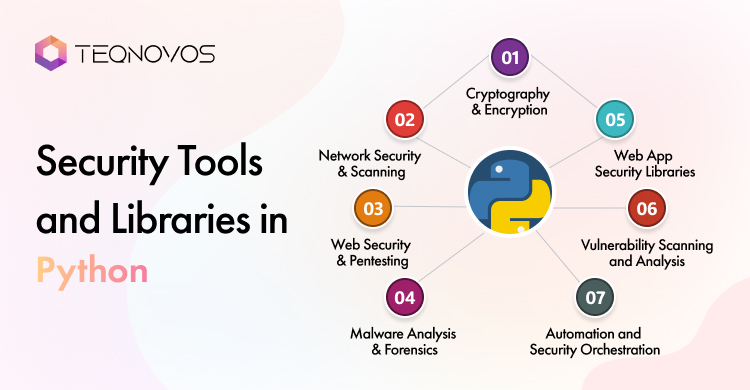
1. Cryptography & Encryption
Use cryptography libraries or hashlib to secure and encrypt data and generate keys. Such tools safeguard sensitive information and block unauthorized access attempts.
2. Network Security & Scanning
The Python programming language for web development offers modules like Scrapy. They allow low-packet manipulation and custom scanning. The Paramiko library provides a secure way to perform SSH-based remote operations. These tools support different network audits and violation detection.
3. Web Security & Pentesting
Frameworks like SQLmap and W3AF help automate penetration testing. Threats like SQL injections and other common vulnerabilities can be identified during testing. They are valuable for testing. Web developers in the Python programming language could use these to test apps.
4. Malware Analysis & Forensics
Various tools, such as volatility, assist with web apps. They help in memory analysis, malware detection, and file inspection. They are helpful in forensic probes.
5. Web App Security Libraries
Libraries such as Django security middleware assist in enforcing headers. They strengthen browser-side protection with the least hassle.
6. Vulnerability Scanning and Analysis
Python, as a web development language, could use Bandit to find insecure code. Check for known issues and outdated packages.
7. Automation and Security Orchestration
Leverage tools like Celery to automate security patching and configuration updates. Using the right set of tools could help secure web apps.
Conclusion
Safe web applications are not just about writing clean app code. Businesses need to understand the risks, apply the best customs, and use the right tools.
Powerful frameworks and an active community could help with the development. By choosing to hire dedicated Python developers, businesses can build applications that are both secure and dependable.
Security is not a one-time step; this process goes on with every cycle. Start your custom web development. Focus on keeping security at the core of the workflow. Visit our website to know more about application development.