Everything You Need to Know About OpenAI’s ChatGPT-5
Overnight, OpenAI released GPT-5 as its most sensational yet powerful artificial intelligence. This tool marks its print as the most significant leap in intelligence and a unified system.
If you think that earlier models were remarkable, this model takes innovation to the next level. ChatGPT-5 is not only intelligent but also sharper and more insightful. It is capable of having interactions closer to a human conversation.
Now, let’s discuss what makes this latest ChatGPT model offer and how it is different from others.
Built on the foundation of earlier available models. It introduced various breakthroughs and transformed the use of AI. A unified system that can perform coding, math, and reasoning. At the same time, boosting app performance and reducing hallucinations.
Some developers also described it as a model that brings multimodal abilities. A mixed bag of powerful and cost-effective tools. Reduced error rates and energy-efficient performance.
However, the saga of GPT-5 goes beyond tech updates. It opens doors to creativity and opportunities for developers to innovate. Generate applications using smart integrations and personalized interactions.
Sounds interesting? Well, this is what ChatGPT-5 is.
Slow yet steady, ChatGPT integration services are becoming a part of the system. A system where voice, virtual reality, and industrial use cases are no longer an idea. These have become active and possible possibilities.
In this blog, we will talk about GPT-5 and how it stands out from the rest. We will discuss the features and applications you never anticipated knowing.
Evolution of ChatGPT
In this transforming journey of AI tools, ChatGPT has been the most extensive tool. But do you even know how it all began? Are you ready to take a quick tour along its evolution journey? Let us figure out what GPT in ChatGPT stands for.
When Was ChatGPT First Launched?
OpenAI introduced its first GPT model in 2022. It launched as a conversational artificial intelligence model based on GPT-3.5. Its features caught global recognition.
Contrary to other AI tools, ChatGPT is capable of understanding frameworks and generating text. It can assist developers in performing complex coding tasks or answering questions.
These features led to the popularity of GPT almost overnight. Within days of its release, it attained a number of trusted users. Thus, it became the booming application in history.
In 2023, after the success of this model, OpenAI introduced GPT4. It offered more advanced features, leading to fewer factual mistakes. And then came GPT-5. The most talked about and creative AI tool. One step ahead of all the other models. One common system that could help with all developing demands.
What Does GPT in ChatGPT Stand For?
GPT represents Generative Pre-trained Transformer.
Generative: It generates almost human-like content.
Pre-trained: Even before interacting with developers, it is trained on vast data. Hence, it can understand language and reasoning.
Transformer: The deep learning architectures that allow the model to process and understand.
From GPT-1 in 2018 to GPT-5 in 2025, now AI feels more intuitive and human-like than ever before.
Overlooked Technical Features In ChatGPT-5
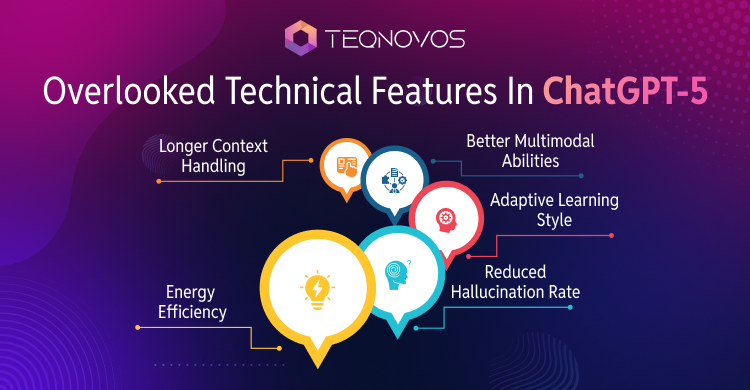
ChatGPT-5 comes with some well-announced upgrades. But the real magic lies in its elusive and overlooked tech innovations. While these innovations might not have grabbed much attention, they could help transform. It goes on revolutionizing the ways of trusting and working with an AI every day. Below are some of the underrated technical innovations of this model.
Longer Context Handling
One of the biggest challenges of the previous models has been retaining memory. Well, not now. GPT-5 could keep its memory and context across those long interactions. It tackles this issue by processing and keeping tabs on much larger stretches of the text. It does not lose context or detail of the text.
Draft research papers, thesis, and analyze documents with the assistance of generative AI. Having an extended chat with the model now feels seamless and consistent.
Better Multimodal Abilities
GPT-5 has broken the tag of just being a content generator. It has multimodal abilities. It can interpret and work with different formats. This includes texts, images, and even audio-visual prompts.
Thus, unlocking its creative applications. Now it can analyze complex diagrams, assist in designing, and get help in voice-driven workflows. Making the model a more versatile tool to use.
Adaptive Learning Style
The engagement and adaptability differ for everyone. Every user engages with AI tools differently. Some users look for quick replies and simplified answers. While others may need deep, technical breakdowns.
GPT-5 is an adaptive learning model. It allows the user to mirror the communication preference. It can adapt to different tones, depths, and structures of the response. Thus, the conversations feel more humanlike and personalized.
Reduced Hallucination Rate
Hallucinations were a common drawback in the previous GPT models. In earlier models, the AI would provide incorrect information and made-up details to the user. Bringing criticism to its models. GPT-5 has drastically reduced these errors. The advanced training and better mechanisms have helped to improve this.
The result? Better and improved results. This has led to user trust in the model’s reliability and makes it safe to use.
Energy Efficiency
Beyond its advanced intelligence, GPT-5 also uses its energy in a smarter way. This model is efficient in consuming fewer computational resources. Although it saves energy, it never compromises on the quality of performance.
This lowers the cost for developers and contributes to sustainable AI practices. Thus, the progress of your project does not come at the cost of excessive energy consumption.
These tech improvements may not be extravagant, but they are the backbone of GPT-5. This adds up to the trustworthiness and adaptability of the model. Hence, it leads to smooth consultations and sustainable performance.
How ChatGPT-5 Handles Human-Like Interactions
There is a remarkable aspect that sets this model apart from others. Well, it is not its intelligence; it is its ability to make conversations more genuine. ChatGPT-5 makes discussions feel almost human-like. It answers questions; moreover, it listens, understands, and then responds to the query. Here’s how it achieves that.
Emotional Intelligence Upgrades
Early models used to respond in a flat and mechanical tone. The current model introduces an upgrade to emotional intelligence. Thus, it can detect elusive hints in human mood, language, tone, or intent.
For instance, it has the ability to detect when a user sounds annoyed or when the user is thrilled. Thus, it responds to the user as per their behavior, encouraging, excited, or supportive.
While it doesn’t experience emotions, this capability makes the exchange feel more empathetic. An essential step towards generic humanoid interactions.
Personalization
Every user is different, with a different mindset. Hence, the conversations should not feel like one can fit all. This is where personalization helps. This advanced model adjusts to the tone and details of the person interacting.
Over time, this adaptability creates a sense of familiarity. The result is more natural engagement and smoother collaboration.
Improved Guardrails
Human-like conversations also need to be safe, balanced, and dependable. The new GPT model comes with improved guardrails. These AI guardrails help reduce harmful, biased, hurtful, and misleading responses.
It is better at understanding sensitive context, guiding conversations without sounding restrictive. This balance ensures that the user can have open and natural discussions. It also helps build trust among users and provides safe responses.
For industries like healthcare, education, or customer support, these guardrails are essential.
Nuanced Conversations
Human conversations are rarely black and white. They’re full of nuance, context, and implied meaning. This generation of AI excels at handling subtlety. It can grasp sarcasm, indirect questions, and layered context better than before.
It also handles follow-ups. The user doesn’t need to re-explain the whole conversation or question again. These small upgrades are powerful innovations to make conversation flow.
These innovations revolutionize the way we used to interact with previous models. It builds conversations among users that are more captivating, empathetic, and responsive. Thus, with emotional intelligence and robust safety measures, it becomes a unified tool.
Effective Integrations and Ecosystem Growth
ChatGPT-5 keeps upgrading itself. While its core knowledge is cut off, it keeps on updating itself when connected with tools.
The main question that keeps arising around this model is, is ChatGPT up to date now? Well, to answer this more clearly, let’s have a look at the various features that help to keep it updated with the tech.
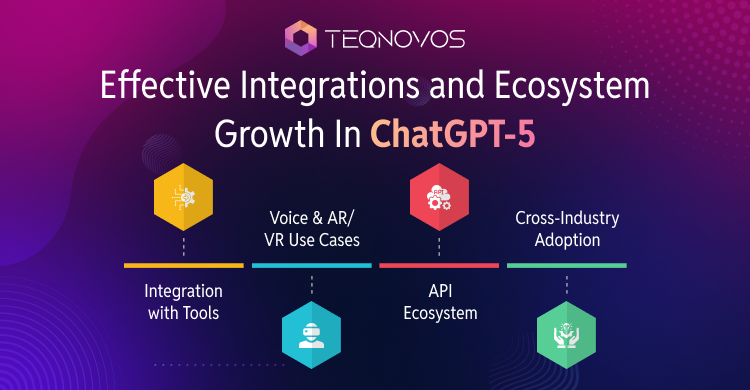
Integration with Tools
Developers can embed GPT into CRMs, project management apps, and other creative platforms. It can fetch user data, generate data, and automate tasks.
Thus, it turns the model into a productivity helper from just an informal provider.
Voice and AR/VR Use Cases
The GPT can handle speech input and output with a real-time API. This makes the model ideal for voice agents to respond to conversations naturally.
In AR or VR, it acts as a guide, answering questions or controlling ecosystems with a single command.
API Ecosystem
The expanded API ecosystem supports text, image, and audio inputs. Developers can blend many APIs to build custom, intelligent solutions.
Cross-Industry Adoption
Industries are already experimenting. Education uses ChatGPT for tutoring and feedback. Healthcare applies it for note-taking and patient support. Retail and banking integrate it into customer service for quick, accurate help.
Future Possibilities with ChatGPT-5
Right now, GPT-5 feels like a benchmark in AI. It blends reasoning, creativity, and multimodal skills into one system. But the future still holds room for growth, and new models may push even further.
Hyper-Personalized Experiences
Upcoming iterations could remember user preferences across long interactions. Imagine an AI that knows your writing style, work habits, or even learning pace. Sounds interesting? Well, this is what the future of GPT looks like.
Smarter Collaboration
AI will not just answer questions but work as a true teammate. It may brainstorm, manage schedules, and even suggest strategies in real time. The collaboration with AI is as effortless as working with a colleague.
Beyond Text
Future GPT models take a step beyond images and texts. There could be a possibility that they could bring videos and real data together. Thus, creating an unimaginably smooth user experience. Collabing with GPT may feel less like a tool to improve and more like a partnership.
Autonomous Agents
Future systems may operate independently. These agents could perform research, check systems, or handle repetitive tasks without supervision.
Conclusion
GPT-5 is more than just being another version of AI. It brings sharp reasoning and stronger interactions. Developers get a dependable tool, and everyday users get an assistant. This advanced AI tool feels natural, responsive, and even empathetic.
The real worth of GPT-5 lies in how it opens new business opportunities. The possibilities for business success keep growing. While there is always space to innovate, GPT-5 has set foot as the strongest model.
Book a free consultation with us to get ChatGPT integration services. Experience advanced AI-driven bot solutions for your business. Connect with Teqnovos today!