What Small Businesses Should Know About AI Software Development in 2026
Artificial intelligence has come a long way from being a new idea. It has become a tool businesses now use to modernize and prepare for future growth.
Even small businesses are turning to AI software development. Startups and small companies embracing this technology are already seeing growth in revenue. AI helps businesses offer better customer support and make smarter data-driven decisions.
AI tools are affordable and easy to access. Businesses don’t need a tech background or a big budget to use them. They can build CRM platforms, chatbots, or predictive analytics tools. They can also automate processes, manage tasks, and stay connected with their customers.
This blog will help you understand the most useful types of AI for small businesses. From machine learning to NLP, you will also learn what skills to look for before hiring. Plus, we will cover the trends shaping industries. Read this guide to know where to begin.
What is Artificial Intelligence for Small Businesses?
Using AI in small businesses means creating software solutions that support everyday operations and adapt to changing market needs. Unlike traditional methods, AI learns from data, identifies patterns, and improves its results over time with experience. For small teams, AI could act as an extra help that never gets tired of doing the same thing. Instead of relying on a human for the manual processes, they could use AI to:
- Manage customer interactions
- Help processes invoices and other tasks.
- Track the inventory for products in real-time.
- Recommend marketing strategies based on user behavior
Unlike the traditional tools that follow the old rules, AI is modern. It adapts to the new changing situations and suggests practices backed by data.
In 2026, the greatest change businesses may see is improved accessibility. Cloud platforms and pre-built AI apps will become affordable. These practical tools could be used even in local shops or service providers. With this, businesses will be able to:
- Run personalized email campaigns with minimal effort
- Streamline the appointments or scheduling process
- Analyze customer behavior and preferences. Thus, improving the products and services provided.
AI will help businesses to work smarter, not the other way around. It helps them to:
- Make decisions faster.
- Serve a customer base with accuracy
- Scale functions without adding any other costs.
Understanding how to use AI in a business niche is the first step. After its integration, it helps businesses stay ahead and grow their presence.
Ready to boost efficiency and revenue? Explore AI tools for your small business!
Schedule a CallTypes of AI Every Small Business Should Know in 2026
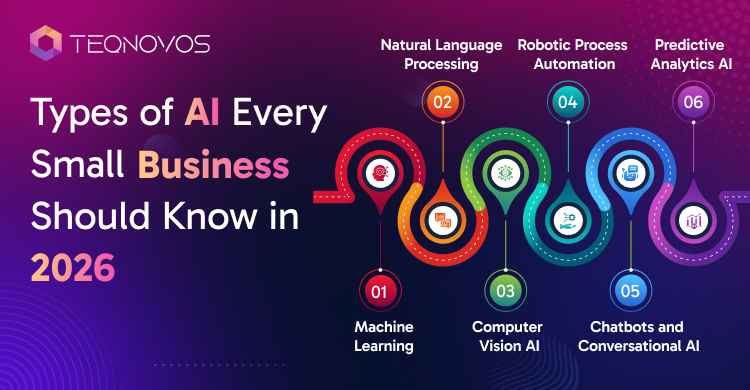
1. Machine Learning
Machine learning allows systems to train themselves using available data instead of fixed programming. These systems improve over time. For small businesses, this could mean better sales forecasting and more accurate product recommendations. Keeping up with new trends also helps businesses serve their customers more effectively.
2. Natural Language Processing
With NLP, AI could better understand the user queries and respond in their language. Thus, making the communication process easier and efficient. NLP could help automate various processes. Email process, sentiment analysis in customer reviews, and optimizing content become easy. This approach helps businesses manage high volumes of support without a big team.
3. Computer Vision AI
Computer vision assists AI in decoding the graphic information. Small businesses could use it to track tasks such as inventory. Enhance the security system or find the defects in products with AI. Computer vision makes visual data actionable in ways that manual observation cannot.
4. Robotic Process Automation
RPA automates repetitive digital tasks that take up valuable time. They could handle invoices, payroll, or scheduling tasks. Thus, the time spent on daily work decreases. Now, the employees could focus on expansion and providing customer service. RPA streamlines everyday tasks and ensures more accurate results
5. Chatbots and Conversational AI
Conversational AI-controlled chatbots are slowly becoming the need of the hour. They are used as a vital tool for serving customers. They assist with scheduling, reply to customer inquiries, and follow order progress. Unlike earlier versions, modern chatbots understand context and deliver more accurate responses. For small businesses, this means improved customer experience at lower operational costs.
6. Predictive Analytics AI
An AI analytics tool uses recent data to foretell the outcomes. Small businesses can use these to know the demands or find which customers will leave. With this, they could also improve the pricing system and manage the online inventory. This provides the admin the ability to make proactive decisions. Predictive analysis helps turn unrefined data into analytical insights.
Essential Skills to Look for in an AI Software Developer in 2026
1. Programming Languages
Every AI project starts with code. A skilled developer should have a strong command of certain languages. Java and C++ remain perpetual and priceless. These languages are used especially for performance-heavy applications. By 2026, businesses may also see a demand for AI-driven languages. A good developer is not just fluid in syntax. They should know how to write efficacious, maintainable code. A code that could adapt to different frameworks and business demands.
2. Machine Learning & Deep Learning
AI developers must understand how machines learn from data. Expertise in training and optimizing machine learning models is critical. It is a must to have knowledge of basic algorithms that spot patterns. Also, a deep insight into learning systems to manage vision or speech tasks. Familiarity with different tools, such as TensorFlow, shows that a developer is innovative.
3. Data Engineering
Data fuels AI. A capable developer should know how to present clean and organized data to models. This includes building data pipelines, handling messy or incomplete information. Without strong data engineering, even the best models fail. Businesses should look for developers who understand both the technical and practical sides.
4. Big Data & Cloud Platforms
In 2026, businesses will still rely on cloud platforms as the backbone of AI adoption. Developers should be comfortable with AWS or Azure, along with tools that manage big data. This skill ensures AI systems run smoothly. It also means avoiding the high costs of maintaining complex functions.
5. Mathematics & Statistics
Behind every AI model lies math. Knowing algebra and probability allows developers to understand the working of a model. Thus, they could improve it when required. This skill also helps in evaluating accuracy and ensuring reliable predictions. While businesses may not see the math directly, its influence is visible in the results.
6. Generative AI
Generative AI is changing the way businesses create content, designs, and even code. Developers working with large language models or multimodal systems will be in demand. They should know how to fine-tune models. Learn to integrate them into business workflows. For small businesses, this skill opens the door to new eventualities.
What AI Trends Mean for Small Businesses in 2026 and Beyond
1. Hyper-Personalization
AI will help businesses to treat every client differently. Providing unique and tailored solutions. Thus, boosting their devotion towards the business and conversion rates.
2. Advanced Automation
More routine work will run on autopilot. Payroll, scheduling, and order tracking will need less human effort. Thus, leaving teams free to focus on growth.
3. Predictive Analytics
Predictions from analyzing the data will help businesses to act ahead of time. Finding new opportunities, spotting risks, and staying with trends.
4. Integrated & Accessible Platforms
AI will be easier to use. Platforms combining marketing, sales, and operations into one dashboard will make adoption simple. Therefore, even the non-technical teams could take part.
5. Specialized AI Models & Agents
Industries will see AI designed for their needs. Healthcare, real estate, retail, and other sectors will use custom agents. Thus making it easy to handle tasks like compliance or inventory.
6. Generative AI for Content & Creativity
Generative AI will support small businesses to provide content, new designs, and ideas. Assisting them to come head-on with big players in the market.
Industry-Specific AI Trends Transforming Small Businesses in 2026
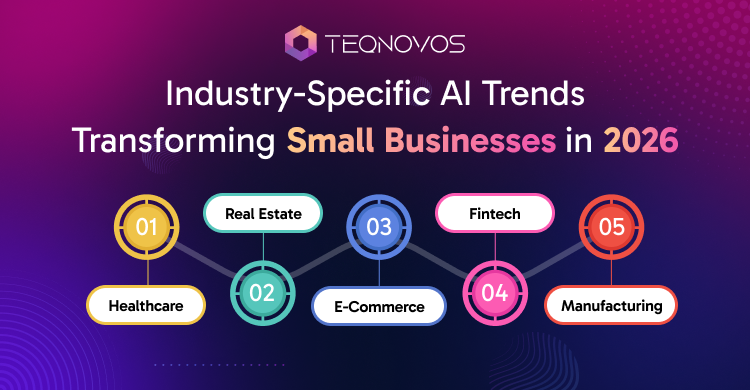
1. Healthcare
In the healthcare system, AI is reshaping the ways to protect data. AI presents the tools for appointment scheduling, patient reminders, and managing records. The diagnostic support systems may assist doctors. Thus, allowing them to diagnose conditions faster. Whereas the bot assistance could help with the daily questions. Therefore, medical personnel could invest more in caring for the patients and less in paperwork.
2. Real Estate
AI will help speed up and simplify property deals in the real estate sector. Agents can use predictive tools to know the market property prices. Matching buyers with homes will become easier with AI tools. These tools will be able to analyze lifestyle data and preferences. This frees agents to focus on closing deals.
3. E-Commerce
Even today, AI is playing a major role in online businesses. It provides the user with recommendations for the products they need. In the future, the pricing tools may be able to adjust the price according to needs. These capabilities allow small e-commerce shops to compete with major platforms.
4. Fintech
AI will strengthen trust and efficiency in financial services. Fraud detection systems will spot unusual activity quickly, protecting both businesses and customers. Automated compliance tools can keep small fintech firms aligned with regulations. Personalized financial insights will also help startups offer tailored advice. Hence, making their services more competitive.
5. Manufacturing
For small manufacturers, AI brings opportunities to boost productivity at lower costs. Smart sensors and AI monitoring can detect issues in tools before their breakdown. Quality control systems can flag defective products. Supply chain AI may elevate inventory levels and reduce waste. This will reduce the unnecessary costs. Hence, small factories will be able to deliver quality products.
Conclusion
AI is moving from being a “big business advantage” to becoming a necessity. In 2026, industry-specific solutions will give small businesses the same competitive edge. It will help small teams work to serve customers better.
AI software development is no longer a tool just for big enterprises. The businesses that embrace these tools early will be the ones that grow quickly and stay ahead.
Join us to get started on this transformation. Visit our website, Teqnovos, to explore resources for your business!