Why LangChain Still Leads AI Orchestration in 2026— Key Advantages Explained
Industries continue to increase their investment in AI, and this growth shows no signs of slowing. Since its introduction, AI has advanced rapidly, moving from experimental projects to an essential part of business.
Companies now rely on it to automate workflows and unlock new value. But to achieve this scale, they need more than powerful models — they need orchestration.
AI orchestration is the systematic integration of LLM and evaluations into unified workflows. It allows applications to reason across steps, remember context, and take reliable actions. Without orchestration, advanced AI agents remain fragmented and fragile. With it, they become dependable systems that drive business outcomes.
As orchestration frameworks expand, LangChain development continues to stand out. Its modular building blocks and strong observability give it speed and flexibility. The platform supports multi-agent workflows at scale while offering developers fine-grained control. Enterprises value how easily it evolves from simple prototypes into production-grade applications.
This blog provides an overview of LangChain AI orchestration as we look ahead to 2026, exploring why it still leads the landscape and the role it will play in shaping the next generation of intelligent systems.
What Is AI Orchestration and Why It’s Important?
ML orchestration focuses on training pipelines and deploying models — managing datasets, compute, and batch processes. While effective, it doesn’t address the challenges of building intelligent systems.
AI orchestration tools operate at a different level. It connects models with memory, external tools, retrieval systems, and evaluation loops. Instead of handling isolated predictions, it manages reasoning across multiple steps. An orchestrated agent can recall past context, query a knowledge base, and invoke an API. It could also synthesize results into a clear answer. This combination transforms a single model into a complete system.
The need for orchestration grows as enterprises push AI into complex workflows. Customer support, research automation, and decision systems demand coordination between many components. Frameworks offering orchestration provide structure for managing logic and controlling state. Without this, AI remains ad hoc and brittle. With this, they deliver consistent and scalable results.
Overview of LangChain and Its Ecosystem
Let’s understand what a Lanchain framework is and when it was first introduced. LangChain was introduced in October 2022 by Harrison Chase. It began as a simple framework designed to connect large language models with third-party tools and memory. The concept gained traction quickly as developers started using it to build chatbots, retrieval systems, and early prototypes.
The project grew at an exceptional pace. Early funding rounds attracted attention, and the LangChain quickly expanded beyond its core library. It soon introduced specialized products designed to support enterprise adoption and handle production-level workloads.
The evolution of the ecosystem shows a clear path. LangChain Expression Language, or LCEL, gave developers a way to define chains. It assisted in a simple and declarative style. LangServe, released in October 2023, allowed deploying chains as scalable APIs.
In February 2024, LangSmith was introduced, offering observability and tracking. By May 2025, the LangGraph platform reached standard accessibility. It offered long-running stateful agents with structured orchestration.
Today, LangChain is more than a framework. It has become an ecosystem that supports the full lifecycle of AI agents. It can help with early experimentation to stable production deployment.
What Makes LangChain the Leader in 2026
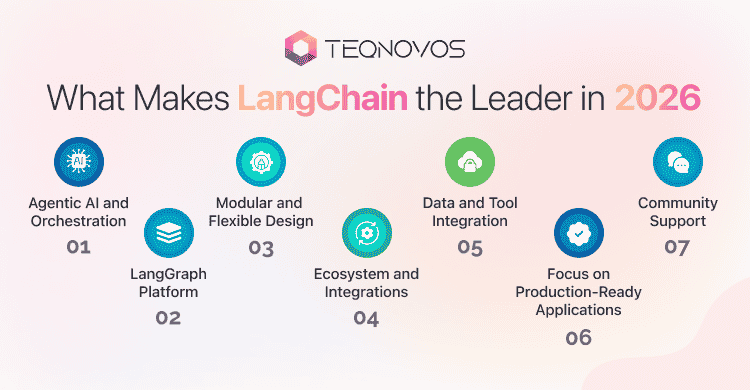
1. Agentic AI and Orchestration
- LangGraph is the core orchestration engine.
- Provides graph-based workflow design with branching, retries, and state persistence.
- Supports long-running, stateful agents for enterprise-grade reliability.
- Enables coordination of multiple tasks and tool usage within a controlled flow.
- Ensures predictable agent behavior in production environments.
2. LangGraph Platform
- Use reclaimable components such as memory, prompts, chains, and tools.
- Developers can start with simple flows and scale into complex workflows.
- The system’s versatility allows flexible configuration of components to meet unique needs.
- Supports incremental adoption: teams only use what they need.
- Reduces lock-in by offering multiple pathways to design solutions.
3. Modular and Flexible Design
- Works with leading LLM providers: OpenAI, Anthropic, Google Gemini, Meta, and local models.
- Works well with different vector databases such as Pinecone, Chroma, and Milvus.
- Works and connects well with major cloud platforms like Azure and AWS.
- Provides enterprise connectors for CRMs and workflow tools.
- A wide integration library reduces build time and increases compatibility.
4. Ecosystem and Integrations
- Supports retrieval-augmented generation pipelines for enterprise knowledge.
- Connectors available for SQL and NoSQL databases.
- Direct integration with document stores and search systems.
- Ability to call APIs and external services inside workflows.
- Suitable for research automation, analytics, and enterprise decision support.
5. Data and Tool Integration
- Supports retrieval-augmented generation pipelines for enterprise knowledge.
- Connectors available for SQL and NoSQL databases.
- Direct integration with document stores and search systems.
- Ability to call APIs and external services inside workflows.
- Suitable for research automation, analytics, and enterprise decision support.
6. Focus on Production-Ready Applications
- LangSmith delivers observability, tracking, and debugging for workflows.
- Offers evaluation tools to measure model accuracy and reliability.
- LangGraph enables developers to take a break, get ready, and recover from breakdowns.
- Built-in persistence ensures workflows can handle long runtimes.
- Provides enterprise teams with the reliability needed for scaling AI applications.
7. Community Support
- One of the most active developer groups in the AI space.
- Support varies from tutorials and open-source modules to advanced integrations.
- Backed by institutional funding, ensuring lasting development.
- Regular updates and new releases are aligned with real requirements.
- Strong ecosystem of partners and contributors expedites adoption.
Boost your AI strategy with LangChain development —discover its enterprise benefits!
Schedule a CallHow LangChain Compares to Alternatives
LangChain remains the most complete orchestration framework. But still, it is often evaluated alongside other options. The LangChain vs AutoGen vs LangGraph highlights how each framework serves different needs. LangChain excels at modularity and integrations. AutoGen is popular for fast multi-agent prototyping. And LangGraph is built for deterministic, stateful workflows.
Understanding these differences helps teams choose the right tool. Businesses could use them for research, experimentation, or production-grade AI systems. Let’s learn about the LangChain features and benefits to know which model suits you best.
| Feature | LangChain | AutoGen | LangGraph |
| Primary Focus | General-purpose AI orchestration with modular building blocks | Multi-agent collaboration through conversational exchanges | Graph-based orchestration for stateful and deterministic workflow |
| Ease of Use | Moderate learning curve, wide documentation, and tutorials | Easy for quick prototyping, simpler agent setup | Sharp learning curve due to graph structures and state machine design |
| Integrations | Broad ecosystem: LLMs, vector stores, APIs, enterprise connectors | Limited integrations, mostly model and research-focused | Built on LangChain integrations, inherits the same ecosystem |
| Production Readiness | Strong with LangSmith (observability, debugging) and LangServe (deployment) | Weaker, lacks enterprise-grade observability and monitoring tools | High authenticity for permanent workflows, supports retries, and persistence |
| Agent Control | Flexible but less deterministic | Conversational coordination, less structured control | Deterministic orchestration with branching and explicit state management |
| Best Use Cases | Enterprise apps, retrieval pipelines, chatbots, multi-agent workflows | Research projects, quick prototyping, and academic exploration | Complicated business processes, long-running stateful agents, and regulated systems |
| Community & Ecosystem | Large, active community, strong enterprise adoption | Smaller community, limited enterprise traction | Growing among advanced users, often used with LangChain as a companion tool. |
Challenges To Consider
LangChain has established itself as a leading framework, but it’s not without its challenges. Developers and enterprises often point out the following concerns.
1. Complex Design
LangChain includes multiple layers of abstraction, which can make small projects feel more complex than necessary. While this structure is valuable for scaling larger systems, it may add extra setup time for simpler use cases.
2. Abstraction Overhead
High-level modules hide important details. This can make debugging harder. Developers may struggle to extend components when workflows behave in unexpected ways. Transparency is limited, which adds friction during customization.
3. Shift to LangGraph
Many agentic modules have moved into LangGraph. This shift introduces a learning curve. Graph-based design is powerful but more complex than linear chains. Teams must invest extra time to get the command of the model.
4. Learning Burden
The framework requires knowledge of prompts, agents, memory, and orchestration. Each piece adds depth, but also extends the learning curve for new developers. As a result, teams may need additional time to become fully productive.
5. Architecture Concerns
Some communities suggest focusing on solid architecture design over black-box frameworks. In certain use cases, direct and lightweight setups may offer greater control and flexibility.
Discover the key benefits of LangChain for smarter, scalable AI orchestration —read more now!
Schedule a CallFuture Outlook: What’s Next for LangChain?
LangChain continues to lead its role in AI orchestration. The roadmap shows a clear focus on making agentic systems reliable and enterprise-ready.
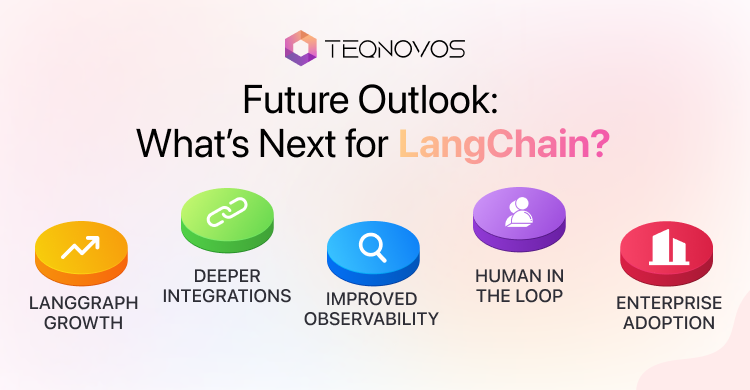
1. LangGraph Growth
The LangGraph platform became mainly approachable in May 2025. In 2026, it is expected to mature further. It will become a stronger tool for building and monitoring long-running agents. Enterprises will rely on it to handle regulated and mission-critical workflows.
2. Deeper Integrations
LangChain will continue to expand connections with APIs, data platforms, and enterprise systems. Broader support ensures that AI agents can plug into existing stacks with low effort.
3. Improved Observability
LangSmith will likely evolve with richer evaluation and monitoring. Teams need fine-grained insights to manage accuracy, reliability, and compliance. LangChain is investing in these features to keep pace with enterprise demands.
4. Human in the Loop
Expect more structured ways to involve humans in workflows. This allows oversight, validation, and correction when agents face uncertainty or high-stakes tasks.
5. Enterprise Adoption
With its strong ecosystem and proven track record, LangChain is well positioned for continued enterprise adoption. It remains a preferred choice for large-scale orchestration, with its future focused on balancing flexibility and the predictability that enterprises need.
Conclusion
LangChain has held its position as the leader in AI orchestration. It combines flexibility with production strength. It provides modular components, broad integrations, and powerful orchestration through LangGraph. With LangSmith, it adds clarity and assessment in the process. Together, these AI orchestration tools create a stable ecosystem. It supports the full journey from prototype to production.
Well, every framework has some challenges. Its abstractions can feel heavy for small tasks. The learning curve has grown as modules move into LangGraph. Developers must weigh the LangChain features and benefits against the effort of adoption.
The outlook for LangChain is strong. Enterprises continue to choose it for workflows that require state, memory, and reliability. The community and ecosystem also keep it ahead of smaller alternatives. Tools like AutoGen or lightweight SDKs are useful for experimentation. But LangChain development offers the depth needed for real-world systems.
In 2026, LangChain still leads because it delivers what AI orchestration demands. It remains the framework that defines how intelligent agents are built and deployed.
If you’re exploring AI orchestration for enterprise workflows, Teqnovos can help you harness LangChain’s ecosystem effectively.