Unlock Business Growth with a Powerful AI Implementation Strategy
Do you wonder how some businesses gain remarkable results with AI? However, some struggle to even scratch the surface. The secret is not just using AI but having a clear approach. A well-planned AI implementation strategy.
AI helps businesses operate and automate various processes. They help enhance customer decisions for smarter solutions. But, without the right method, it can become a costly attempt. A solid strategy turns AI from a buzzword into a growth engine.
This blog explains why your business needs a clear AI implementation strategy and what makes it successful. From automation and predictive analytics to AI chatbot development, discover how the right approach can turn AI into a true growth driver.
Importance of a Solid AI Implementation Strategy for Your Business
Businesses no longer rely on scattered or one-off AI experiments to gain a real advantage. A well-defined AI implementation strategy helps turn innovation into measurable growth. It aligns technology with business goals and ensures consistent results across operations.
Let’s understand how a planned approach creates valuable AI solutions.
- Operational Efficiency: Improve business productivity by automating jobs. It helps eliminate human errors in solutions.
- Enhanced Decisions: Get foresight from user data.
- Customer Experiences: Custom products and services grab user attention.
- Innovation & Scalability: Adjusting to the rising trends quickly.
Without a strategy, businesses face wasted investments. This results in poor data quality and issues with the integration.
Key Components of a Winning AI Implementation Strategy
Building an engaging AI implementation strategy begins with the right approach. Every component plays an essential role in the overall process. Together, they help in turning AI proposals into tenable business results.
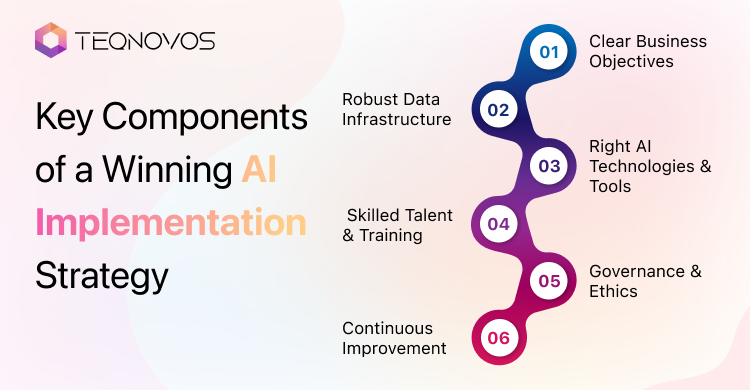
1. Clear Business Objectives
Start with a well-defined purpose. Be clear about why your business is adopting AI and what goals you aim to achieve. What is the need for using artificial intelligence in business strategy? Is it to improve efficiency or increase business revenue? A clear why ensures every step taken delivers results.
2. Robust Data Infrastructure
AI flourishes on worthy data. Maintain a clean data structure to ensure the data is accurate. Authentic data helps in better insights and predictions.
3. Right AI Technologies & Tools
Select scalable and progressive platforms that align with the business needs. The right tools simplify integration and support lasting creation.
4. Skilled Talent & Training
Empower teams with AI skills through training and collaboration. A well-informed workforce accelerates adoption, enhances efficiency, and drives innovation across the organization.
5. Governance & Ethics
Determine strong data governance to maintain data privacy and security. Eliminate bias and ensure ethical AI usage in all functionalities.
6. Continuous Improvement
AI success is an ongoing journey. To move with continuous enhancements, review performance, and gather feedback. Continue to refine strategies to stay relevant with the competition.
Together, these components help create a strong, adaptable AI strategy. This helps drive lasting business growth and innovation.
Top Challenges Businesses Face With AI Implementation Strategies
Implementing AI in businesses is not without some challenges. They face various obstacles. They could delay the progress or reduce the impact of their AI initiatives.
But recognizing these issues early during development helps plan better. Hence, it is possible to achieve meaningful results.
1. Data Quality & Availability Issues
AI clearly depends on the data provided. Inconsistent or incomplete data provided can lead to poor solutions. It can mislead the business with poor and inaccurate predictions.
2. Lack of Clear Use Cases
Unclear objectives result in failed projects. AI failing to align with the businesses well makes it hard to measure success.
3. Skill Gaps & Talent Shortages
AI is not new, but there is still a scarcity of its expertise. Organizations lack skilled experts in the field. They need developers who can handle and manage AI systems.
4. Integration Complexities
People often ask why AI is good in businesses. However, this step can backfire if AI is combined with legacy systems that crash. The process is demanding. It can lead to performance issues.
5. Change Management Resistance
Some people may resist accepting AI into businesses due to the fear of losing jobs. Without proper knowledge, there could be a lack of trust in automated systems.
A proactive plan and AI for business strategy can help overcome these. Expert support helps improve data quality in businesses. Integrating AI in businesses fosters a culture to embrace new tech.
Steps to Build a Winning AI Business Strategy
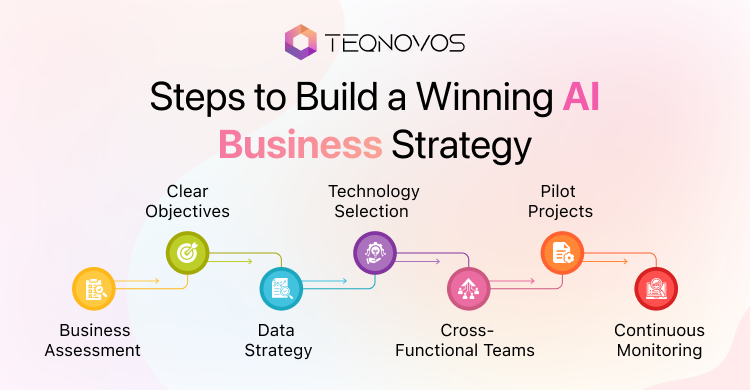
Building a winning AI business strategy is about connecting technology with purpose. It’s not just about accepting AI tools but using them to solve real business problems. The right strategy helps to grow businesses with confidence. Read how AI implementation strategies are helpful. Here’s how to build one that truly works for the organization:
1. Business Assessment
Start by taking a close look at the business. How does AI enhance business strategy for purpose-led organizations? It could be automating repetitive work or predicting market trends. Understanding the current systems and how data floats around. Discuss the various obstacles faced at the starting point.
2. Clear Objectives
Every successful AI project begins with a well-defined goal. Define what to want to achieve and how to measure success. Setting realistic KPIs keeps the AI initiatives focused. It ensures every effort leads back to business growth.
3. Data Strategy
Good data is the backbone of great AI. Focus on organizing the data. The data should be clean and reliable for better insights. Establish strong data privacy rules. This helps keep everything legal and compliant.
4. Technology Selection
Choose tools that fit the business. Before deciding, think about whether the tool is good for business. Do not go with the trend. Look for solutions that are secure and follow the setup. Pick a professional partner to select the technology for the business.
5. Cross-Functional Teams
AI works best when people from different areas work together. Bring in the tech specialists and the biggest data experts. Their combined insights ensure the AI solution makes sense both technically and strategically.
6. Pilot Projects
Start small. Run pilot projects to test how AI performs in real scenarios. Measure results and learn what works for the business. Then start to scale with those wins into other parts of the business.
7. Continuous Monitoring
AI isn’t “set and forget.” Keep an eye on how it’s performing, update the models. Adjust the approach to the AI as the goals evolve. Persistent improvement keeps the AI related and effective.
When these steps come together, AI becomes more than just a technology investment. It is what becomes the main driver for accelerating business growth. Turn ideas into measurable results and move the business forward with AI.
To know more: Explore the Future of AI Chatbot Development and Its Role in Business Growth!
Measuring the Success of AI Strategy
It’s important to regularly evaluate the success of your AI strategy. Without tracking progress, it’s difficult to know why AI is important for business. The right metrics help analyze what works and what needs to be tuned. It also helps see how AI is adding value to the business.
Below are some of the metrics to ensure the AI is bringing success to the business:
- ROI and Cost Savings: Track how much value AI initiatives have generated. Compare it with the investment. Look for reductions in operational costs. See how much the profit margin improved.
- Operational Efficiency: Assess the time saved on operations and the number of errors. See if there has been any faster turnaround in key business processes.
- Customer Engagement: Check whether the user interaction is through the use of AI.
- Accurate Decisions: Get the insights and the overall efficiency of artificial intelligence.
- Employee Productivity: Review the impact of automation on problem-solving situations. Observe the changes.
Keeping a track of these basic KPIs helps know if the AI is well aligned with goals. Constant reviewing helps find the gaps in the functions and makes corrections quickly. When the right approach is taken, this evaluation turns to sustainable business growth.
How Teqnovos Can Help Win In 2026 with AI?
Teqnovos is a trusted partner for businesses looking to turn AI potential into measurable success. Our deep expertise in AI development helps businesses scale faster. We help organizations move beyond experimentation and build solutions that deliver real impact.
Our core service areas include:
- Custom AI Model Development
- Machine Learning and Data Analytics
- Automation and Predictive Systems
- AI Integration
We combine technical excellence with business insights. Our customized solutions align well with business goals to deliver results. Partner with Teqnovos to unlock the full potential of AI and lead with confidence in the digital era.
Conclusion
A solid AI implementation strategy is no longer optional. It is a must for businesses looking to grow in a changing world. AI has the power to simplify activities and discover new opportunities. But it delivers true value only when steered by a clear plot.
Integrating AI into the core of the business with the right instructions helps invent faster. Put customers first and make thoughtful choices that drive lasting business growth. Implement those and get ready to scale your business.
Partner with us and unlock the full ability of AI to change. Book a free call with us to start your project with AI chatbot development.