Secret to Hiring Generative AI Developers Nobody Talks About
AI no longer remained a mere hype. It has already started transforming industries. The experimentation phase has concluded, and deployment is now underway.
Agentic AI, the next phase of evolution, takes it a step ahead.
Companies move beyond pilot applications to building domain-specific models. AI systems are not only helping draft content but also automating workflows. It now executes complex, multi-step processes autonomously.
As this shift accelerates, the demand for generative AI developers has grown. However, there are real limitations in the available talent pool. But the challenge isn’t just scarcity; most companies don’t even know what they truly need.
Many organisations hire AI talent based on surface-level skills. They check their familiarity with LLM APIs without evaluating the deeper capabilities.
Hiring generative AI developers is not about finding coders. It’s about identifying technologists who can bridge the gap. Let’s learn how to hire these dedicated resources.
What Does a Generative AI Developer Really Mean?
Many have misconceptions about what a top generative AI developer is. They are often categorized as those who write prompts or integrate LLM APIs into apps.
Having such assumptions often leads to hiring mismatches and stalled projects. Enterprise AI demands deeper capabilities. These developers work across model behavior, data quality, infrastructure, and risk management.
However, their responsibilities are vast and not limited to one expertise. They ensure the solutions are accurate and aligned with the business context.
A strong generative AI developer typically:
- Understands how models learn, adapt, and behave in different scenarios.
- Applies fine-tuning or parameter-efficient training to improve performance.
- Builds retrieval systems that allow models to access and reference organizational knowledge.
- Design workflows that support scale and monitoring in production environments.
They also collaborate with security and product teams. Enterprise deployment raises questions of privacy, particularly regarding data and long-term maintenance. This approach requires a developer to evaluate the risks and implement controls.
Thus, solving the assumption around why generative AI developers are important. They operate at the intersection of research and business strategy. Organizations that recognize this make better hiring decisions and achieve reliable AI outcomes.
Let’s build your next AI success story —hire expert Generative AI developers today!
Schedule a CallThe Hidden Skill Sets & Red Flags
Hiring generative AI developers requires looking beyond surface-level experience. Many candidates can demonstrate basic prompting or API integration.
However, enterprise AI success depends on deeper, less visible competencies. These skills support reliability and auditability. Understanding them helps organizations separate genuine expertise from short-term experimentation.
Core Technical Skills
Generative AI developers for hire have hands-on experience with foundation models. They should be able to optimize these models using techniques such as:
- Model Adaptation Techniques: Knowledge of LoRA, QLoRA, and reinforcement learning. They use human feedback to refine model output in controlled and efficient ways.
- RAG and Vector Search: Ability to build retrieval-augmented generation pipelines. Practical experience in operating vector databases. They should be able to integrate proprietary organizational knowledge securely.
- Multi-Agent Workflows: Experience designing systems where multiple AI agents interact. Skilled developers can delegate tasks and maintain context across workflows.
- MLOps and Infrastructure: Understanding cloud platforms and model deployment frameworks. Monitoring the production cost and using scaling strategies is one of the key skills of generative AI developers.
- Security and Governance: Building a model is only half the job. Dedicated developers for AI should have familiarity with data controls and access policies.
These capabilities allow the developer to move from prototype to stable enterprise deployment.
Soft Skills and Business Alignment
Having technical knowledge alone is not enough. Strong developers should have these key generative AI skills:
- Communicate how model tuning affects the accuracy and reliability of the product. They can explain how model development leads to cost-effectiveness and build trust.
- Collaboration with the product engineers and other teams helps build reliable solutions. A strong hire knows how to work in partnership rather than handling everything alone.
This ensures AI integrates seamlessly into business workflows.
Red Flags Many Hiring Guides Miss
Not every developer possesses generative AI skills for enterprise work. Warnings may include:
- Demo-Level Experience: Candidates who showcase experiments but lack real-world deployments. They may struggle in production environments.
- Model Risk: Inability to discuss model drift or audit readiness indicates skill gaps.
- Experience: Some developers excel at prototyping but lack architectural knowledge.
Explore the complete guide to building a powerful AI implementation strategy. Read more about the AI Implementation strategy.
Hiring Across the AI Lifecycle: Why Timing Matters
Generative AI projects move through several stages. Each stage has different goals and requires different skills. When companies try to hire one type of developer for the entire journey, it could slow down the progress. Matching skills to the phase of work helps projects move ahead. This clarity also improves how businesses can use generative AI models effectively across their operations.
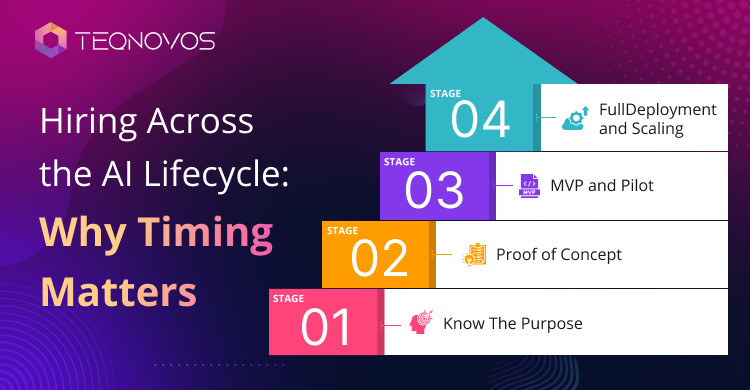
Stage 1: Know The Purpose
At the start, the goal is to confirm whether AI is the right approach. The focus is on understanding the problem and checking if quality data exists. Hire dedicated generative AI developers who can assess value and shape direction.
A small strategic team works here. Avoid recruiting developers only focused on coding.
Stage 2: Proof of Concept (PoC)
Next, the team experiments. They build simple models or retrieval systems to see if the idea holds up. The goal is quick learning, not perfection. An active developer who can iterate fast is ideal for this stage.
Stage 3: MVP and Pilot
Once the concept shows promise, the project moves closer to real users. Monitoring and workflow planning begin. This stage calls for developers who understand how systems behave.
Stage 4: Full Deployment and Scaling
Finally, the system must perform reliably for large numbers of users. This requires strong infrastructure and stable operations.
Specialized engineers join to maintain performance and ensure smooth running.
The key insight is simple: different phases require different strengths. When teams align talent to each stage of work, AI projects move faster.
In-House vs Outsourcing vs Hybrid
Choosing how to build a generative AI team affects the speed and budget of a firm. Each of these approaches carries some trade-offs. The right decision to hire AI developers depends on the project stage and its goals.
| Model | Advantages | Considerations |
| In-House Team | Better control, internal knowledge retention | Requires higher investment and long lead time to hire |
| Outsourced Partner | Fast execution and proven frameworks. They provide immediate expertise | Requires strong alignment and knowledge transfer planning |
| Hybrid Model | Balanced control with accelerated capability building | Most suitable for phased growth and enterprise scaling |
Pro Tip: Hidden Costs To Consider
Many companies sometimes underestimate the ongoing costs. However, the key is to select a model that fits the business. Compare them and see which of them offers a long-term business vision. Do not hire just to get an immediate resource under pressure.
Below are some costs to watch for:
- Cloud computing and storage
- Data preparation and pipelines
- Monitoring and retraining models
- Security and audit controls
Keeping an eye on these costs prevents unnecessary resource usage. It also ensures the solution remains scalable.
Move from concept to deployment— work with dedicated Generative AI experts!
Schedule a CallEffective Tips to Avoid Hiring Mistakes
Rushing into AI recruiting leads to misalignment and waste of resources. Avoid getting a single developer to handle everything. Generative AI work touches data, infrastructure, model tuning, and security. One person cannot cover all of these areas effectively in an enterprise environment.
Make sure your hiring approach matches your compliance and risk standards. Below are some points to follow:
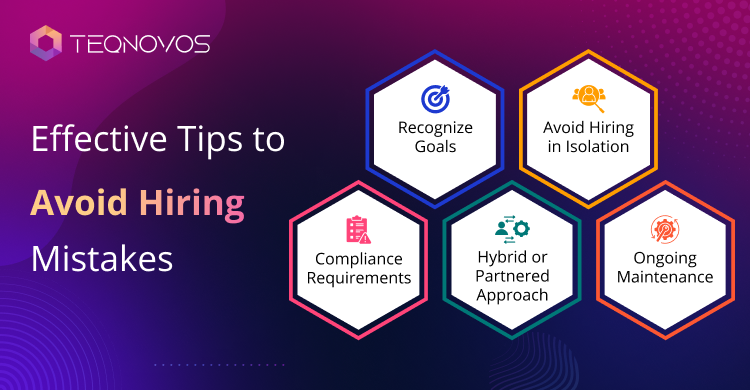
Recognize Goals
Take the time to clarify the project stage. Before starting, explain the intended use case and desired scale. This prevents misalignment and helps to select talent that fits the actual scope of work.
Avoid Hiring in Isolation
Do not rely on a single developer for all AI operations. Generative AI requires capabilities across different niches. From engineering the product to deploying and lastly monitoring it, generative AI is vast. A single developer cannot manage all the responsibilities.
Compliance Requirements
If the organization works with sensitive data, hire a dedicated AI development team that understands governance frameworks. Having regular audits helps mitigate risks. Developers need to follow the guidelines before starting the project, not after.
Hybrid or Partnered Approach
If internal capability is limited, partnering with an experienced firm ensures faster progress. It leads to smoother knowledge transfer. This reduces the risk of errors.
Ongoing Maintenance
Once deployed, models require continuous retraining and cost oversight. Treat AI as an evolving system. It helps maintain performance and reliability.
Conclusion
Hiring dedicated resources is not only a technical decision. It is a strategic choice that shapes how AI will perform.
Success depends on recognizing that different project stages require different skills. A well-structured team can effectively handle the full lifecycle.
The key is to match the hiring model to your goals and growth plans—partner with Teqnovos to plan your next step with generative AI developers. Visit our website to hire the right team and accelerate your AI initiatives.