




























How Much Does Mobile App Development Cost In Dubai, UAE
The technological advancement has made mobile applications the most dominant and versatile form of digital communication. They play the most vital role in the success of a brand. They offer the comfort of access on demand to information and solutions.
Dubai is emerging as a global tech hub, with its thriving startup ecosystems fueling the need for innovative mobile apps. They have become the latest and most adopted marketing approach by organizations. Thus, helping brands and businesses to increase productivity and target an increased user base, ensuring maximum ROI.
According to Kepios’s analysis, the number of internet users in the UAE increased by 372 thousand between 2024 and 2025. The UAE ranks at the top of digitally connected countries globally. It has the world’s fastest available mobile internet speed. The latest available data indicated that there were 11.1 million internet users in the UAE as of January.
Building on these compelling stats, it is clear that mobile apps are revolutionizing how businesses connect with their customers. On the other hand, they also emphasized their true value in digital strategy. With the UAE ranking among the top nations in smartphone adoptions, companies are more focused on asking the most essential question: “What is the cost of mobile app development in Dubai?”
But here’s what makes things get more interesting: the cost of developing a mobile app in Dubai is not fixed, nor is it predictable. The answer depends on various dynamic factors such as quality expectations and government regulations.
The UAE app market is unique. Dubai has elevated mobile experiences to a mandatory standard of operational efficiency rather than just a convenience tool. The majority of customer interactions in government services and transportation in Dubai happen through mobile devices.
Dubai’s technology ecosystem operates under a rigorous framework of digital regulations and standards. Government initiatives such as Smart Dubai, the Dubai Cashless Strategy, and many more have opened opportunities for businesses. Thus, the expectation for app performance and security is higher than in many other regions.
Meeting these standards ensures reliability and trust. It also influences the complete development cost and timeline. In addition to answering the question “How much does it cost to develop a mobile app in the UAE?”, we will also focus on other aspects.
This comprehensive guide is to help businesses understand all these factors clearly. Build your smart startup MVP or a feature-rich marketplace app. This will help break down everything you need to know about building an app in Dubai.
How Much Does It Cost to Develop a Mobile App in the UAE?
Teqnovos has analyzed Dubai’s fast-evolving tech market and introduced new, competitive mobile app development prices for 2026, tailored specifically for B2B clients. As a Dubai-based company, our end-to-end mobile app solutions start from just 30,000 AED to 50,000+ AED, covering everything from development to deployment. This pricing model helps local businesses accelerate digital transformation with high-quality, cost-efficient, and locally supported app development.
A company starts with mobile app development on an innovative concept. The latest market analysis, combined with a reliable idea, helps businesses define the interaction with the target audience.
How much does it cost to develop a mobile app? is the first question businesses ask when entering the digital ecosystem. The answer to this question varies depending on the project complexity and the features added. But it is crucial to understand the pricing landscape to set expectations before getting started.
Somehow, many ideas that lack proper planning have an unorganized budget and have extended deadlines. This increases the chances of immediate failure. However, to reach a certain goal, it is essential to understand the budget required.
In general, the mobile app development cost in Dubai ranges from 30,000 AED to 50,000+ AED. This depends on various factors like the app complexity and technologies used during the development phase. A complex application directly impacts the overall cost of development. Dubai’s competitive tech environment and higher expectations for UI/UX mean that app costs tend to be aligned with international development prices.
Even though finding the exact development cost in Dubai is a tough task. It requires a dedicated mobile app development company in Dubai to provide the expected budget based on the requirements. For a clearer picture, here’s a simplified breakdown of what is commonly seen in the UAE market:
Simple Mobile Applications
These represent entry-level applications typically used by small businesses or startups launching an initial digital presence. They usually include:
- Basic UI with 5–7 screens.
- Simple backend or no backend.
- Standard features (login, form submissions, content display).
- Single-language support.
- Minimal custom design.
This range is ideal for businesses needing a lightweight app quickly without deep integrations or automation.
Medium Complexity Applications
This is the most common category in Dubai. These apps include more advanced UI/UX and functionality:
- Multi-screen workflows.
- API integrations (payment gateways, Google Maps, etc.).
- Authentication and user management.
- Admin panel/dashboard.
- Custom dashboards or booking systems.
- Arabic + English support.
- More polished design elements.
Apps in this range are typically used by SMEs, small eCommerce stores, and other service providers.
High-Complexity Enterprise Applications
These applications require advanced secure architecture and custom-built features. They are aligned with Dubai’s digital-first industries, like government-based apps or real estate applications. These apps are also used for on-demand services.
Such apps often include:
- Real-time tracking (GPS, routing, driver/courier modules).
- Video/audio streaming.
- Marketplace or multi-vendor systems.
- AI-driven features (chatbots, recommendations, analytics).
- Complex admin systems with multi-role access.
- Social networking features.
- High-level cybersecurity standards.
- Integration with government or enterprise systems.
These costs also reflect extended testing cycles, accessibility compliance, performance optimization, and long-term maintenance.
Having a rough estimate of the cost at the initial development stage could help make up one’s mind regarding the investment. It also provides a chance for necessary negotiations over the complete app development budget.
However, analyzing various factors such as app complexity and market stats of the app helps tackle the challenges along the way.
Want to know the exact cost of your mobile app development in Dubai? Get a free estimate!
Schedule a CallUAE Digital Landscape – Stats That Justify the Investment
Understanding the mobile app development cost in Dubai requires focusing on the larger digital ecosystem. The country is one of the most aggressively digital, mobile-first markets in the world. This environment defines user expectations and regulatory standards. This helps businesses decide the level of investment they must make to build competitive applications.
Below is a comprehensive list of the factors that make Dubai a premium mobile app market.
UAE’s Mobile-First Population
The UAE has one of the highest smartphone penetration rates globally. Mobile devices became the primary medium for customer interaction. Residents use smartphones for almost every daily function:
- Banking and payments.
- Shopping and eCommerce.
- Transportation & delivery apps.
- Telemedicine and healthcare access.
- Government services (visa, licensing, renewal).
- Real estate browsing and property management.
This mobile-first behavior pushes businesses to invest in these apps. They need to build apps that respond faster and are visually appealing, using advanced technologies.
High Daily Mobile Usage Drives Expectations
UAE residents spend more time on mobile applications compared to many global markets. This creates:
Zero friction: Users expect instant transitions from an application with immersive UI/UX. They need real-time responsiveness from the app.
Global-quality design: The user expects a quality design from the applications. Apps are compared to products like Amazon.
Reliability: A single crash or slow response can cost the brand trust and customers.
These expectations directly influence how much it costs to develop a mobile app in the UAE. Higher expectations require higher engineering quality.
World-Leading 5G & Digital Infrastructure
Dubai has one of the fastest and most reliable mobile networks in the world, enabling:
- Real-time location tracking.
- Video streaming.
- Large-scale cloud integrations.
- IoT interactions.
- AI-powered features.
- High-volume data processing.
Apps must be engineered for speed and performance. Users do not tolerate lag. The infrastructure itself sets the performance benchmark high. Apps are tested on multiple devices, network conditions, and use cases to meet UAE standards.
This technical foundation elevates the price for app development in Dubai. Apps must operate flawlessly within this high-performance environment.
Government-Led Digital Transformation
Dubai’s digital transformation is intentional and well-funded, with major initiatives such as:
- Smart Dubai.
- Dubai Paperless Strategy.
- UAE Digital Government Strategy 2025.
- Government Initiative.
These programs are pushing private and public sector businesses to adopt the mobile delivery strategy.
The apps must follow strict data handling and privacy standards to keep user data safe. They must function seamlessly in English and Arabic. Also, they need to comply with the UAE’s digital agenda, where accessibility is no longer optional.
Compliance adds architecture, testing, and design layers. All these factors contribute to higher overall development costs.
Competitive App Ecosystem
Dubai’s private and government sectors are undergoing rapid digital transformation. As competition grows:
- Apps require more advanced features.
- Brands invest in premium UI/UX.
- Ongoing improvements become essential.
- Users demand unique, personalized experiences.
This competitive pressure pushes businesses to invest more in technology to stand out.
Why This Justifies Higher App Development Costs?
When an economy is:
- Highly volatile.
- Rapidly digitizing.
- Government-supported.
- Infrastructure-rich.
- User-demand driven.
These factors command premium-quality app development. A better knowledge of this landscape helps businesses make smarter decisions about budgets and long-term digital strategies.
Evaluate the mobile app development cost in Dubai with experienced technical guidance. Plan your project effectively.
Schedule a CallGovernment Rules & Compliance That Impact App Development Cost
Rules and regulations in Dubai significantly affect the mobile app costs. Mandating specific, complex technical and legal demands. The cost arises from the need for special security features and legal expertise related to every industry.
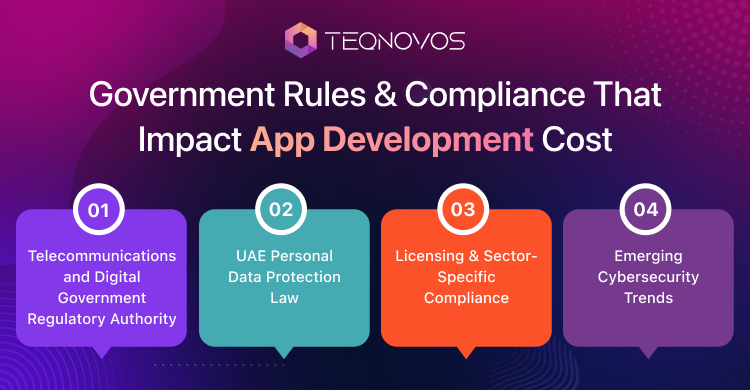
Telecommunications and Digital Government Regulatory Authority
The primary regulator for telecom and digital services in the UAE is TDRA. Established under Federal Decree‑Law No. 3 of 2003.
- Under this law, any provider of telecommunication or digital-communication services needs to operate under TDRA’s regulatory framework.
- It issues licensing or exemptions under this framework. If a mobile app qualifies as a service, then license and compliance obligations may apply.
- The TDRA enforces guidelines related to user content, their data, and protection against its theft. Require that digital services avoid such content or risk being blocked.
- For an app targeting UAE users, the app needs to comply with TDRA content guidelines.
Working under TDRA’s regulations adds licensing overheads and compliance complexity. Adhering to it also assures legality and reduces risk, which helps build user trust and long-term ROI.
UAE Personal Data Protection Law
This federal law is similar to GDPR. It requires explicit user consent for data collection and secure processing of personal information.
- Since 2022, the UAE has had a comprehensive data-privacy regime under Law No. 45 of 2021.
- For app developers: if a mobile app collects user data. They must design proper consent flows for user data rights.
- Many UAE government and private services emphasize accessibility standards. This may require additional UI/UX design effort and multi-language support.
- All this work adds to the development time and costs.
But in exchange, the app gains legal compliance and likely better adoption. This helps with ROI and brand reputation.
Licensing & Sector-Specific Compliance
Not all apps are the same; some belong to niche sectors like fintech or e-commerce. Regulatory overhead can vary significantly.
- Before launching a monetized or service-oriented app, businesses need a proper trade license or corporate license.
- If the app deals with sensitive data, additional regulations may apply.
- This legal groundwork often requires consultation with legal experts, adding upfront cost.
- The app may also require periodic compliance audits if the app evolves or new features are added. This means ongoing costs beyond just development.
Emerging Cybersecurity Trends
In the evolving ecosystem in the UAE, there are new compliance burdens that developers should expect:
- With the country’s increasing focus on cybersecurity, apps might soon be required to adopt rigorous norms.
- They need to ensure a zero-trust architecture with regular security audits and secure session management.
- Apps handling sensitive or financial data may need related niche certifications or compliance with international standards.
- As cross-border data flows remain common. Obtaining approvals for transfers under PDPL may become a significant overhead.
How Do These Regulations Translate into Extra Development Costs?
Architecture and design overhead:
Building a secure and encrypted data storage for users.
- Engaging professionals early on to navigate the complex regulatory landscape and draft necessary documents.
- Implementing costs for features like user consent management and secure data transfer protocols.
- Robust security testing and ongoing assessments are essential to avoid penalties.
- To operate globally, the app requires permits.
- Ongoing updates are necessary to ensure continuous attachment to evolving regulations, adding 15-20% of the initial development cost.
- Non-compliance can result in substantial fines and reputational damage, making upfront investment a necessity.
These factors elevate the development cost compared to a “generic” app built for an unregulated market. However, they ensure legal safety and increase app credibility in the market.
What Can Fluctuate the Development Cost of a Mobile App in Dubai?
Mobile app development in Dubai never follows the same pricing model. Two apps may look similar on the surface, but still end up with completely different budgets depending on what’s happening behind the scenes. Several moving parts influence the final cost of the app. Understanding these factors early helps businesses set realistic expectations and avoid surprises later.
Scope & Feature Set
The app’s scope is the biggest indicator of how much to spend. A lean MVP keeps things simple. Adding essential features to test the idea and gather real user feedback. It’s cost-friendly and fast to build. This is ideal for startups validating their concept.
Adding more sophisticated features results in the cost rising. A complicated design requires more engineering and testing hours.
Features that typically increase costs include:
- Real-time chat or messaging.
- Voice or video calling.
- Complex booking or scheduling systems.
- Advanced dashboards or reporting tools.
- AI-driven features like chatbots or recommendations.
- AR/VR experiences.
- Marketplace or multi-vendor setups.
Every new feature means more logic and more development time.
Platform Choice
The choice between iOS, Android, or cross-platform has a direct impact on cost.
Native apps: Deliver top-tier performance and full access to device capabilities. But because each platform requires its own codebase, they cost more.
Cross-platform frameworks: Allow developers to build once and deploy on both platforms. This can significantly reduce development time and cost, making it a popular choice for MVPs and mid-scale projects.
When to start with one platform?
- If the budget is tight.
- While testing a new idea.
- If the user base leans heavily toward one platform.
When to invest in both?
- When the product is consumer-facing.
- When a wide reach is crucial.
- When the competition already exists on both platforms.
Choosing the right platform strategy early can save a substantial amount of money down the road.
UI/UX Design Complexity
Dubai users have high expectations. They interact daily with polished apps. Anything slower or visually outdated can hurt a brand.
This is where UI/UX design becomes a major cost variable.
Costs increase when:
- Requirement for a custom interface instead of template-based layouts
- If an app includes animations or branded visuals
- Need illustrations or detailed motion effects
- Designing for both English and Arabic, which requires mirrored layouts and cultural adaptation
Beautiful design takes time. And in a design-sensitive market like Dubai, the extra investment is often worth it.
Backend Infrastructure
If UI is the face of the app, the backend is the brain. And depending on the business model, this brain can be simple or incredibly complex.
Here’s where backend costs fluctuate:
Custom Backend vs. BaaS
- A custom backend offers full control and complex logic. But the cost is more.
- Backend-as-a-Service options like Firebase reduce cost and time for MVPs. But it may limit flexibility later.
Third-party integrations
Each integration adds setup time, testing, and, in some cases, monthly fees.
Common integrations in Dubai include:
- Payment gateways
- Google Maps or Apple Maps
- SMS/WhatsApp verification
- KYC and identity verification
- Logistics or delivery networks
- CRM/ERP systems
Scalability needs
Apps expected to serve thousands of users can run on a basic architecture.
- Load balancing
- Auto-scaling servers
- High availability setups
- Monitoring and cloud security tools
- All of this increases infrastructure and DevOps costs.
Experience & Engagement Model
How much it costs to develop a mobile app in the UAE depends on its architecture. Who is building the app matters, too.
1. Team location
Dubai-based teams: More expensive, but they understand the local market and quality standards.
Offshore teams: More affordable, but may struggle with communication and understanding UAE requirements.
2. Developer experience
Senior developers write scalable and efficient code. The approach is costly but faster overall.
Junior developers cost less but may slow the project and require more oversight.
3. Engagement models
Fixed-price: Good for clear, well-defined scopes.
Dedicated team: Ideal for long-term projects or evolving products where flexibility matters.
Choosing the model that best suits ensures predictability and reduces risk.
Timeline & Urgency
Project timelines also shape the overall cost.
Shorter timelines on the app development result in higher prices.
- More developers may need to work simultaneously
- Teams may need to work extended hours
- QA and design must overlap with development
- Compromise on iteration time, leading to potential post-launch fixes
However, starting early allows:
- Spread the workload
- Avoid rushed decisions
- Plan future features
- Reduce overall cost
- Produce a higher-quality app
In Dubai’s competitive landscape, thoughtful planning can save businesses thousands of dirhams and prevent costly rework.
Service-Wise Development Cost Breakdown
Understanding how the app development budget is distributed helps businesses make informed decisions and plan effectively. Each phase of the development cycle delivers a specific set of outcomes. These stages determine the overall investment. Below is a clear breakdown of how we typically allocate resources across each service.
Discovery & Product Consulting – Free of Cost
This is the foundation of a successful project. During discovery, we align with the business. We ensure that we know about the technical requirements. Based on this, we strategically plan to place the app in the Dubai market.
This phase usually includes:
- Requirement workshops.
- Competitor and market analysis.
- Feature prioritization and MVP planning.
- User journey mapping.
- Technical stack recommendations.
A strong discovery phase eliminates risks and ensures the team builds the right product.
UI/UX Design – 3600 AED – 10000 AED
In Dubai, users expect intuitive and culturally aligned interfaces. Our design process follows modern standards and considers bilingual design requirements. We provide users with accessibility guidelines inspired by the UAE’s design system.
Design deliverables include:
- User flows and experience mapping.
- Wireframes for all core screens.
- Custom UI design.
- Design system creation.
- Clickable prototypes for stakeholder testing.
The more custom visual elements a product requires, the higher the design effort.
Core App Development – 14600 AED – 20000 AED
Development transforms design into a fully functional mobile application. Most of the engineering effort takes place in designing the app for different platforms.
Common features that impact cost:
- Product or service listings
- Push notifications
- Maps and geolocation
- Secure payment gateways
- Multi-language support
Each feature adds complexity, which increases development time and testing requirements.
Backend Development & APIs – 15000 AED – 18000 AED
The backend powers the entire application. It handles data, business logic, and more. The scale and complexity of the backend depend on the app’s functionality.
Backend responsibilities include:
- API development.
- Database architecture.
- User roles & permission systems.
- Booking and scheduling systems.
- Secure cloud hosting setup.
On-demand services and other niche-related applications require more advanced backend logic and encryption. This results in higher costs.
Security & Testing – 3200 AED – 5508 AED
Quality assurance ensures the app performs reliably across all devices and operating systems. In Dubai, where users expect high performance and government compliance is strict, testing becomes critical.
Our QA process includes:
- Functional testing.
- Regression testing.
- Performance and load testing.
- Security audits and vulnerability checks.
- Compliance validation aligned with TDRA expectations.
Apps that handle sensitive data or payments undergo additional testing cycles to ensure security.
Launch & App Store Management – Free of Cost
Launching the app requires careful preparation to ensure smooth approval on the App Store and Google Play.
This stage covers:
- App Store and Play Store listing setup
- Compliance checks for both stores
- Certificate and build configuration
- Submission and handling reviewer feedback
- Post-launch bug monitoring for stability
A successful launch ensures the app meets store standards and delivers a strong first impression to users.
Ongoing Improvements
When the app is live, continuous maintenance keeps it secure. Keep the app updated and aligned with evolving user expectations.
Maintenance activities include:
- Regular OS compatibility updates.
- Bug fixes.
- Enhancements and new feature releases.
- Monitoring server performance.
- Updating third-party APIs.
Most businesses in the UAE opt for monthly retainers to ensure uninterrupted support and growth.
Industry-Wise Mobile App Development Cost in Dubai
One of the most common questions we hear is, “What is the price for app development in Dubai for my industry?” The numbers depend on scope and complexity. But we can estimate ranges based on typical UAE market expectations. Dubai’s digital landscape is advanced. This means some industries require more technical depth.
Below is a practical breakdown to help businesses understand where their project may fall.
eCommerce & Marketplace Apps
eCommerce remains one of the fastest-growing sectors in the UAE. Shoppers have high expectations for browsing websites and reliable payment processing. Marketplace apps demand backend logic because they handle multiple vendors and large user bases.
Typical features include:
- Product catalogs.
- Search and wishlists.
- Shopping carts and checkout.
- Payment gateways.
- Vendor dashboards.
- Real-time order updates.
- Loyalty programs.
Why do costs range from mid to high?
These apps require multiple integrations and scalability planning to handle thousands of products and users. Performance and security also play major roles during peak sale periods, common in Dubai.
On-Demand & Delivery Apps
Apps such as food delivery and home service platforms are the most complex categories to build. These systems usually involve multiple user roles, each with its own interface and workflow:
- Customer app
- Driver/service provider app
- Admin panel
Key features include:
- Real-time GPS tracking
- Live order updates
- Route optimization
- In-app chat/voice communication
- Wallets and secure payments
- Rating and review systems
Why are costs higher?
On-demand apps rely heavily on real-time operations and scalable infrastructure. They must work flawlessly during peak hours. This requires careful planning and optimization.
Fintech & Banking Apps
Fintech apps in the UAE require a different level of security, compliance, and backend architecture. Whether the product involves digital wallets, payments, personal finance, or banking functionalities, trust and reliability are everything.
Typical features include:
- KYC/identity verification
- Biometric authentication
- Transaction history & audit logs
- Secure payments or transfers
- Encryption protocols
- Real-time notifications
- Analytics dashboards
Why do costs fall on the higher end?
Fintech demands strict regulatory and cybersecurity standards. Every feature must undergo deeper testing and compliance evaluation. Even small errors disrupt user trust, so the engineering effort is higher.
Healthcare Apps
Telemedical apps are growing quickly in Dubai due to the rise of wellness platforms and digital health services. However, they require careful handling of sensitive medical information.
Typical features include:
- Appointment scheduling
- Teleconsultations
- Digital prescriptions
- Medical history and records
- Available doctor profiles
- Insurance integrations
Why do costs increase?
Handling medical data requires severe diligence. Compliance with UAE privacy expectations and integration with hospital systems often add layers of complexity.
Public Service Apps
Government and education apps in the UAE follow very high standards of usability and accessibility. These solutions must operate seamlessly across devices and support bilingual interfaces.
Core features usually include:
- Multilingual support
- High accessibility compliance
- Secure login through systems like UAE PASS
- Integration with existing government databases
- User dashboards and service requests
- Real-time notifications
Why do costs lean high?
These apps often integrate with government systems and must follow strict UI guidelines. Ensuring high performance and reliability increases development hours.
How to Reduce Mobile App Development Cost Without Compromising Quality?
Building an app in Dubai is a long-term investment. With the right choices, businesses can control their budget. They could still deliver quality mobile apps that perform well in the UAE market. These simple methods help you reduce costs without lowering standards.
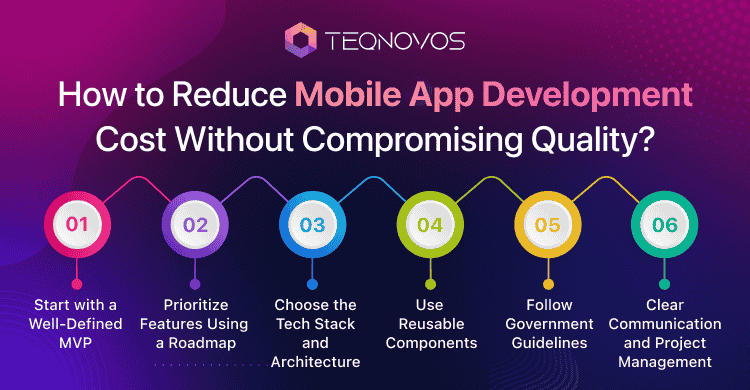
Start with a Well-Defined MVP
A clear MVP helps to avoid spending on features that are not essential. Focus on the core function that solves the main problem. Launch early and learn from user feedback. This simple method prevents overbuilding and saves both time and money.
Prioritize Features Using a Roadmap
A feature roadmap keeps the project on track. Separate ideas into urgency items and later phase items. This reduces scope creep and protects the budget. It also helps the team stay aligned on the real goals.
Choose the Tech Stack and Architecture
The tech stack chosen will affect both speed and cost. Cross-platform options like Flutter or React Native work well for many Dubai projects. Start building an app and release it on iOS and Android. This approach works best for apps that do not need advanced native features.
Use Reusable Components
Businesses do not need to build every feature from scratch. Use proven services for login or analytics. Pick safe and compliant tools that reduce development time. This helps speed up delivery and lowers overall cost.
Follow Government Guidelines
Dubai has strict rules for accessibility and security. Following TDRA and UAE Design System guidance from the start helps avoid expensive fixes. It also helps the app pass reviews more easily and meet user expectations in the UAE.
Clear Communication and Project Management
Good communication prevents delays. Use clear documentation and regular demos to keep the team aligned. Early clarification reduces rework and protects the budget. When everyone stays informed, the project moves much faster.
Conclusion
Now you know what really drives mobile app development cost in Dubai. Feature scope and industry requirements for government compliance shape consumer expectations.
These factors make app development a strategic and reliable investment. Planning with clarity reduces risk and sets the product up for success.
If you’re exploring an idea or preparing your budget, Teqnovos is here to help. Share your concept with us, and we’ll provide you with a Dubai-focused cost estimate. Visit our website today!