Fintech AI Solutions: Blueprint for Modern Financial Institutions
Digital finance has entered a decisive transformation phase. Traditional banking models no longer meet modern client expectations. Customers demand instant approvals with transparency. On the other hand, investors demand measurable growth. This shift accelerates the adoption of AI solutions across global financial institutions.
Artificial intelligence refers to systems that simulate human intelligence through data-driven models. In financial services, AI enables predictive decisions with risk analysis and automation. This transformation is driving demand for advanced solutions for fintech. They help modernize lending, payments, and customer engagement without disrupting core operations.
The competitive landscape pushes leaders to adopt intelligent systems that drive faster credit decisions and lower default rates. This demand fuels interest in the AI lending solutions in fintech as lenders seek smarter underwriting frameworks. Strategic guidance from an experienced AI software development consultant ensures these systems scale securely and align with regulatory goals.
How It Works: The Core Framework of Fintech AI Solutions
Modern fintech AI solutions function through structured intelligence layers. Each layer solves a defined operational challenge. When combined, they create a secure and scalable financial system.
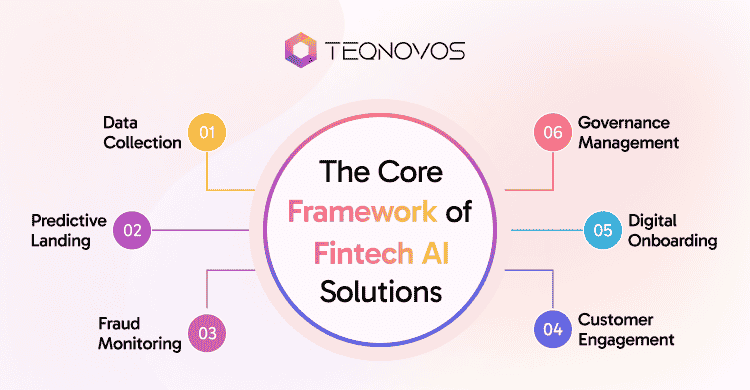
1. Data Collection
AI systems begin with reliable data. Financial institutions collect transactional and historical credit information. Clean and structured data ensures making accurate decisions for consumers.
- Collect structured and unstructured financial data
- Standardize and clean datasets for model training
- Build secure data pipelines for real-time processing
- Enable scalable analytics across departments
This stage forms the backbone of advanced solutions for fintech.
2. Predictive Lending
Machine learning models analyze historical repayment behavior and financial trends. These models identify risk patterns beyond manual analysis and improve the approval speed.
- Assess borrower risk profiles
- Predict default probability using insights
- Improve approval speed with automated scoring
- Reduce portfolio risk exposure
This approach strengthens businesses seeking fintech AI knowledge management solutions for compliance.
3. Fraud Monitoring
Scam detection systems continuously monitor transaction activity. AI identifies anomalies that may indicate suspicious behavior and implements instructions to protect the consumer’s personal data.
- Detect unusual spending patterns instantly
- Minimize false positives through adaptive learning
- Strengthen fraud prevention frameworks
- Protect institutional and customer trust
Deploy AI-powered fraud detection platform solutions for businesses to prevent financial loss.
4. Digital Onboarding
Customer onboarding becomes faster and more secure with AI automation. Systems verify identities and perform risk screening within seconds to enhance the user experience.
- Automate document verification
- Conduct biometric identity validation
- Screen customers against risk databases
- Accelerate account opening workflows
Businesses rely on AI-based digital onboarding solutions for fintechs to balance compliance.
5. Governance Management
Regulatory compliance requires continuous monitoring and governing audits. AI centralizes documentation and tracks evolving requirements efficiently.
- Maintain audit trails automatically
- Monitor policy updates in real time
- Flag compliance gaps early
- Improve reporting accuracy
Evaluate the fintech company’s ideals and solutions on the AI M&A platform to strengthen governance.
6. Customer Engagement
AI enhances how banks interact with customers. Personalization engines and virtual assistants improve digital engagement by providing consumers with recommendations.
- Provide instant AI customer assistance
- Deliver tailored product suggestions
- Analyze behavioral trends for cross-selling
- Improve customer lifetime value
This layer completes the intelligent ecosystem powered by modern fintech AI solutions.
Discover how AI fintech solutions improve lending, fraud detection, and compliance. Connect with AI fintech solutions experts.
Schedule a CallRevenue Model of AI Solutions for Fintech
Profitability depends on automation risk deduction and smart pricing frameworks. Businesses invest in AI banking software development consultants to improve efficiency and unlock new revenue streams. A structured monetization model ensures solutions remain maintainable.
1. SaaS Model
Many fintech platforms operate under a subscription-based Software as a Service structure. Clients pay recurring fees for continuous AI access. This ensures predictable revenue and builds longer contracts. It also allows providers to update models without service disruption.
2. Usage Pricing
Some providers charge based on transaction volume or API calls. This model aligns cost with platform activity. It works well for lending fraud detection and onboarding systems. Scalable pricing supports growing fintech ecosystems.
3. Enterprise Licensing
Large institutions prefer full platform ownership through enterprise agreements. These contracts include custom integrations and dedicated support. This model suits advanced AI solutions for fintech deployed across multiple departments. It ensures deeper operational control and strategic alignment.
4. ROI Through Automation
AI reduces manual workload and operational errors. Automated underwriting and compliance workflows lower processing costs. Businesses implementing the best AI lending solutions in fintech often see improved portfolio performance. Efficiency directly translates into higher margins.
5. Revenue Protection
Fraud prevention and forecast models protect revenue streams. Early risk detection reduces default exposure and reimbursement. AI-driven safeguards improve financial stability. Strong risk control enhances long-term profitability.
6. Profitability Optimization
AI enhances loan portfolio management and pricing strategies. Predictive modeling improves risk adjustment returns and provides accurate borrower segmentation with early predictions. By integrating structured intelligence into credit workflows, strengthen profitability while maintaining compliance.
Explore advanced AI fintech solutions for modern financial institutions. Build smarter digital banking systems with AI.
Schedule a CallHow Banking AI Solutions Evaluate Performance and Strategic Impact
Deploying intelligent systems is only the first step. Continuous evaluation ensures performance and regulatory alignment. Structured assessment from an AI banking software development consultant helps improve strategic decisions.
Accuracy Benchmarks
Model accuracy determines lending quality and fraud prevention strength. Institutions measure prediction precision and false positive rates. Performant systems improve portfolio stability and borrower trust. Continuous recalibration keeps solutions for fintech aligned with data patterns.
Risk Metrics
Risk reduction remains a primary evaluation factor. Teams monitor default ratios and exposure trends to prevent fraud. Effective analytics lowers nonperforming assets and strengthens capital efficiency. Businesses using the best AI lending solutions in fintech often report improvement in risk forecasting.
Compliance Efficiency
Regulatory adherence must be measurable and traceable. Organizations assess audit readiness to adjust policy alignment. Integrated fintech AI knowledge management solutions for compliance improve documentation accuracy. Strong adherence metrics reduce penalties and enhance operational transparency.
BI Dashboards
Business intelligence in the banking industry provides executive visibility into performance data. Real-time dashboards track KPIs and portfolio health indicators. Leadership uses predictive insights to refine strategy. These analytics strengthen confidence in deployed banking AI solutions.
Strategic Review
Expansion and acquisition decisions require structured analysis. Leadership teams evaluate the fintech company’s ideals and solutions on the AI M&A platform to assess scalability and integration readiness. This evaluation framework reduces investment risk. It ensures technology aligns with growth objectives.
Governance Score
AI governance requires oversight and accountability. Institutions measure explainability model transparency and data integrity. Ethical AI frameworks protect reputation and regulatory standing. A strong governance score confirms that financial services operate responsibly and sustainably.
Key Use Cases of AI Solutions for Fintech in Banking
Artificial intelligence drives fundamental operations in finance. AI-based digital onboarding solutions for fintechs to improve security and compliance. These applications deliver measurable value across departments. Below are the most impactful use cases.
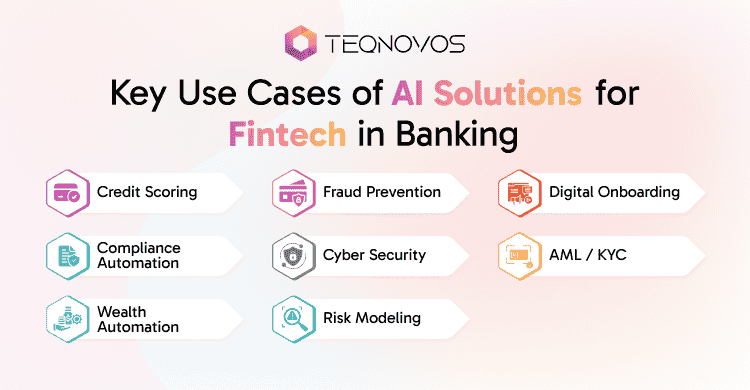
Credit Scoring
AI improves borrower evaluation by studying broader financial and behavioral data. Predictive models assess repayment probability with higher precision. Implementing the best AI lending solutions in fintech strengthens portfolio stability. Faster decisions also improve customer experience.
Fraud Prevention
AI systems monitor transactions continuously across channels. They detect abnormal behavior patterns in real time. Early intervention reduces financial loss and reputational risk. Fraud intelligence supports modern banking solutions for fintech.
Digital Onboarding
Automated identity verification accelerates account creation. Adopting AI-based digital onboarding solutions for fintechs to reduce friction and manual review. Real-time screening improves compliance accuracy. This balances speed with regulatory discipline.
Compliance Automation
AI banking software consultant service streamlines regulatory monitoring and reporting. Compliance solutions for banks centralize policy documentation and audit workflows. Evaluate the fintech company’s ideal solutions on the AI M&A platform to improve transparency. Automated oversight reduces operational strain.
Cyber Security
AI strengthens cybersecurity by recognizing threats before damage occurs. Systems examine network behavior to detect intrusion attempts. Predictive threat modeling reduces exposure to evolving attacks. Secure infrastructure is essential for scalable banking AI solutions.
AML/KYC
Robust screening helps businesses to detect any questionable behavior and verify the identity data. Constant monitoring improves regulatory compliance. Anti-money laundering and know-your-customer processes benefit from AI automation. These frameworks protect institutional integrity.
Wealth Automation
AI-powered fintech solutions are used by next-generation family offices for portfolio forecasting and performance optimization. This analysis enhances asset allocation strategies. Intelligent automation improves the risk returns and insights available to support the financial growth.
Risk Modeling
Advanced AI models affect economic shifts and credit stress scenarios. Early risk indicators allow proactive intervention. Institutions refine strategy using predictive analytics. Strong risk modeling reinforces resilient AI solutions.
How to Integrate Banking AI Solutions in Legacy Systems
Legacy infrastructure was not built for intelligent automation. Many banks still operate on rigid core systems. Integrating modern AI-based digital onboarding solutions for fintechs requires a structured and low-risk transition plan. The objective is modernization without operational instability.
Gap Analysis
Integration begins with a technical and operational assessment. Understand system limitations before introducing AI layers. This stage prepares the foundation for stable solutions for fintech deployment.
- Audit core banking architecture
- Identify data silos and bottlenecks
- Evaluate scalability and performance limits
- Assess compliance readiness
API Layer
Application Programming Interfaces APIs act as secure connectors between legacy systems and AI modules. They allow controlled data exchange without full system replacement.
- Build secure API gateways
- Enable real-time data access
- Maintain encrypted communication channels
- Ensure backward compatibility
Phased Migration
A gradual rollout reduces operational disruption. Businesses begin with limited scope pilots before expanding. This approach minimizes risk while upgrading to modern banking solutions.
- Launch AI in one department first
- Monitor system performance closely
- Optimize based on live data
- Scale after validation
Middleware Design
Middleware creates a bridge between traditional cores and advanced analytics engines. It standardizes data flow across platforms, strengthening long-term AI scalability.
- Normalize structured and unstructured data
- Enable interoperability across systems
- Support real-time processing
- Improve system flexibility
Regulatory Safeguards
Compliance must remain intact during system upgrades. Governance controls protect and maintain business integrity. These safeguards ensure responsible AI deployment.
- Maintain full audit trails
- Enforce data privacy protocols
- Monitor model explainability
- Align with financial regulations
Our Approach to Banking AI Solutions Development
Scalable AI banking software consultant service requires structure and regulatory awareness. Every stage must align with financial risk frameworks.
Discovery Phase
Begin with a structured infrastructure assessment. This includes system architecture and operational gaps. A strong foundation ensures successful solutions for fintech deployment.
Strategic Design
An experienced AI banking software development consultant defines the system blueprint. Banking Software Consultant Service ensures clarity before the build begins.
Model Development
Machine learning models are trained using structured financial data and data cleansing to improve prediction accuracy. This supports institutions implementing AI-powered fraud detection platform solutions for fintech businesses.
Secure Architecture
Security is embedded at every layer of development. Scalable cloud frameworks ensure resilience and uptime. Secure design strengthens modern banking services.
Compliance Integration
Integrated fintech AI knowledge management solutions for compliance and centralized reporting workflows. This ensures responsible implementation across jurisdictions.
System Integration
Legacy systems require phased connectivity. APIs enable controlled data exchange without operational disruption. AI banking software consultant services help with structured integration to protect continuity while updating infrastructure.
Performance Optimization
Periodic updates refine predictive performance and risk forecasting. Ongoing improvement keeps AI compliance solutions for banks aligned with market demands.
Advanced AI Fintech App Development Services
Current financial platforms reduce risk exposure and enhance customer experience. Enterprise-grade AI solutions for mobile banking applications focus on scalability and compliance readiness.
AI Consulting
AI strategy begins with evaluating financial use cases and challenges. AI consulting define value drivers, such as risk automation or customer personalization. Strategic planning supports scalable solutions for fintech deployments.
Chat Integration
Conversational AI enables intelligent customer interaction across digital channels. AI chatbot modules guide users through account queries and transactional support. These systems reduce service load and improve response times.
Mobile Banking
AI enhances mobile financial apps with real-time analytics and personalized insights. Secure mobile interfaces monitor transactions and detect unusual activity promptly. Intelligent mobile ecosystems strengthen digital banking adoption.
MVP Development
Early deployment validates performance and user response. Iterative improvement refines models based on real data. This reduces investment risk while scaling banking solutions for fintech responsibly. MVP development focuses on core AI features.
Digital Wallets
AI wallets analyze spending behavior and detect anomalies instantly. Intelligent authentication improves account protection. Real insights support smarter financial decisions. Secure wallet infrastructure reinforces advanced AI solutions.
P2P Platforms
Peer-to-peer platforms use AI to evaluate borrower credibility and automate matching. Predictive risk models improve approval accuracy. Automated workflows reduce operational overhead. Intelligent matching enhances lending efficiency.
Robo Advisors
Analyzing risk tolerance and market patterns through automated portfolio allocation improves investment precision. Continuous monitoring adjusts strategies dynamically. Intelligent advisory platforms expand digital wealth management.
System Integration
AI development company in Dubai offers AI banking software consultant services that integrate with legacy systems through secure APIs and middleware. Controlled connectivity prevents operational disruption. Strong integration design supports scalable solutions for banking deployment.
Regulatory Compliance for Banking AI Solutions
Businesses operate in one of the most regulated industries in the world. AI deployment must align with strict supervisory standards. Sustainable AI solutions depend on structured regulatory governance.
Regulatory Mapping
Each AI deployment must align with regional and international financial laws. Regulatory mapping identifies obligations before implementation begins. This prevents compliance gaps during scaling. Structured alignment strength AI solutions for fintech across jurisdictions.
Data Governance
AI systems rely on quality data management frameworks. Controlled access validation rules and retention policies protect sensitive information. Clear data lineage ensures traceability. Strong governance safeguards institutional credibility.
Decision Transparency
Automated judgments must remain reviewable and explainable. Financial regulators require clarity in credit approvals and fraud flags. Transparent logic reduces legal exposure. Explainable models increase institutional trust.
AML Controls
Anti-money laundering frameworks require continuous transaction screening. AI enhances pattern recognition across large data volumes. Suspicious activity detection becomes faster and more accurate. Intelligent AML systems reduce compliance risk.
KYC Standards
This standard verification must remain accurate and traceable. AI supports identity authentication and behavioral validation. Continued assessment strengthens customer risk profiling. Robust KYC processes protect financial ecosystems.
Supervisory Audits
AI models require periodic validation under supervisory review. Autonomous audits help confirm the quality of performance and bias control. It ensures seamless regulatory inspection with constant oversight, supporting AI services adoption.
Conclusion
The regulatory landscape for AI in banking will continue to tighten. Businesses investing in reliable AI solutions will build competitive moats that competitors cannot match. These scalable banking AI solutions improve lending fraud control and compliance efficiency. Businesses adopting advanced solutions for fintech strengthen risk management and operational performance.
Implementing AI lending solutions in fintech ensures smarter credit decisions and portfolio stability. Strategic guidance from an AI banking software development company supports secure integration.
Connect with Teqnovos for growth in this competitive digital ecosystem. Book a free call to evaluate the AI fintech solutions provider company Teqnovos on AI-driven compliance solutions.