Guide to LangChain Framework Integration Services for Modern AI Apps
Businesses are moving fast with AI applications. Many teams launch new tools with strong expectations. Early results often look promising, but growth reveals deeper challenges. Systems begin to lose consistency, and outputs vary across similar inputs.
This shift has pushed businesses to focus on management rather than just development. Companies now aim to manage LLM applications using the LangChain model to bring stability into complex workflows.
LangChain works as a framework to connect models with data sources and application logic. It helps define how inputs move through the system and how outputs are generated. LangChain framework integration services support this process by creating structured architectures to improve control and performance.
This blog explores how businesses manage LLM-powered applications in real environments. It highlights practical approaches to improve consistency and performance. It also explains how the LangChain framework integration services support scalability and control.
Why Is Managing LLM Applications Complex?
Businesses often face real challenges after deploying LLM-powered applications. Early success creates confidence, but its management reveals deeper issues. These systems depend on multiple input data sources and logic layers. Without structure, the flow becomes difficult to control.
1. Inconsistent Outputs
Many teams notice that similar inputs may generate different outputs. This creates inconsistency and reduces trust in the system. Over time, this affects user experience and business reliability.
2. Scalability Issues
As user demand grows, the system must handle more requests without delays. Many applications fail to maintain performance at scale. This leads to slower responses and unstable workflows.
3. Context Management
Context refers to the information the system uses to understand user intent. Without proper handling, responses may lose relevance. Systems may fail to connect past interactions with current queries.
4. Lack of Monitoring
Teams need visibility into how the application performs in real environments. They must track output quality errors and response behavior. Many systems lack this control, which makes optimization difficult.
Design smarter, future-ready AI systems with advanced LangChain framework integration services. Let’s begin.
Schedule a CallWhat Businesses Need for LLM Application Management?
Businesses cannot rely on basic setups when they scale LLM-powered applications. They need a structured system to support stability and control in real environments. Teams now focus on building systems that perform consistently under load and adapt to changing inputs.
1. Workflow Control
LLM applications require defined workflows to process inputs and generate outputs. Workflow control ensures that each step follows a clear path. It reduces randomness and improves consistency in responses. Teams design predictable systems that behave as expected.
2. Context Handling
Context plays a key role in how an application understands user intent. Systems must retain and use relevant information across interactions. Strong context handling improves response accuracy and keeps conversations meaningful.
3. Data Connectivity
Modern applications depend on multiple data sources. These include databases and internal systems. Seamless data connectivity allows the application to fetch and use the right information at the right time. This improves decision-making and output quality.
4. Monitoring Systems
Teams need full visibility into how the application performs in real environments. Monitoring systems track response quality errors and usage patterns. This helps teams identify issues early and improve system performance over time.
5. Scalable Architecture
Applications must handle growth without breaking performance. Scalable architecture ensures that the system manages increasing demand. This helps businesses support smooth operations as user traffic expands.
Read this blog: a comprehensive guide to LangChain for app development to better understand it. See how LangChain works for LLMs to develop applications.
Role of LangChain Integration Services in Business Environments
Businesses often build LLM applications with basic model connections. These setups work in early stages but fail in real environments. The gap appears when systems need stability and long-term control. This is where langChain framework integration services become important. They focus on execution rather than theory.
1. Service-Driven Implementation
Integration services convert ideas into working systems. Teams do not just connect a model. They design how the system behaves in real scenarios. This includes defining workflows to handle edge cases and ensuring reliable outputs.
2. Custom Workflow Engineering
Every business has unique requirements. Integration services build workflows to match specific use cases. This approach helps teams manage LLM-powered applications by the LangChain model with better control. It removes guesswork from how the system responds.
3. Environment Level Integration
Applications do not run in isolation. They interact with internal tools and APIs. Integration services ensure that all components work together smoothly. This creates a connected environment to support real business operations.
4. Production Readiness
Many applications fail when they move from testing to production. Integration services prepare systems for real usage. They focus on response consistency and system reliability. This ensures applications perform well under actual demand.
5. Continuous Improvement
LLM applications need ongoing updates. Integration services create systems to support monitoring and refinement. Teams improve outputs and adapt workflows without breaking the system. This helps in the smooth working of the application.
How LLM Applications Are Designed for Production?
Managing LLM-powered applications in production requires a clear system design. Businesses need an architecture to define how each layer interacts with the model. This structure ensures stability and predictable performance.
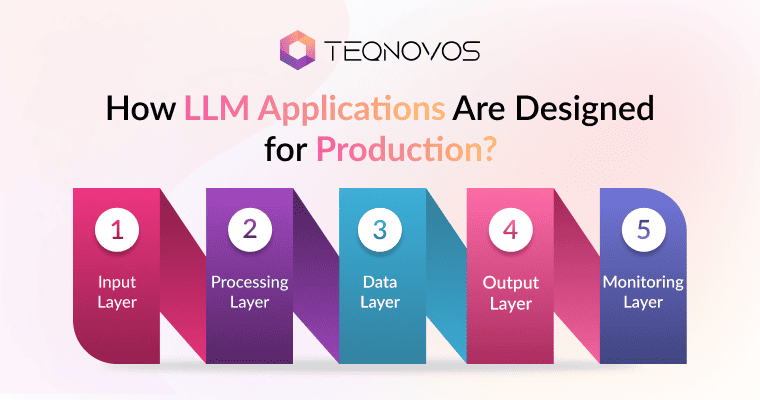
1. Input Layer
This layer handles user requests and system triggers. It prepares inputs before they reach the model. Clean input processing reduces errors and improves response quality. It also ensures that data follows a consistent format across the system.
2. Processing Layer
This layer uses chains and logic to process inputs. Chains define a sequence of steps that guide how the model generates outputs. This is where LangChain framework integration services bring structure into workflows. Each step follows a defined path, which improves consistency.
3. Data Layer
This layer connects the application with external and internal data sources. It retrieves relevant information during processing. Many systems use RAG to pull data from external sources before generating a response. This improves accuracy and keeps outputs relevant.
4. Output Layer
This layer delivers the final response to the user or system. It ensures that outputs follow defined formats and quality standards. Proper output handling improves user experience and reduces inconsistencies.
5. Monitoring Layer
This layer tracks system performance and behavior in real time. It helps teams identify issues and improve outputs. Monitoring ensures that the application continues to perform well as usage grows.
Build production-ready AI systems with trusted LangChain framework integration services. Let’s start.
Schedule a CallHow to Manage LLM-Powered Applications by the LangChain model?
Managing LLM applications is not only about system design. It is about controlling behavior in real environments. Teams need to ensure the system performs consistently across different use cases. This requires continuous control over output and performance.
1. Output Control
Teams must define how responses should look and behave. This includes tone and format accuracy. LangChain allows structured prompt control, which improves consistency. It reduces variation across similar queries.
2. Workflow Adjustments
Business needs change over time. Teams must update workflows without breaking the system. LangChain development services support flexible chain updates. This helps teams adapt quickly to new requirements.
3. Context Tuning
Applications must maintain relevant context across interactions. Teams need to adjust how much context is stored and used. Proper tuning improves response accuracy and avoids irrelevant outputs.
4. Error Handling
Real systems face unexpected inputs and failures. Teams must define how the system responds to such cases. LangChain helps manage fallback logic and error responses. This improves system reliability.
5. Performance Tracking
Teams need to track how the system performs over time. This includes response quality and usage patterns. Continuous tracking helps identify gaps and improve workflows.
6. System Updates
LLM applications require regular updates. Teams refine prompts and integrations based on performance. LangChain development supports iterative improvements without major disruptions.
Key Integration Components in LangChain Framework Integration Services
Managing LLM systems requires more than basic connections. Businesses need specific LangChain development components to support control accuracy and scalability. LangChain framework integration services focus on building these essential elements into the application.
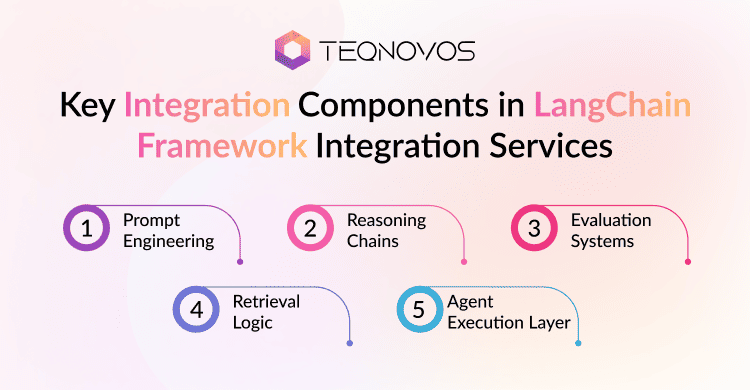
1. Prompt Engineering
Prompt engineering defines how the model receives instructions. It controls how queries are structured before processing. Well-designed prompts improve response accuracy and reduce variation. This ensures consistent outputs across different use cases.
2. Retrieval Logic
Many applications need access to external data. Retrieval systems fetch relevant information during processing. These systems support retrieval-augmented generation. The model uses external data before generating responses. This improves accuracy and keeps outputs aligned with real data.
3. Reasoning Chains
Reasoning chains guide how the system breaks down complex tasks. Instead of generating direct answers, the system follows a structured thinking process. This improves reliability in tasks that require multiple steps.
4. Agent Execution Layer
Agents allow the system to take actions based on user input. These actions may include triggering workflows or completing defined tasks. This moves the system beyond static responses into active execution.
5. Evaluation Systems
The systems measure how well the application performs. They track the quality of the response with its accuracy and consistency across queries. This helps teams identify weak areas and improve outputs over time.
Common Mistakes Businesses Make Without Integration Services
Many businesses launch LLM applications with basic setups and expect them to perform well in real environments. This approach often leads to unstable results and poor system control. These mistakes usually appear during scaling and long-term usage.
1. Unstructured Model Usage
Teams connect directly with models without defining clear workflows. The system generates responses without guidance. This creates unpredictable outputs and reduces reliability.
2. Over-Reliance on Prompts
Some applications depend only on prompt design to control responses. This limits system capability. Without structured logic, the model cannot handle complex tasks effectively.
3. Ignoring Context Control
Applications often fail to manage context properly. Context refers to the information used to understand user intent. Poor context handling leads to irrelevant or disconnected responses.
4. No Evaluation Setup
Many systems do not track performance after deployment. Teams cannot measure accuracy or consistency. This makes it difficult to improve the application over time.
5. Weak Error Handling
Real systems face unexpected inputs and edge cases. Without proper handling, the application may return incorrect or incomplete responses. This affects user trust.
6. Scaling Without Structure
Applications that work at a small scale often fail under higher demand. Without defined architecture and workflows, performance drops and errors increase.
Benefits of LangChain framework integration services for Enterprises
Enterprises focus on outcomes when they adopt Langchain development. LangChain framework integration services help achieve these results by turning experimental setups into reliable systems.
1. Improved Output Consistency
Enterprises need predictable responses across different scenarios. Structured workflows guide how the model generates outputs. This reduces variation and improves trust in the system.
2. Faster Iteration Cycles
Teams often need to refine prompts and workflows with integrations. A structured setup allows quick updates without breaking the system. This helps teams improve performance in less time.
3. Better System Control
Enterprises require full control over how applications behave. Integration services define clear logic for processing inputs and generating outputs. This ensures that the system follows business rules.
4. Scalable Performance
Applications must handle increasing demand without losing quality. A structured approach supports smooth scaling. Systems remain stable as usage grows.
5. Reduced Operational Risk
Uncontrolled systems can produce incorrect or inconsistent outputs. Integration services reduce this risk by adding structure and validation. This protects business operations and user experience.
6. Long-Term Maintainability
Enterprises need systems that evolve. Integration services create flexible architectures to support updates and improvements. This ensures longer reliability in businesses.
How to Choose the Right LangChain Framework Integration Services Partner
Choosing the right partner plays a key role in the success of LangChain development services. Businesses need more than basic development support. They need a team that understands real execution and longer system management.
1. Experience in LLM Systems
A strong partner should have proven experience in building and managing LLM applications. This ensures that the team understands real challenges and can deliver stable solutions.
2. Business Workflows
Every application must align with business needs. The right partner studies workflows and designs systems that support real operations. This improves adoption and long-term value.
3. Integration Expertise
LLM applications depend on multiple systems, such as databases and internal tools. A capable partner ensures smooth integration across all components. This creates a connected and efficient system.
4. Focus on Scalability
The partner should design systems that handle growth without performance issues. Scalable architecture supports increasing demand and ensures consistent performance.
5. Clear Approach
A structured development process ensures better execution. The partner should follow the defined steps for design integration testing and deployment. This reduces risks and improves delivery quality.
6. Post Deployment
LLM applications require continuous updates and improvements. A reliable partner provides ongoing support to refine workflows and improve performance over time.
Conclusion
Businesses are moving beyond experimentation with AI systems. They focus on building applications that deliver stable, consistent results in production environments. LLM-powered applications offer strong potential, but they require structured management to perform well over time. Without control systems, accuracy and reliability may degrade as they scale.
A clear integration approach helps solve these challenges. Many teams manage Langchain for LLM application development to bring structure into workflows and improve system behavior. This approach supports better control over outputs. It ensures the applications remain aligned with business needs. LangChain framework integration services enable this transition by creating stable and scalable systems.
Enterprises investing in LLM-based agents deliver long-term value to the business. They reduce operational risks and improve performance across use cases. This shift allows businesses to move from basic implementations to reliable AI systems to support growth and innovation.