
How to Build a Strategic Global Capability Center in India?
A GCC in India is no longer seen as a delivery unit alone. It plays a bigger role in business growth. Companies expect more than process support. They want stronger ownership with sharper decision-making and deeper business value.
A strategic GCC helps businesses move closer to product thinking and digital innovation to enhance enterprise impact. It supports long-term goals and not just daily execution. That is what makes this model more important today. The focus is no longer only on building a center in India. The focus is on building one that scales, leads, and contributes at a higher level.
Businesses still exploring the setup journey can first read how to set up a global capability center in India. This blog takes the next step. It explores how a GCC can grow into a smart and scalable business function with strategic impact.
What Makes a GCC Strategic?
A GCC becomes strategic when it takes on work to shape business outcomes and workflows. It moves closer to the core business and supports goals with stronger ownership. Teams add value through product thinking and focused execution. They help the business solve bigger problems and not just complete assigned tasks. This is where the GCC starts becoming a true growth driver.
- Owns business-critical functions
- Supports product and platform goals
- Adds value through better decisions
- Improves innovation and execution
- Contributes to long-term growth
How GCCs Assist in Creating Business Impact?
A GCC creates more value when it moves beyond assigned delivery. It starts contributing to outcomes that matter across the business. The focus shifts from task completion to business progress. This change shows maturity. It also shows that the center has earned a larger role.
1. Outcome Focus
A mature GCC does not work only against ticket volume or delivery speed. It starts aligning work with business goals. Teams support growth and efficiency to enhance customer value. This makes the center more relevant to leadership.
2. Product Support
The next shift happens when the GCC gets closer to product work. Teams support roadmap planning and platform improvement as per user needs. They do not stay limited to execution alone. They begin shaping what gets built and why it matters.
3. Business Alignment
Enterprise impact grows when the GCC works in step with the wider business. Teams understand priorities and respond with better judgment. They support functions that affect revenue operations and experience. This brings the center closer to business decisions.
4. Capability Growth
The role of the GCC expands as capability grows. Teams take on stronger ownership across engineering and data analytics. This shows trust in the enterprise program. It also shows that the center can handle more complex work with confidence.
5. Strategic Role
A GCC becomes more strategic when leaders rely on it for more than delivery support. It starts influencing direction through insight execution and problem-solving. That is when the center moves into enterprise impact. It becomes a driver of value and not just a support unit.
Launch a strategic global capability center in India and drive impact from day one.
Schedule a CallHow GCCs Build Smarter Operations?
A GCC becomes smarter when it improves how work flows across the business. It uses better systems for stronger data visibility and faster response models. This helps teams act with clarity and less friction. The goal is not only speed but to improve how decisions move and how work gets done. That is how an AI driven GCC in India starts creating stronger value.
1. Better Systems
Smarter operations begin with the right systems. Teams use connected tools to reduce gaps across functions. This creates smoother execution and stronger control across daily work.
2. Clear Insights
A smart GCC uses data to support faster action. Teams track patterns and spot issues early. This helps the business respond with better judgment.
3. Faster Workflows
Smarter operations remove slow manual steps. Teams simplify routine tasks and reduce delays in everyday processes. This improves consistency and saves time across functions.
4. Stronger Support
A GCC adds more value when it supports better operational choices. Teams give leaders the visibility they need to plan with more confidence. This shifts the GCC closer to business impact.
5. Smarter Growth
This is what makes the model stronger over time. A skilled and scalable GCC not only manages activity but also improves how the business runs through smarter operations.
How GCCs Build Deeper Capability?
A GCC becomes more valuable when it builds strong capability across functions. The focus shifts from basic execution to sharper business contribution. Teams grow through domain depth and stronger leadership. They begin to handle work that needs judgment and ownership. This is where it starts creating stronger GCC enterprise value.
1. Domain Depth
A skilled GCC understands the business it supports. Teams know the market, the product, and the customer context. This helps them solve problems with more accuracy. It also improves the quality of outcomes.
2. Cross-Functional Teams
Capability grows faster when teams work across roles and functions. Product engineering, data operations, and business teams learn to work in one flow. This improves coordination and reduces handoff gaps. It also makes the GCC useful to the wider business.
3. Leadership Strength
Strong capability needs strong leadership. Local leaders guide priorities to build trust and raise execution standards. They help teams move with clarity and better judgment. This makes the GCC more dependable over time.
4. Problem Solving
A skilled GCC does not wait for step-by-step direction. Teams learn to assess issues and ask better questions to solve problems with more ownership. This changes the center into a stronger business partner. It also supports better decisions across functions.
5. Capability Maturity
This is what makes the model stronger in the long run. A smart skilled scalable GCC is not built on headcount alone. It is built on deeper capability with stronger thinking and work that creates lasting value.
How GCCs Scale Without Losing Clarity?
The real goal is to widen business support without creating confusion. A clear model helps the GCC take on more responsibility while staying aligned with enterprise goals. This is what gives a scalable GCC model real strength.
1. Function Expansion
A GCC often starts with a narrow scope. Over time, it may take on product work data to support platform ownership or enterprise services. Each added function should solve a clear business need. This keeps the structure focused.
2. Role Clarity
As the GCC expands, each team should know what it owns. Clear roles reduce overlap and make decisions easier. They also help leaders manage performance with better visibility.
3. Common Methods
Larger teams need shared ways of working. Common review cycles operating rules and success measures keep the model steady. This helps new teams fit into the structure with less disruption.
4. Decision Flow
Scalability becomes harder when decisions slow down. A strong GCC keeps decision paths simple. Teams know when to act and when to escalate. This supports speed without losing control.
5. Controlled Expansion
A GCC should widen its scope in a measured way. New teams should come in when the business is ready to use them well. This keeps expansion practical and helps the center stay effective over time.
6. Scale With Purpose
A smart, skilled, scalable GCC does not expand for size alone. It expands where it can create stronger value. That is what helps the model stay clear and easier to manage.
Businesses still planning the budget for their GCC model can also read our blog on the cost to set up a GCC in India. Get a clear insight into the budget planning and how to use GCC for business growth.
Planning a strategic global capability center in India? Get expert support to build and scale from day one.
Schedule a CallHow GCCs Support Product Ownership?
A GCC becomes more valuable when it moves closer to the product. It starts supporting what gets built and how it creates value for users. This shift gives teams a larger role in business growth. It also helps the center move beyond support work into real ownership. That is where GCC product ownership starts becoming visible.
1. Roadmap Support
Product ownership begins with stronger involvement in planning. Teams support release goals and platform direction. They help shape what matters most and why it should move first. This brings the GCC closer to product decisions.
2. Platform Focus
A GCC adds more value when it helps manage core platforms. Teams improve system performance and reliability for long-term usability. They not only support delivery but helps the platform grow with the business.
3. User Thinking
Product ownership also needs a clear view of the user. Teams should understand user behavior and experience gaps. This helps them make better product choices. It also improves how the platform serves business goals.
4. Shared Decisions
Ownership grows when teams work closely with product and business leaders. They raise flag issues and support better tradeoffs. This creates stronger alignment across planning and execution. It also builds more trust in the GCC.
5. Product Mindset
A GCC creates more impact when it thinks like a product team and not only a delivery unit. Teams focus on outcomes and business value. This is how a strategic global capability center in India moves closer to enterprise impact through product ownership.
How Strategic Global Capability Center in India Lead AI and Innovation?
A GCC grows in value when it moves beyond support and starts leading change. This happens when the business gives it a real mandate for AI and innovation. The focus is no longer limited to delivery quality or speed. The center begins to improve workflows and create new ways of working. It becomes a place where teams solve business problems with sharper thinking and stronger technical depth. This is where a GCC starts acting like an innovation engine.
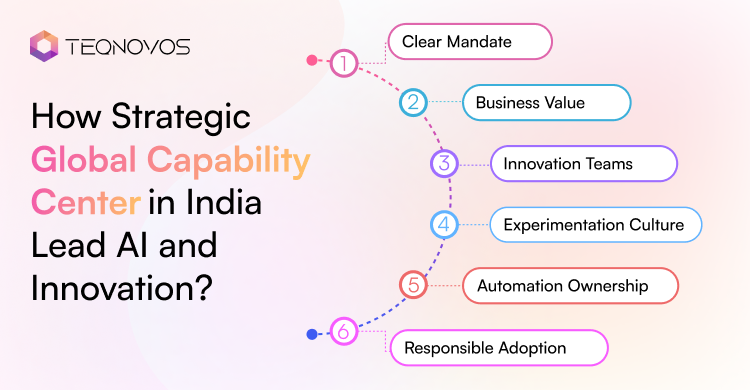
1. Clear Mandate
AI and innovation need clear ownership. Teams cannot create useful outcomes if they only respond to requests. They need space to build proofs of concept and improve how work happens across the business. A clear mandate gives the GCC the room to show leadership and trusts the center with work that shapes future growth.
2. Experimentation Culture
Strong GCCs do not wait for perfect conditions. They test small ideas and learn from real business needs. Some experiments improve internal workflows. Some support better customer experiences. Some uncover new product opportunities. This kind of work builds confidence across the business. It also helps the GCC become more active in solving bigger problems.
3. Automation Ownership
AI becomes more useful when the GCC owns practical automation. Teams reduce manual steps to improve reporting and speed up repetitive decisions. AI helps make work cleaner and more efficient. An AI-driven GCC in India creates value by turning everyday friction into measurable improvement.
4. Business Value
Innovation matters most when it creates business value. A GCC supports this by building tools to improve platforms and finding better ways to use data. It also helps the business discover new service ideas or improve internal capability. This shifts the center closer to revenue impact and enterprise progress. That is how a GCC innovation engine starts taking shape inside the business.
5. Innovation Teams
Many businesses expect GCCs to support focused innovation work. This may include AI teams with automation specialists, data experts, or platform thinkers. They connect with product operations and leadership to turn ideas into usable outcomes. This gives the GCC a stronger role in long-term business change.
6. Responsible Adoption
AI and innovation should follow clear goals and a business context. Teams need to know where to experiment and where to stay careful. This helps the GCC avoid noise and focus on work that brings real improvement. It also makes innovation easier to scale.
How Does this Looks In Real-Life?
- Teams test real business use cases
- Automation improves daily operations
- AI supports faster internal decisions
- Innovation teams work across functions
- New tools solve recurring business problems
- ideas move from pilots to usable outcomes
When a GCC leads AI and innovation, it stops being seen as a support layer. It becomes a center for progress and new value creation. That role gives it a stronger place inside the business and a clearer path to long-term impact.
Building Centers of Excellence Inside the GCC
A Global Capability Center becomes stronger when it builds focused capability hubs inside the larger model. These hubs are called Centers of Excellence. A CoE gives the business skills in one area and helps the GCC create sharper value across functions. It also shows the center is growing beyond broad support into focused expertise.
- Builds deep expertise in areas like AI, cloud data, or cybersecurity
- Creates stronger standards for quality methods and execution
- Helps teams solve complex business problems with more clarity
- Supports faster innovation through focused experimentation
- Expands the GCC role across more business functions
- Turns specialized knowledge into long-term business value
A CoE turns GCC into a more focused and capable organization. It turns their skills into a structured business value. This is why many growing companies are building CoEs as part of their long-term model.
Why Leadership Matters in GCC Growth?
A GCC grows faster when leadership is clear and trusted. Strong leaders do more than manage delivery. They guide to build confidence and connect local teams with business goals. This is what helps the center move into a bigger role across the enterprise.
1. Clear Direction
A GCC needs leaders who set the right direction early. They help teams stay focused on the work that matters most. This reduces confusion and keeps the center aligned with business priorities.
2. Decision Power
Leadership becomes stronger when decision-making does not stay blocked at the top. Local leaders should have enough authority to move work forward. This helps the GCC respond faster and work with more confidence.
3. Business Trust
A GCC creates more value when the wider business trusts its leadership. That trust grows when leaders show ownership and follow a plan for steady execution. It also helps the center take on more important work over time.
4. Team Growth
Strong leaders help teams grow in the right way. They build the capability to raise standards and support better problem-solving. This creates a stronger base for long-term progress.
5. Cross-Border Alignment
A GCC works better when local leadership stays connected with global teams. Leaders help bridge expectations across regions and functions. This keeps the center aligned without slowing down the work.
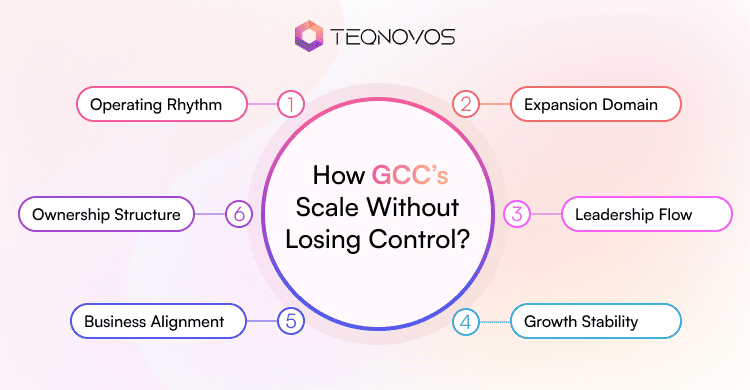
How GCCs Scale Without Losing Control?
Growth works best when the GCC expands with clarity. A larger team does not always create better outcomes. Real scale comes from a model that can grow without losing pace or business fit. This is what makes the GCC more dependable across the business.
1. Operating Rhythm
A growing GCC needs a steady way of working. Teams should know how priorities move and how progress is reviewed. This keeps execution stable as the scope becomes wider. It also helps leaders spot issues early.
2. Ownership Structure
Scale becomes harder when ownership stays vague. Each team should know what it owns and where its role begins or ends. Clear ownership reduces overlap and prevents decision gaps. This helps the GCC grow with less friction.
3. Business Alignment
A GCC should stay close to business priorities as it expands. Teams need to understand what matters most and why it matters now. This keeps growth tied to real business needs. It also helps the center stay relevant as the model becomes larger.
4. Expansion Domain
A GCC should not widen its scope too fast. New functions should come in only when the existing structure can support them well. This creates a more stable path to scale. It also supports a stronger, scalable GCC model over time.
5. Leadership Flow
Control weakens when decisions move too slowly. A growing GCC needs leaders who guide work at the right level. They should remove blockers to support teams and keep direction clear. This helps the center move forward with enthusiasm.
6. Shared Accountability
Scalability works better when teams stay accountable for outcomes and not just activity. Each function should understand what success looks like. This keeps effort tied to value and not only output. That is what helps the GCC create a stronger business impact.
7. Growth Stability
A GCC keeps control when growth is shaped with intent. Strong rhythm with clear ownership keeps business alignment and measured expansion. This is how the center grows without losing clarity and without drifting away from enterprise value.
Conclusion
A strategic global capability center in India delivers more than operational support. It helps the business build stronger ownership with sharper execution and wider enterprise value. It provides real strength by supporting product thinking with AI-led progress and focused innovation.
This helps GCC to become an asset to drive business growth by improving decisions and supporting scalable transformation. Connect with Teqnovos for Offshore captive center services and learn how we can help streamline your operations. Book a call with us today!