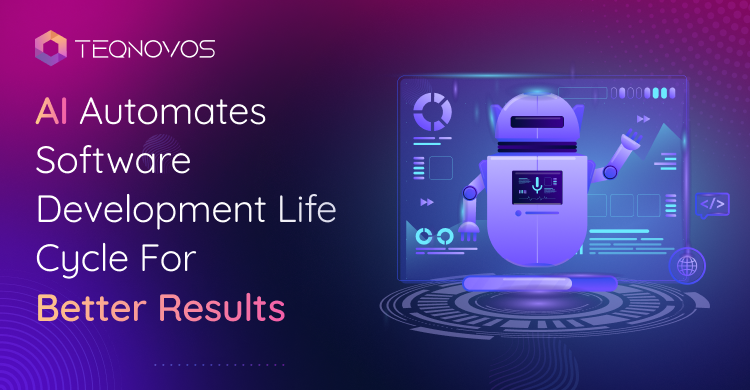
AI Automates Software Development Life Cycle For Better Results
Over the years, the software development life cycle has been a major strength. It has the potential to help teams direct through the long development cycle. But with the economy evolving so quickly, the old SDLC approach is no longer enough
The manual process of developing and debugging is slowing down velocity and innovation. The new era defines rapid development, real-time collaboration, and evolving user needs. This is no longer just an approach to follow. Development must become innovative, adaptive, and automated.
Ever wondered how to achieve this without cutting corners? That’s where AI software development services help companies move faster and smarter.
AI is powering every phase of development and accelerating it like never before. It speeds planning, design, testing, coding, and deployment. Get smarter automation, cleaner code, and quick delivery.
This blog guides on how AI-driven software automates life cycles. We will discuss how it boosts productivity and quality. Let’s get into this further to see the future of faster and keener software development.
What is AI-Driven Software Development?
Businesses are approaching AI-driven software development to build apps and systems. These systems use artificial intelligence software development services to execute various tasks. Usually, these tasks require human intelligence to continue. These tasks include knowledge of natural language, automating complex decisions, and others.
These systems learn from codebases and past development projects. This helps them adapt to the developer’s style and background. Generative AI in the software development life cycle helps with various functions. The AI code assistant can write functions and complete code syntax. It can even help draft complete modules.
The testing tools can produce test cases and detect patterns. But – deployment tools can help track apps in real time. They could help fix issues before they intensify.
The goal is to reduce tedious work and enhance the executive process. Developers can focus on building the structure while AI handles time-consuming tasks. The result is faster project cycles with quality software and improved team productivity.
How AI Integrates Into the Software Development Life Cycle
AI is transforming almost every step of the SDLC. It reduces user efforts and accelerates the transformation cycle. Here is how it improves accuracy and fits into each phase.
Requirements Gathering and Analysis
AI-powered tools use natural language processing. This helps analyze customer feedback, market data, and project records. Thus, they can identify patterns, prioritize features, and predict the potential risks.
Design
AI software development services assist in creating wireframes and prototypes. It also helps with system architecture suggestions. It further analyzes the previous designs and recommends optimal layouts with performance improvements.
Development
With AI, companies can create functions, generate full code, and detect errors in real time. They adapt to developers’ style and work . Automating repetitive tasks and suggesting more efficient solutions.
Testing
Artificial intelligence software development services automate test cases. They help find bugs, enhance test efficiency, and ensure software quality. It can examine the code coverage in the development cycle. It could also help provide insights for comprehensive code testing. Even with constant changes in testing, self-healing scripts maintain stable, updated code.
Let AI Drive Your Software Projects — Connect with Our Development Team!
Schedule a CallDeployment
AI can optimize CI/CD pipelines. It can predict launching issues and support rolling back in case of failure. It ensures a smooth launch of the application with nominal downtime.
Maintenance and Monitoring
Planning in the software development life cycle helps keep a trail of the project. Monitor the app performance, detect anomalies, and trigger proactive fixes before. They also provide insights for future updates.
Project Management
By forecasting timelines and balancing resources, AI project tools adapt schedules. This helps teams stay aligned and cost-efficient.
How Does AI Increase Developer Productivity?
Artificial intelligence is becoming a core part of the software development life cycle. It goes on to become the ultimate code partner to modern web developers. It helps streamline tasks and minimize errors. Thus, it provides businesses with the time to innovate. Here is how it boosts project productivity.
1. Faster Code Writing
AI code assistants suggest snippets, complete functions, and flag issues instantly. This helps developers move from concept to execution quickly.
2. Smarter Debugging
The AI development life cycle services identify bugs in the code. They highlight the root cause and suggest fixes in real time. This helps end the long debugging cycle. Thus, the project development cycle keeps moving.
3. Automated Repetitive Tasks
Creating boilerplate codes and setting up project ecosystems, AI handles the tiresome work. Thus, developers could focus on building features more essential to the app.
4. Improved Collaboration
Artificial intelligence helps improve collaboration with the team. They organize documents, track progress, and align communication. Thus, making it easier for teams to stay updated.
5. Continuous Learning
The AI-driven software development life cycle adapts to changes from previous projects. The more it learns, the better it adapts to a developer’s style.
Benefits Of AI In Software Development
Let’s discuss some of the major advantages of AI in software development. And how it is helping businesses to expand and achieve their goals.
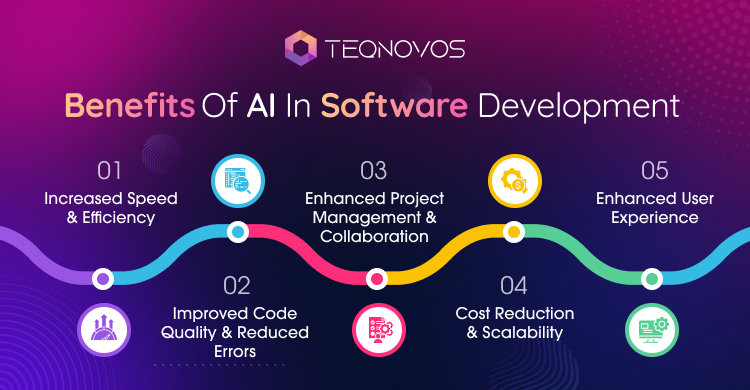
1. Increased Speed and Efficiency
Automated repetitive tasks
AI handles boilerplate code, refactoring, documentation, dependency updates, and environment setup. It creates scripts, scaffolds modules, and fills routine templates. Teams save hours and avoid context switching.
Faster development cycles
Generative AI in the software development life cycle speeds coding with instant suggestions and context-aware completions. It shortens reviews by proposing changes and test updates. Feedback arrives in real time, so features move from idea to release sooner.
Streamlined workflows
When repositories, ticketing, CI/CD, and chat are linked, workflows move effortlessly across tools. AI automates handoffs, opens pull requests, links issues, tags reviewers, and triggers pipelines.
2. Improved Code Quality and Reduced Errors
Code analysis and bug detection
AI can scan code for errors and security issues. It understands patterns across the codebase and flags root causes with examples. Developers fix issues earlier and with more confidence.
Enhanced testing and QA
Generate unit, integration, and UI tests. It executes visual checks and self-healing tests that are modified when the UI changes. Coverage improves without slowing delivery.
Reduced manual effort
Engineers focus on design and logic while repetitive tasks run automatically. Thus, it’s get easy to outline reviews, upgrade configs, and triage failures with AI services.
3. Enhanced Project Management and Collaboration
Data-driven decision making
AI gathers and optimizes information from commits, builds, incidents, and customer interactions. It surfaces trends, cycle time, and quality metrics. Developers select the right scope and sequence.
Improved collaboration
AI software development services summarize specs, threads, and pull requests. It clarifies next steps, translates across languages, and maintains shared context. Teams align faster with fewer meetings.
Predictive analytics
It could help forecast delays, risk areas, and capacity gaps. It estimates effort from historical work and alerts on likely bottlenecks. Plans adjust before issues escalate.
4. Cost Reduction and Scalability
Reduced development costs
Automation cuts labor on routine tasks and lowers the need to redo tasks due to late defects. Fewer production issues reduce support and downtime costs. Budgets stretch further once manual labor and costly rework are minimized.
Optimized resource allocation
Matches tasks to skills and availability. It balances workloads and recommends pairing or swarming when risk is high. The right people work on the highest-impact items.
Better scalability
AI models demand and suggest performance and capacity changes. It runs load tests, tunes queries, and recommends architecture improvements. Systems scale smoothly as usage grows.
5. Enhanced User Experience
Personalized user experiences
Get tailored content, search, and recommendations for each user. It adapts flows based on behavior and context. Resulting in improved user engagement and retention.
See How AI Can Boost Your SDLC — Get Started Today!
Schedule a CallImproved accessibility
AI generates captions and alt text. It checks contrast and keyboard paths, and flags layout barriers. Products become usable for more people by default.
Better UI/UX design
It studies behavior, heatmaps, and feedback to propose layout and copy changes. It enforces design system rules and spots conflicts in the design. Interfaces feel clear, fast, and consistent.
Tools and Platforms Driving AI in Development
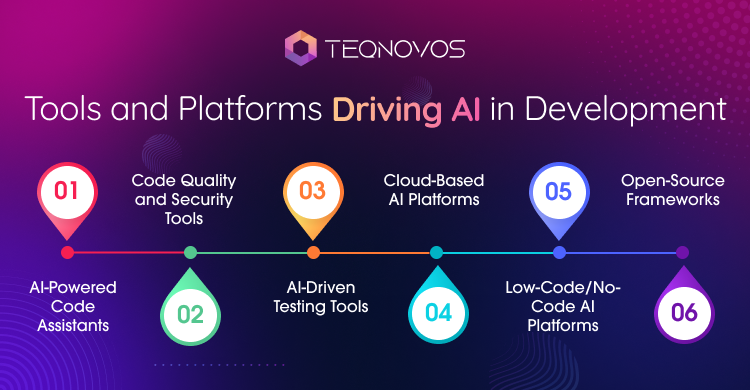
AI-Powered Code Assistants
AI software development services offer tools to help developers. With AI tools, they can write code faster with wise suggestions. Auto-complete the code and even generate full functions.
They understand the programming languages from the project context and adapt the style. There are different tools available, such as Tabnine, that reduce syntax errors.
Code Quality and Security Tools
AI tools scan code in real-time to help detect bugs and execution bottlenecks within the code. They go beyond basic analysis with deeper logic flaws and potential vulnerability risks. Platforms like DeepCode ensure safer and more maintainable code with fewer code reviews.
AI-Driven Testing Tools
These tools automate test case generation, execution, and maintenance. They can run regression tests, perform visual validation, and adapt to UI changes. TestSigma uses machine learning for accuracy, reduces false positives, and speeds up cycles.
Cloud-Based AI Platforms
AI services from cloud providers plug directly into development workflows. Platforms like Azure Cognitive Services provide similar cloud services. They provide APIs for NLP, image recognition, speech processing, and predictive analytics. Thus, it becomes easy to add advanced AI abilities without building new models.
Low-Code/No-Code AI Platforms
Mapping AI in the software development life cycle empowers non-technical users. They can build AI-driven apps with minimal coding. Tools such as Mendix use visual interfaces and pre-built AI components, reducing dependency on large development teams. Learn more about how low-code/no-code platforms combined with AI are shaping the future of software development here.
Open-Source Frameworks
Popular AI frameworks like PyTorch help engineers to build tailored models. These frameworks bring flexibility, active community backing, and ongoing innovation. Thus, they become the perfect option to build complicated models.
Conclusion
AI in software development services has moved beyond theory into everyday practice. These services are actively transforming every stage and every industry. Automating tasks, solving code issues, and speeding up the delivery.
The benefits go beyond efficiency. AI-driven tools enhance collaboration and reduce costs. As its adoption continues, the role of developers evolves. The next wave of innovation is here, and AI is set to work with it.
Join Teqnovos to get into this trend of AI-driven solutions. Connect with us today!