AI-Driven Phishing: Emerging Risks and How To Stay Protected?
Phishing was easy to spot. It displayed some classic red flags, such as awkward wording and tempting emails. In many cases, attackers produced emails with poor tone or grammar.
However, the generative AI development has completely changed the game. With advanced AI tools, these threats have become more dangerous. Now, attackers generate messages in a natural voice within seconds.
Looking to copy someone’s writing style? Simple. Need to write a personalized email with data available publicly? Done in seconds.
And if you’ve ever thought, “I’d never fall for that,” think again. This statement would be true if AI had not entered the picture.
In this blog, we’ll break down what’s actually happening behind the scenes. Also, consider the emerging threats most organizations are not yet prepared for. Let’s see some practical steps users take to stay protected from this threat.
Think of this as a guide to the new era of phishing. Same goal, different weapon. And the stakes have never been higher.
Let’s dive in to know more!
What Is Generative AI and Why Is It Being Used in Phishing?
Generative AI
It is a type of machine-learning system that generates new content, including text messages, related images, or any data-related codes, based on the patterns learned from datasets. Generative AI solutions help with next-level innovation by increasing efficiency.
However, cybercriminals use the same tools to create misleading information. Earlier, phishing relied on hackers to write and generate messages; now, artificial intelligence has made things more convenient.
How Does AI Work in Cybercrime?
Modern phishing campaigns often rely on LLMs to generate messages that seem human. A cybercriminal feeds the model a few details, and the model produces tailored messages that mimic the tone.
This is how attackers use AI in phishing attacks. They draft email variants, fake websites, and counterfeit audios to trap users.
Why Is AI-Enhanced Phishing Hard to Detect?
AI-generated phishing messages are typically polished and error-free. It is a more accurate and personalized scam than in the past. This makes instinctive red-flag detection far less reliable.
Some key challenges include:
- Fewer Language Issues: AI produces native-sounding language that doesn’t trigger suspicion.
- Tailored Messages: Fake-drafted emails appear personalized as AI utilizes publicly available data.
- Mass Variation: Attackers generate numerous unique email versions. This fails the previously used traditional pattern recognition detection methods.
- Rapid Change: Just in case a phishing email gets blocked, AI instantly rewrites to get it unblocked.
Even experienced users may struggle to distinguish legitimate emails from AI-generated ones.
Real-World Examples of AI-Driven Phishing
There are already use cases showcasing how AI is used in phishing attacks. They significantly increase the credibility and impact of attacks:
- Voice Scams: Criminals use AI to generate audio to imitate someone. They tricked people into urgent money transfers.
- AI E-mails: Hackers crafted perfect messages to request payments and access private information.
- Fake Support Chats: AI chatbots mimic customer support channels to deceive users. They convince victims to share credentials or financial information.
- Spear-Phishing Campaigns: Attackers combine leaked information with AI. Using this, they craft emails that look like standard internal communication.
Generative AI does not change the goals of phishing, but it increases the speed and scale of attacks. For defenders, this means being more aware and investing in advanced tools.
How Does AI Enhance Phishing Attacks?
Artificial Intelligence has changed phishing from obvious scams into polished attacks that feel real. By automating writing and voice synthesis, cybercriminals craft messages and user experiences that closely resemble legitimate communication.
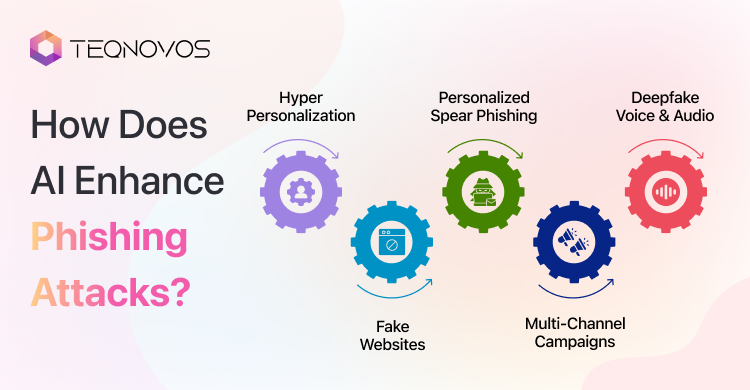
- Hyper-Personalization: LLMs instantly create emails that match natural writing patterns and professional tone. This removes many of the traditional red flags users rely on to spot phishing attempts.
- Personalized Spear Phishing: Attackers feed public data into AI tools. They craft a tailored message that references real details about the target. These small human touches make things compelling and difficult to detect.
- Deepfake Voice & Audio: Cloning tools allow attackers to mimic audio with accuracy. These fake calls push urgency, making people act without verifying.
- Fake Websites: Generative AI creates professional phishing pages that resemble real login portals. These sites appear credible but steal data through deception.
- Multi-Channel Campaigns: It enables attackers to coordinate emails and social media outreach at scale. This multi-touch approach increases the chances of catching a victim off guard.
Because of this, organizations need stronger practices to defend themselves against these attacks. They must understand how to identify AI-generated phishing emails and deepfake calls.
New & Emerging AI-Driven Phishing Threats
Generative AI introduced new forms of phishing that move faster and adapt easily. These threats shift tactics in real time and blend into normal digital activity.
1. AI Domain Squatting & Website Cloning
Attackers now use AI to generate duplicate domains and clone websites within minutes. These sites include realistic texts and layouts that make it difficult to identify the real one.
2. Prompt Injection for Malicious Content
Criminals manipulate prompt injection to push AI models into generating malicious content. This lets them create persuasive phishing messages and instructions. Normally, such messages get blocked.
3. Autonomous Agent-Based Phishing Bots
AI agents run phishing campaigns without human oversight. They send messages and follow up to make the user believe it’s a real deal. They usually adjust wording and continue to work until blocked.
4. AI-Powered Conversation Hijacking on Social Media
Scammers use generative AI for phishing to join social conversations and mimic user behavior. They reply with natural language to build trust and insert malicious links at the right moment.
5. Real-Time Polymorphic Phishing Scripts
LLMs can rewrite phishing messages in real time. Each version appears different, which helps attackers bypass filters that rely on pattern recognition.
Strengthen your security with advanced AI-driven protection. Get expert solutions from Teqnovos today!
Schedule a CallHow Does AI Amplify Social Engineering Risks?
AI has expanded the reach and impact of social engineering by enabling fraudulent interactions. Attackers now use data and automation to craft messages that strike the right emotional tone and appear trustworthy.
1. Large-Scale Personalization Using Public Data
AI tools scan social profiles through websites and scan public records in seconds. Attackers use this information for social engineering AI attacks. This level of personalization makes scams feel relevant and lowers a victim’s guard.
2. Hyper-Realistic Fake Personas & Chatbots
Cybercriminals now create lifelike online personas with AI-generated photos and posting patterns. These people use AI for personalized phishing to hold conversations with chatbots. They use messages to target different platforms and build trust before delivering a malicious link.
3. Emotional Manipulation Through Data-Driven Messaging
AI social engineering attacks analyze language patterns. They have a better understanding of what themes or emotions influence a target. Attackers use this insight to craft messages to evoke urgency. Short, well-tailored prompts like “fake support alerts” trigger quick action without verification.
How To Defend Against AI-Driven Phishing Attacks?
Phishing detection using AI requires stronger defenses that focus on verification and testing. A layered approach gives organizations the best chance to detect and stop attacks.
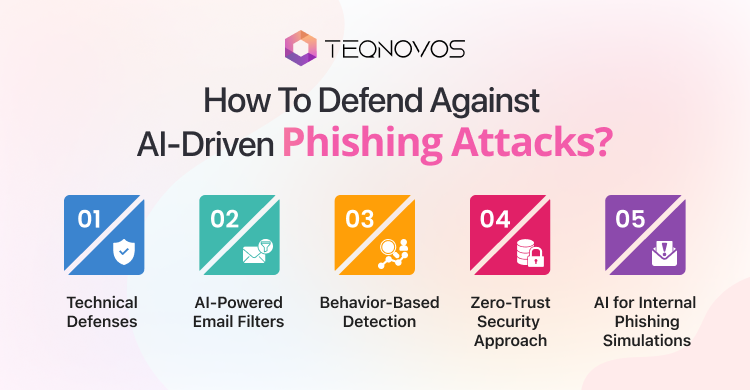
1. Technical Defenses
Email authentication standards remain essential. SPF and DMARC help verify sending domains and reduce spoofing attempts. While they don’t stop every message, AI-powered email security helps eliminate many sources of fraud.
2. AI-Powered Email Filters
Modern AI threat intelligence tools use machine learning to analyze tone and behavior. They spot subtle patterns that traditional filters miss when AI-generated messages appear professional.
3. Behavior-Based Detection
Attackers often behave differently from actual users. To identify this, keep an eye on unusual login locations and odd file access patterns. A sudden spike in communications helps flag compromised accounts. These signals are critical when phishing emails appear legal.
4. Zero-Trust Security Approach
This model assumes that no message or user is trustworthy by default. It requires continuous verification and limits access to only what each user demands. This reduces the impact of a successful attack.
5. AI for Internal Phishing Simulations
Organizations need to learn how to identify AI-generated phishing emails. They can use AI to craft realistic training scenarios. These imitations help businesses recognize modern threats and adapt to more sophisticated attacks.
How To Use AI As A Security Tool?
AI also provides the best tools to detect AI-generated phishing. Using modern defense strategies helps teams to keep pace with the attacks. When used right, it strengthens detection and uncovers threats that may have been missed previously.
1. AI for Real-Time Threat Intelligence
AI processes vast amounts of data in seconds. It identifies emerging phishing domains and detects new malware patterns as they unfold. This provides defenders with earlier warnings and a clearer picture of active risks.
2. Predictive Detection of AI-Generated Threats
Machine learning models identify AI-powered emails or any fraudulent messages generated by an automated system. They analyze writing style and sender behavior to predict suspicious activity.
3. Watermarking & Detection of Synthetic Content
Researchers are developing methods to watermark AI-generated text or images at the point of creation. Detection tools can then scan for these hidden markers. Although the technique is still evolving, it promises a perfect way to verify the authenticity of the content.
4. Large Language Models
Security teams use AI threat intelligence tools like LLMs. They help classify messages and interpret subtle cues that traditional filters overlook. These models evaluate email tone or context mismatches to help identify misleading communication.
Don’t wait for a breach—secure your business now. Talk to our AI security specialists and stay protected.
Schedule a CallHuman-Focused Defense Measures
Technology alone can’t stop AI-powered phishing. Human awareness remains a critical line of defense, and understanding is essential. AI-powered email security strategies help recognize deceptive signals and question unexpected requests.
1. AI-Driven Employee Phishing Awareness Training
Modern tools use AI to create realistic simulations that match current trends. Employees receive practice with emails and scenarios that mirror real AI-crafted threats. They help users build practical instincts instead of relying on outdated cues.
2. Security Culture Building in Organizations
A strong security culture encourages employees to speak up. Leaders should reinforce simple habits: double-checking urgent requests and using approved communication. These small changes help employees become aware of attacks. When they feel supported, they respond more responsibly to threats. It could be included as part of the employee cybersecurity training.
3. Identifying Red Flags in AI-Generated Email
Even polished AI-generated emails leave clues. Employees should watch for tone shifts and vague sender details. Cross-checking the request through another channel is a way to avoid deception.
Find out how to hire the right generative AI developers for your business. Read this blog!
Future of AI Generation in Phishing & Cybersecurity
The future of AI in cybersecurity will bring faster defenses and smarter attacks. But with the hackers evolving will also use AI to create threats. Mails and messages that feel more personal. These attacks may appear across email and social platforms with little warning.
However, security teams will fight back with stronger AI models and better monitoring. To learn how to stop AI-generated phishing attacks, organizations must use layered defenses.
Simple habits like checking the sender and slowing down remain powerful. The future requires continuous awareness and rapid response.
Conclusion
AI has transformed phishing into a fast and highly convincing threat. Defenders now face attacks that look real and evolve in seconds. The path forward is clear: stronger security tools. Businesses combining human awareness with modern AI defenses will stay ahead of these risks.
If you want to protect your business against AI-driven threats, Teqnovos can help. Our generative AI solutions for next-level innovation equip the team with the necessary skills.
Reach out to Teqnovos today to strengthen your defenses with our generative AI development solutions. Visit our website today to learn more!