AI Powered Voice Assistant Development For FinTech: Complete Guide
Fintech is going through a deep digital revolution, driven by artificial intelligence. Until recently, AI was considered a future experiment in traditional banking. Well, this has changed since 2024, the year AI stopped being just a side project and became an essential engine for digital banking.
More than seventy percent of financial institutions now invest in artificial intelligence to improve customer experience and operational efficiency. Customers expect instant support and secure access to services at any time. Traditional systems struggle to meet these rising expectations.
AI voice assistants for fintech address this gap by delivering intelligent voice-driven interactions. Financial institutions adopt these solutions to reduce service costs and enhance banking automation at scale.
What Are AI Voice Assistants for Fintech?
These are intelligent voice-driven systems to automate financial interactions through natural conversations.Innovative AI solutions for call center automation in fintech assist in understanding spoken requests and responding in real time.
AI voice assistants interpret intent through context and respond with dynamic answers based on the request. This makes interactions faster and more personalized. Unlike traditional interactive voice response, AI voice assistants do not rely on rigid menu paths.
These systems are powered by:
- Natural language processing to enable understanding of the user intent.
- Machine learning assists businesses in improving accuracy through data learning.
- Automatic speech recognition helps convert spoken input into understandable text.
Financial organizations use voice AI to:
- Verify user identity securely
- Retrieve account and transaction details
- Guide customers through service requests
- Escalate complex issues to human agents
The main goal is not just to provide convenient services but to offer secure and scalable banking automations. These technologies work to power faster interactions and more personalized experiences.
Upgrade your fintech support with AI voice automation. Deploy intelligent voice assistants today.
Schedule a CallWorking Model of AI Voice Agent Development for Fintech
These voice assistants function as secure transaction engines. They analyze speech to validate the identity and execute financial workflows. These systems combine intelligence with strict operational controls to support banking AI solutions at scale.
1. Secure User Authentication
Every interaction begins with identity verification. Financial systems require strong access control before exposing sensitive data. Security layers activate immediately after voice input.
- Voice biometrics recognition
- One-time password validation
- Registered device verification
- Knowledge-based identity prompts
2. Intelligent Intent Processing
After authentication, the assistant interprets the spoken request. ASR converts speech into structured input. NLP analyzes meaning and maps the request to a defined workflow.
- Balance inquiries
- Transaction history retrieval
- Card management requests
- Loan or credit status checks
3. Controlled Transaction Execution
Advanced voice AI solutions for fintech move beyond answering queries. They execute approved financial actions within secure boundaries. Every action follows predefined compliance rules.
- Fund transfers between accounts
- Bill payment scheduling
- Dispute submission logging
- Loan application updates
4. System Integration Layer
Voice AI operates through secure integration with financial infrastructure. Real-time connectivity ensures accurate data exchange and process continuity.
- Core banking systems
- Payment gateways
- CRM platforms
- Fraud detection engines
5. Governance Controls
Financial automation requires strict oversight. Every workflow aligns with policy and regulatory standards. Transparent tracking ensures accountability.
- Transaction value limits
- Role-based access permissions
- Real-time risk monitoring
- Automated compliance logging
6. Learning and Optimization
Performance improves through structured data feedback. ML refines intent recognition and response precision over time. Monitoring ensures consistent system accuracy.
- Intent accuracy improvement
- Response time reduction
- Containment rate growth
- Risk detection enhancement
Core Technologies Powering AI Voice Assistants Development for Fintech
This depends on a combination of intelligent systems and secure infrastructure. These technologies work together to deliver accurate conversations and reliable transactions. Each layer of AI voice assistant development for FinTech supports performance and scalability.
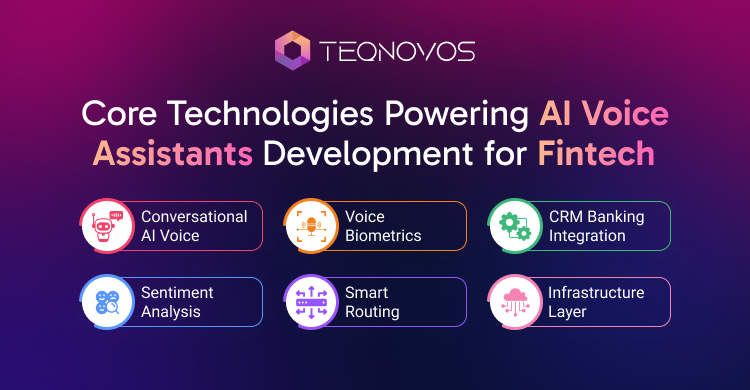
1. Conversational AI Voice
Enables natural human-like interaction through the system that understands the context and intent of the financial terminology. It creates fluid dialogue instead of scripted responses.
- Intent detection models
- Context retention memory
- Financial domain training datasets
- Response generation frameworks
2. Voice Biometrics
Security remains central to financial automation. Voice biometrics analyzes unique speech patterns to verify identity. Fraud detection models monitor anomalies during interactions.
- Voice pattern recognition
- Behavioral risk analysis
- Real-time anomaly detection
- Transaction risk scoring
3. CRM Banking Integration
Voice AI systems must connect directly with financial infrastructure. Real-time integration enables accurate data retrieval and transaction execution. Secure API connections maintain system consistency.
- Core banking data access
- CRM synchronization
- Payment processing gateways
- Account management platforms
4. Sentiment Analysis
Detect the emotional tone of the customer during normal discussions to detect the depth of conversation. The system identifies frustration or urgency. This allows adaptive responses or escalation.
- Tone classification models
- Emotional intensity scoring
- Customer satisfaction indicators
- Escalation trigger detection
5. Smart Routing
Complex financial cases require intelligent routing. AI-driven routing assigns interactions based on intent risk level and customer profile. This reduces transfer delays.
- Skill agent mapping
- Queuing based on priority
- Risk-sensitive case routing
- Automated context transfer
6. Infrastructure Layer
Behind the intelligence layer stands a secure infrastructure. The stability and performance depend on the technical infrastructure. It ensures reliability across high-volume financial interactions.
- Secure API integration framework
- End-to-end data encryption
- Cloud deployment architecture
- Scalable processing environments
Strengthen fintech customer engagement with voice AI. Implement secure AI voice solutions.
Schedule a CallMeasurable Business Impact of Voice AI Solutions for FinTech
Financial institutions invest in automation to improve reliable outcomes. AI voice assistant development for fintech delivers impact across operational efficiency and cost control. Industry benchmarks show consistent performance gains when implementation follows structured and integration standards.
1. Handle Time Reduction
Average handle time remains a critical performance indicator in financial support operations. Voice AI solutions for banking reduce the time required to authenticate users and retrieve account data. Automated intent recognition removes repetitive questioning. Real-time system integration enables faster execution of approved tasks.
2. Resolution Improvement
This measures the percentage of cases solved during the initial interaction. Voice AI solutions for fintech improve this metric by delivering contextual responses based on user history and intent. Intelligent routing prevents unnecessary transfers. Higher resolution rates reduce customer frustration and operational backlog.
3. Containment Growth
Interactions are resolved without any human intervention. Advanced AI systems process routine financial queries and approved transactions autonomously. This increases automation coverage in banking. These results depend on the workflow design of the model, analyzing the data quality and security configuration.
4. Cost Optimization
Operational expenses rise with staffing demand and manual processing. Innovative AI solutions for banking automation reduce dependency on live agents for repetitive tasks. Intelligent escalation ensures agents focus on complex cases. Savings emerge through lower handling time and improved containment, leading to workforce optimization.
5. Continuous Availability
Customer expectations extend beyond standard working hours. Voice AI systems operate continuously without performance degradation. Real authentication and secure processing allow uninterrupted service. Continuous availability strengthens brand trust. It also reduces peak-hour pressure on human support teams.
AI Solutions for Call Center Automation in Fintech
Call centers remain central to financial service delivery. Innovative AI solutions for banking automation help them improve efficiency while maintaining regulatory control and service quality.
Demand Stabilization
Interaction volumes continue to fluctuate on a daily basis. Salary cycles and security alerts create traffic spikes. Automation absorbs predictable demand patterns before they reach human queues. This prevents sudden workforce strain. Service stability improves during both peak and low periods.
Interaction Standardization
Human responses and interpretations vary across agents. Innovative AI solutions for banking automation introduce consistent handling logic for repetitive financial queries. Standardized flows ensure identity checks follow uniform steps and policies, and aligned responses remain consistent. This reduces the risk of variation in the responses.
Queue Compression
Manual processing creates layered waiting time. Manual data authentication and data lookup consume a lot of time. Repetitive explanations slow down the conversation. Automation compresses this into structured sequences, leading to short cycles. Support capacity expands without increasing physical staff.
Workforce Reallocation
Not all financial queries require human judgment to start with. Automation handles predictable transactional flows well. Agents transition toward advisory and complex resolution roles. This redistribution increases skillfulness utilization. Staff focus shifts from repetition to value-driven engagement.
Service Continuity
Unexpected events disrupt staffing levels. Holidays, due to illness or sudden change of volume surges, reduce availability. Automated systems maintain baseline support regardless of staffing variation. Continuity strengthens customer confidence and improves operational resilience.
Supervisory Oversight
Manual supervision requires random sampling of calls. Automation creates structured visibility across every interaction. Supervisors review authentication accuracy, leading to escalation triggers and compliance checkpoints through centralized dashboards. Oversight becomes proactive rather than reactive.
Process Discipline
Financial environments require strict workflow discipline. Automation enforces defined execution paths. Unauthorized shortcuts cannot occur within controlled flows. This discipline protects the organization and the customer. Governance becomes embedded in the service model.
Cost Containment
Labor represents the largest operational expense in contact centers. Automation reduces repetitive call handling volume. Cost growth no longer scales linearly with interaction growth. Budget planning becomes more predictable, leading to efficiency gains that compound over time.
Experience Stability
Customers value clarity and speed. Inconsistent service creates frustration among them. AI solutions for call center automation in fintech maintain steady interaction quality across time and volume shifts. Predictability improves satisfaction, and stability strengthens brand trust, leading to more customer engagement.
How AI Systems Are Redefining Banking Automation in FinTech
Financial organizations are moving beyond using digital tools. Automation supports core banking workflows and customer engagement models. Innovative AI solutions for banking automation improve operational speed and strengthen compliance across financial ecosystems.
Automated Payment Reminders
AI voice systems send structured reminders before due dates. Customers receive timely notifications through voice interactions. This reduces late payments and improves cash flow stability.
Loan Eligibility Screening
Automation evaluates applicant data against predefined credit criteria. The system verifies basic qualification parameters instantly. This accelerates loan pre-approval decisions and reduces manual review load.
Debt Recovery Automation
Intelligent voice agents manage structured follow-up calls for overdue accounts. They provide payment options and schedule commitments securely. This improves recovery rates while maintaining professional communication standards.
Automated Onboarding and KYC
AI-guided voice workflows assist customers during account setup. Identity validation follows structured verification paths. Onboarding becomes faster while maintaining regulatory compliance.
Fraud Alert Handling
Automated systems notify customers about suspicious activity immediately. The assistant verifies transactions through secure confirmation steps. Rapid response reduces fraud exposure and strengthens customer trust.
Multilingual Support
Voice AI adapts to different language preferences. Customers interact in their preferred language without service delay. This expands accessibility and improves inclusion across global banking platforms.
Security and Compliance in Voice AI Solutions for Banking
Security remains the foundation of financial automation. Voice systems process sensitive account data and transaction instructions. Institutions must ensure every interaction follows strict regulatory standards. Trust depends on structured controls and transparent governance.
1. PCI DSS Compliance
Payment environments require strict protection of cardholder data. Voice AI systems must align with PCI DSS requirements. Sensitive payment details cannot be stored without authorization.
Secure environments restrict data exposure during transactions. Access controls limit internal visibility. Controlled workflows protect financial credentials during voice interactions.
2. GDPR Compliance
Customer data privacy is a legal obligation in many regions. Voice AI platforms must process personal data responsibly. Data usage must follow consent-based principles.
Institutions must ensure customers can request data access or deletion. Privacy policies must align with automated processing practices. Transparency builds trust among consumers for a longer period.
3. ISO Standards
Information security frameworks strengthen operational resilience. ISO practices guide structured risk management. Businesses assess exposures and enforce documented controls.
Risk mitigation procedures reduce exposure to cyber threats. Continuous monitoring improves defense posture. Security governance remains proactive rather than reactive.
4. Data Encryption
Voice interactions involve the dispatch of sensitive information. Encryption protects data during its transfer and storage. Secure communication channels prevent interception.
Encrypted storage ensures transaction records remain protected. Key management policies restrict unauthorized access. Data integrity remains preserved across systems.
5. Audit Logging
Financial institutions require a traceable transaction history. Voice AI systems record authentication checkpoints and execution steps. Structured logs support internal and external audits.
Interaction records remain accessible for compliance review. Automated documentation reduces the manual oversight burden. Governance becomes measurable and verifiable.
Step-By-Step Implementation Of AI Voice Agent Development for FinTech
Building secure voice automation in financial services requires structured execution. AI voice agent development for fintech must align with regulatory standards and system architecture constraints.
1. Requirement
The process begins with a structured assessment. Stakeholders define automation scope and integration dependencies. Success metrics are defined before development begins.
2. Voice Design
Conversation architecture determines user experience quality. Designers map intent journeys and escalation logic. Every dialogue must align with financial governance rules.
3. Model Training
Training datasets must reflect financial terminology and real interaction patterns. Secure anonymization protects data during preparation. Evaluation ensures precision remains within acceptable thresholds.
4. System Integration
Voice systems must connect securely to core banking infrastructure. APIs enable access to account data and transaction services. Latency constraints are measured during system testing.
5. Security Testing
Financial automation demands rigorous validation. Systems undergo penetration testing and authentication stress testing. Compliance checkpoints are validated before deployment.
6. Deployment
Production deployment follows phased rollout planning. Initial release may target limited user groups. Performance metrics are monitored closely. Deployment stability remains a primary focus.
Challenges in Implementing Voice AI Solutions for FinTech
Businesses must balance innovation with compliance and operational control. Deploying voice automation in AI solutions for fintech requires careful planning. Implementation challenges often emerge during integration and scaling phases.
1. Legacy Systems
Many financial organizations operate on outdated core platforms. These systems were not designed for modern automation frameworks. Integration complexity slows transformation efforts.
- Conduct structured system audits before development
- Use secure middleware for gradual connectivity
- Prioritize high-impact workflows first
- Plan phased modernization rather than full replacement
2. Regulatory Complexity
Financial services operate under strict legal frameworks. Automated systems must align with local and global compliance standards. Misalignment creates operational risk.
- Map automation workflows to regulatory requirements
- Involve compliance teams early in design
- Maintain structured audit logging
- Perform periodic governance reviews
3. Data Protection
Voice interactions involve sensitive financial information. Improper handling increases exposure to cyber threats. Strong security architecture is mandatory.
- Restrict access based on roles
- Conduct penetration testing regularly
- Apply end-to-end encryption
- Monitor real-time risk indicators
4. Language Variability
Customers speak in diverse accents and dialects. Misinterpretation reduces interaction accuracy. Financial terminology adds complexity.
- Train models on region-specific datasets
- Continuously retrain using real interactions
- Implement fallback clarification prompts
- Provide seamless human escalation paths
5. Customer Trust
Customers may hesitate to use automated financial systems. Trust develops through transparency and reliability. Consistent experience builds confidence over time.
- Clearly communicate security measures
- Offer human assistance when required
- Maintain consistent response quality
- Monitor satisfaction through feedback loops
Voice AI vs Traditional Interactive Voice Response in Banking
Financial institutions are moving beyond rigid phone trees toward innovative AI solutions for call center automation in fintech. The table below highlights the operational and strategic differences between modern voice AI and legacy IVR systems.
| Comparison Area | Voice AI in Banking | Traditional IVR in Banking |
| Intelligence | Understands natural speech and detects intent using contextual analysis. Learns from interaction data over time. | Follows fixed menu paths based on keypad input. Cannot interpret intent beyond predefined options. |
| Personalization | Adapts responses using customer history account data and behavioral patterns. Delivers contextual guidance. | Provides uniform scripted responses regardless of customer profile. Limited personalization capability. |
| Security | Supports voice biometrics verification and structured audit logging. Enables layered authentication. | Relies primarily on PIN entry or static security questions. Limited dynamic risk assessment. |
| Cost Efficiency | Reduces average handle time and increases containment rates. Optimizes agent workload for complex cases. | Requires higher agent intervention due to limited automation depth. Escalations increase operational cost. |
| Scalability | Handles high interaction volumes without proportional staffing growth. Maintains consistent performance during peak demand. | Scalability depends on call center capacity and staffing levels. Performance fluctuates during traffic surges. |
| Customer Experience | Enables natural conversation with faster resolution cycles. Reduces frustration from rigid navigation. | Often leads to menu fatigue and repeated transfers. Increases abandonment risk. |
| Operational Visibility | Generates structured analytics for resolution trends and workflow optimization. | Limited insight beyond call duration and transfer metrics. Minimal behavioral analytics. |
The Emerging Future of Voice AI in Financial Services
Financial organizations are entering a new phase of intelligent automation. The next generation of AI voice assistants for fintech will focus on prediction and proactive risk management.
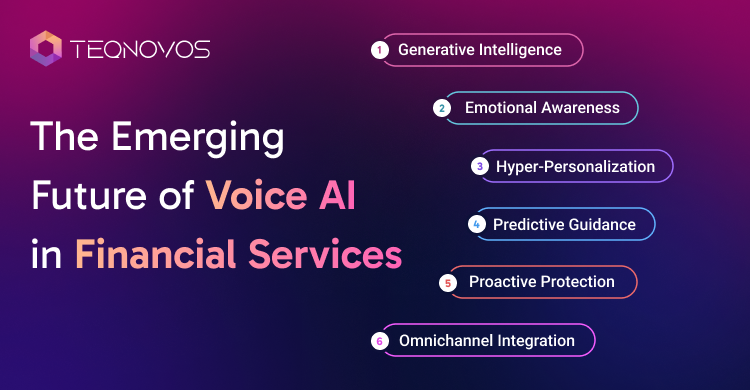
1. Generative Intelligence
Voice systems are shifting toward generative capabilities. They will create dynamic responses instead of relying on predefined templates. Conversations will feel more natural and context-aware.
- Generate real contextual explanations
- Adapt responses based on customer profiles
- Summarize financial insights instantly
- Assist in complex financial discussions
2. Emotional Awareness
Future voice systems will detect emotional signals in speech. Tone analysis will help identify hesitation or urgency. Service responses will adjust accordingly.
- Detect frustration indicators
- Identify urgency in payment discussions
- Trigger priority escalation automatically
- Personalize reassurance during sensitive cases
3. Hyper-Personalization
Automation will use behavioral and transactional data to tailor every interaction. Financial conversations will reflect individual spending habits and service history.
- Adjust the communication tone by profile
- Suggest relevant financial products
- Provide customized financial recommendations
- Anticipate service needs before requests
4. Predictive Guidance
Voice AI solutions for fintech will evolve from reactive support to proactive advisory roles. Systems will analyze financial behavior patterns to forecast needs.
- Alert customers about upcoming obligations
- Recommend savings optimization strategies
- Predict credit utilization risks
- Suggest early intervention for account issues
5. Proactive Protection
Fraud detection will become more anticipatory. Systems will identify abnormal behavior patterns before financial loss occurs.
- Trigger real-time fraud alerts
- Validate suspicious transactions instantly
- Initiate preventive verification workflows
- Reduce exposure through early detection
6. Omnichannel Integration
Voice AI solutions for banking will operate seamlessly across channels. Conversations will continue across phone chat and digital platforms without data loss.
- Synchronize context across channels
- Maintain consistent identity verification
- Enable unified interaction history
- Support seamless channel transitions
Why Enterprises Choose Custom AI Voice Assistants Development for Fintech
Large financial institutions operate in highly regulated environments. Automation must align with policy architecture and growth strategy. Custom development offers structured control and strategic flexibility.
Regulatory Alignment
Financial organizations must comply with strict governance standards. Generic platforms may not fully match internal control frameworks. Custom solutions allow precise configuration of authentication logic and audit requirements. Risk exposure is reduced through structured rule enforcement.
Operational Control
Enterprise environments demand control over conversation logic and escalation flows. Custom development enables alignment with internal service models. This ensures automation supports institutional discipline rather than disrupting it.
Integration Flexibility
Financial ecosystems include core banking systems and fraud monitoring tools. Custom architectures connect securely with these internal environments. Real-time synchronization ensures accurate transaction processing. Institutions avoid dependency on rigid third-party frameworks.
Scalability Planning
Growth in digital banking increases interaction volume. Custom voice AI solutions for banking infrastructure are designed to scale based on projected expansion. Performance stability remains intact during peak demand periods. Scalability becomes a planned capability rather than a reactive adjustment.
Competitive Differentiation
Financial brands compete through service precision and reliability. Custom voice assistants reflect institutional tone and engagement philosophy. Customer interactions feel aligned with brand identity. This creates differentiation in increasingly competitive fintech markets.
Conclusion
Financial institutions are redefining automation through intelligent voice systems. AI voice assistants for fintech enable secure transactions and scalable customer engagement. Institutions that integrate voice automation with compliance-driven architecture strengthen resilience and service precision.
Connect with Teqnovos for innovative AI solutions for call center automation in fintech. Adopt secure voice automation to modernize your financial operations and build a digital advantage. Book a free call with us to get started on your solution today!