
Angular vs React vs Vue—Which Framework Fits Businesses Best?
Modern web application development needs more than ideas. The selected framework helps shape the speed of development, cost, and long-term solidity. When it comes to developing the front end of the app, only one language can claim dominance.
The language is JavaScript. However, the case is not the same with its frameworks, and this is what makes it even difficult to choose. The choice to pick between Angular, React, and Vue is not just technical. It impacts the budget of the project, productivity, and the launch of new features.
The difference between the three frameworks is basic and simple. Yet these differences set them apart.
A flexible library with a vast ecosystem is React. Vue is famous for its easy adoption and simplicity. Both of these are stronger choices for startups. On the other hand, Angular is trusted for its structure, adjustability, and support. It comes with built-in tools and TypeScript integrations. It is ideal for complex applications.
This blog explores the differences between these frameworks from a business perspective, with a particular focus on Angular. We will discuss why many companies trust AngularJS development services to build scalable, high-performance web applications.
What is AngularJS?
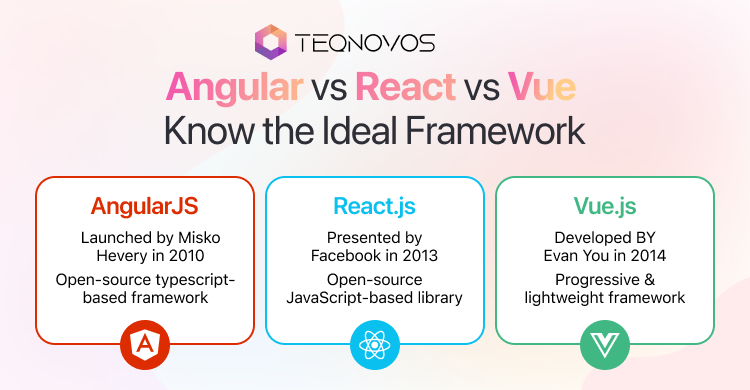
Misko Hevery first launched this front-end framework. It was later adopted and supported by Google. It has significantly played an essential role in developing and popularizing this framework. AngularJS version 1.2 came out in 2013. It wasn’t the first release, but it represented an important step forward for the framework.
Angular provides a complete ecosystem. It offers everything from data handling to routing. Thus, the framework is perfect for enterprise-level projects.
Advantages
-
Two-Way Data Binding
Angular coordinates data between the model and the view. This decreases repetitive coding tasks and ensures applications remain responsive and productive.
-
Dependency Injection
Applications developed with Angular are modular and easily maintainable. This feature simplifies the testing process. Thus, the developers can reuse services across many components.
-
Full Framework
Angular goes beyond being a UI library. It includes built-in solutions for forms, state management, HTTP communication, and more. Teams save time by not having to integrate separate libraries.
-
Declarative UI
The use of HTML templates makes it easy to code and understand the user interface. Developers can focus on implementing logic rather than complex UI definitions.
-
Built-In Routing
Navigation is straightforward with Angular’s router. It supports new features that improve the app’s performance.
Recent releases, including Angular v15, have introduced better performance and modern development practices. Businesses can hire dedicated Angular developers to build reliable apps. This makes Angular a strong option for projects that demand long-term reliability.
Build High-Performance Web Apps with Angular, React, or Vuejs – Learn How!
Schedule a CallWhat is ReactJS?
A popular JavaScript library, released to the public as a version form in July 2013. It was first introduced by Jordan Walke, a software engineer at Facebook. It was first used as a Newsfeed feature at Facebook in 2011 internally. This was then subsequently open-sourced on GitHub. Ever since then, it has evolved with the introduction of major versions.
Unlike a full framework, React is more focused on the view layer. Thus, developers have an opportunity for flexibility, combining it with other tools. The lightweight nature and large community hub make it a top choice for companies. This library offers the speed and adaptability businesses need to launch their products.
Advantages
-
SEO Friendly
It is easy to optimize React apps for search engines. Since the framework is light, it becomes easy compared to traditional JavaScript-heavy apps. Thus, it becomes simple to improve visibility and attract customers through organic search.
-
React Developer Tools
The browser extension offers robust debugging and inspection features for websites. This helps developers easily understand component hierarchies. Identifying performance issues becomes easy to handle.
-
Virtual DOM
The React library uses a virtual copy of the DOM to track the changes in the website. It updates only the essential parts of the UI. This results in faster rendering of the website and improved client satisfaction.
-
Component-Based Architecture
React stimulates the development of reusable components. This approach improves the maintainability and reduces the development time. It works well when working on a large project that requires repeating elements.
-
One-Way Data Binding
Data flows in a single direction. This makes applications more predictable and easier to debug. The structure helps developers keep better control over the data lifecycle.
React continues to progress with regular updates that align with current development traditions. This framework aligns best to build single-page apps and dashboards.
With React Native, developers can develop responsive and attractive mobile apps. For businesses, React offers a balance between flexibility and performance. Thus, it becomes an appealing choice for projects that need dynamic user interfaces.
What is VueJS?
VueJS is described as a progressive framework. It is best known for its balancing power of simplicity and power. First launched by Evan You. The first source code committed to the project was made in July 2013. VueJS was then publicly launched in February 2014. This framework was built to make front-end development approachable. The main motive was to keep the framework as flexible as possible.
Unlike bulkier frameworks, Vue can be adopted gradually. It gives the teams an opportunity to start small. They can further expand as the project requirements grow. This makes it an appealing option for startups and medium-sized businesses.
Companies looking for faster launches and proficiency can opt for this structure. Many organizations also choose VueJS development to create polished, interactive interfaces quickly.
Advantages
-
Beginner-Friendly
Vue is widely recognized as one of the easiest frameworks to learn. Clear documentation and intuitive syntax allow even junior developers to get productive.
-
Reactive Data Binding
Vue’s reactivity system keeps the user interface in sync. It automatically syncs with the underlying data. This results in more friendly, more dynamic applications without excessive coding effort.
-
Single-File Components
With Vue, templates, logic, and styling live together in one file. This modular approach makes projects more organized and simplifies collaboration across teams.
-
Composition API
A more recent addition, the Composition API, gives developers better control over code. It supports cleaner organization and makes complex applications easier to maintain.
-
Rich Ecosystem
Vue provides various official tools. Vue Router for navigation and Pinia are some of its popular tools. Its ecosystem also includes a variety of community-driven libraries. They help developers move quickly.
Vue is a framework that adapts to both small prototypes and larger applications. Its mix of accessibility and flexibility allows businesses to reduce development time. They can still deliver trustworthy products.
With strong community support and frequent updates, Vue continues to grow. It has become a trusted choice for advanced web projects.
Angular vs React: What’s the Key Difference for Businesses?
Today, Angular and React have become the most extensively used frameworks. They are useful technologies in building a modern web application. While both these frameworks create dynamic user interfaces, there are differences between them. They differ in structure, approach, and the kind of projects they serve best.
Here are some of the main differences:
-
Type of Technology
Angular is a full-stack framework supported by Google. It comes with various built-in tools. They are best suited for routing, forms, HTTP communication, and state management.
React, launched by Meta, is a JavaScript library focused only on the view layer. To build a complete app with React, engineers often require third-party libraries.
-
Architecture
Angular follows a systematic, rigid architecture that guides the development of a project. This makes it ideal for large teams that need uniformity. React offers more adaptability. It allows developers to design their own architecture. While this is powerful, it can lead to variations in code style across teams.
-
Data Binding
The two-way data binding in Angular revamps the view when a change in the model occurs and vice versa. React uses one-way data binding; the data here flows in a single direction. This makes React applications easier to debug but often requires more coding work.
-
Performance
React’s virtual DOM makes it fast when rendering dynamic content. Angular has a heavier initial load. However, it improves performance with features like ahead-of-time compilation and lazy loading. They help to optimize performance in large applications.
-
Scalability
Angular’s all-in-one framework and strict conventions make it highly scalable.
React can also scale well. But it requires careful planning and the right combination of libraries.
In essence, Angular provides structure and built-in features for enterprises. On the other hand, React offers flexibility and speed for projects. It emphasizes dynamic interfaces and customization.
Angular vs React vs Vue: Know the Ideal Framework
The best framework relies on the type of project and the objectives of the business. Each option serves a different intention.
Angular works well for enterprises. This framework includes routing and state handling of the app out of the box. Teams follow a clear structure. Thus, it reduces the confusion in larger projects. Businesses that need stability in the project and room to scale often select Angular.
React fits companies that want speed and flexibility. This library best aligns with handling the user interface. React is also the basis for React Native. Businesses can build mobile apps using this framework. Startups and mid-sized enterprises often use it to release new features. It can connect with many third-party tools.
Vue suits smaller teams and lean projects. It is simple to pick up and easy to apply to existing code. Vue helps businesses release prototypes or MVPs fast. As projects grow, Vue can expand without forcing a full rebuild.
In short, Angular supports expansion, React supports flexibility, and Vue supports speed. We can see that the difference between Angular and React is not much. The selection of a framework depends on various factors. It could be the team size, the project complexity, and the business growth.
Take Your Web Application to the Next Level – Hire Skilled Angular Developers Now!
Schedule a CallConclusion
Angular, React, and Vue each bring their extraordinary abilities to development. Angular delivers structure and adaptability, making it ideal for ventures. React offers resilience and a rich ecosystem. It is suited for businesses that need dynamic interfaces. Vue focuses on simplicity, which helps smaller teams launch projects.
There is no single “best” framework. The right option relies on the business need and its design plans. Balancing the framework with the project’s needs sets the stage for lasting achievement.
If you are looking for expert guidance, Teqnovos can help you. We provide Angular development services to turn your vision into digital solutions.