Cloud Computing Basics: Everything You Need to Know
The modern business has introduced some of the best transformations for businesses. Cloud computing is one such technology. It goes on to become the backbone for business operations.
It goes on transforming how businesses operate, grow, and compete in the marketplace. New businesses and even established ones are moving to the cloud. It has become a solution to improve flexibility, reduce costs, and drive innovation.
According to Gartner, the global public cloud spending is set to reach new heights. In 2025, it is going to reach over $679 billion. Cloud computing has shown a steady rise in its demand. It is due to the need for digital transformation and remote accessibility.
There is a high demand for speed, security, and global collaboration among businesses. The traditional IT techniques often fail to keep up with these appeals. The cloud computing software fills this crack with flexible pricing and smooth incorporation. A better approach to the latest tools, such as AI, data analytics, and automation.
This blog will cover the core perks of cloud services. These include faster deployment and simple IT management. We will also discover the emerging trends. Let’s see what cloud services provide and more.
Keep reading!
What Is Cloud Computing?
The modern business has introduced some of the best transformations for businesses. Cloud computing is one such technology. It goes on to become the backbone for business operations.
It continues to transform how businesses operate, grow, and compete in the marketplace. New businesses and even established ones are moving to the cloud. It has become a solution to improve flexibility, reduce costs, and drive innovation.
According to Gartner, the global public cloud spending is set to reach new heights. In 2025, it is going to reach over $679 billion. Cloud computing has shown a steady rise in its demand. It is due to the need for digital transformation and remote accessibility.
There is a high demand for speed, security, and global collaboration among businesses. The traditional IT techniques often fail to keep up with these appeals. The cloud computing software fills this crack with flexible pricing and smooth incorporation.
Cloud platforms provide a better approach to the latest tools, such as AI, data analytics, and automation. To unlock the full potential of these technologies, many companies choose to hire dedicated developers who can build scalable cloud-based solutions tailored to their needs.
This blog will cover the core perks of cloud services. These include faster deployment and simple IT management. We will also discover the emerging trends. Let’s see what cloud services provide and more.
Keep reading!
Types Of Cloud Computing
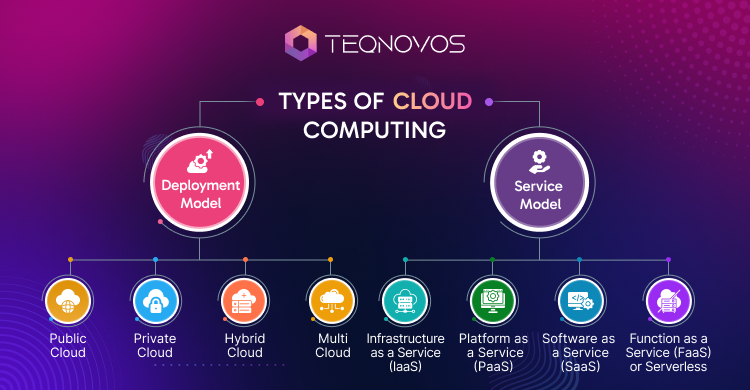
Cloud computing services can be broadly divided into two categories, based on how they are delivered and managed.
-
Deployment
This model describes the access of cloud solutions to users based on ownership and extent. It includes public, private, hybrid, and multi-cloud approaches.
-
Service Model
The service model defines the control and services offered by the cloud. These services are mainly divided into three categories: IaaS, PaaS, and SaaS.
1. Deployment Model
Let’s discuss this model in detail.
-
Public Cloud
In this model, mediators deliver cloud services to the users. Well-known providers such as Amazon Elastic Compute Cloud (EC2) and Microsoft Azure supply computing resources. These contain storage and records for users. They share the infrastructure among the users. The workload in cloud computing remains isolated.
The public model is affordable and scalable. This model is ideal for businesses not looking for advanced control and customization.
-
Private Cloud
Private cloud computing is a dedicated environment created for a single organization. It is usually managed either internally or by a third-party provider, with restricted access for enhanced security.
It offers high levels of safety, control, and customization.
These are common in healthcare, finance, and government industries. As they focus on compliance and data protection.
-
Hybrid Cloud
A hybrid cloud combines elements of both private and public models. This allows data and apps to share and move between two ecosystems.
By choosing a hybrid model, businesses could use a private model to run sensitive tasks. And the public cloud for other non-sensitive tasks.
This way, businesses get flexibility, resource use, and improved performance. A hybrid cloud is useful for firms shifting from traditional to cloud environments.
-
Multi-Cloud
The multi-cloud model refers to using services from different suppliers.As an illustration, a business could rely on AWS for hosting infrastructure while leveraging Azure for advanced machine learning tasks. Similar to this, they could hire dedicated companies for different tasks.
This approach avoids the issue of locking vendors and enhances redundancy. A simple way to choose the best services for each business operation’s needs. Multi-cloud is becoming common among firms with diverse tech needs.
Explore Cloud-Native Solutions Tailored to Your Business — Hire Dedicated Developers Now
Schedule a Call2. Service Model
Service models define the computing stack management. Each model offers varying control and responsibility.
-
Infrastructure as a Service (IaaS)
IaaS delivers the core IT components—such as servers, storage, and networking—through cloud platforms. Through IaaS, users can access virtualized servers, data storage, and networking tools via the internet. Users could install, manage applications and operating systems.
Gain complete control over the computing environment. It is suitable for businesses looking for versatility without investing in substantial hardware.
-
Platform as a Service (PaaS)
PaaS delivers a ready-made environment with operating systems and developer tools, enabling teams to create, test, and launch applications more quickly.
The cloud provider handles updates, security, and resource allocation. This model is ideal for development teams to write code and deliver faster.
-
Software as a Service (SaaS)
A functional software application accessible through a web browser. With SaaS, the vendor is responsible for hosting, maintaining, and continuously updating the software. Users do not need to deal with or install any software.
Common examples include email platforms, relationship management tools, and efficiency suites. The SaaS in the cloud computing model is popular for its ease and convenience.
-
Function as a Service (FaaS) or Serverless
Serverless computing is well-known under another name, FaaS (Function as a Service). The model allows dedicated developers to run separate functions or code blocks. The developers could use this without managing the hectic server.
The provider automatically assigns resources and completes sales based on the order. The billing hours depend on the actual running time of the code. This model is best for event-oriented or rapid scaling apps with the least costs.
Read our blog on why to hire dedicated developers for your business growth. And how you can hire the right developers.
Key Benefits Of Cloud Computing
Cloud computing platforms offer various key benefits to businesses. Below are some of the advantages that help businesses grow in this digital realm.
1. Cost Savings
- Reduced Capital Expenditure: Get rid of the expensive hardware and physical infrastructure. Thus, it reduces the initial setup cost.
- Lower Operational Costs: With pay-as-you-go pricing, businesses could avoid paying for resources not used.
- Optimized Resource Utilization: These platforms offer the possibility for better resource management. Automate and scale easily with the cloud.
2. Flexibility and Scalability:
- On-Demand Resources: Users could get storage, computing power, and services based on their current needs.
- Scalability: Cloud systems can automatically scale capacity up or down to match workload demands.
- Accessibility: Teams could get data and apps anytime. Access information through any internet device without exception.
3. Enhanced Security:
- Advanced Security Features: Providers give integrated security tools such as encryption, firewalls, and threat detection.
- Data Backup and Recovery: The backup system, driven by automation, provides a guarantee of the data. The user will not lose data, nor will it be corrupted.
- Granular Access Control: Firms can determine who will have access to particular data and systems. Thus facilitating compliance and safety.
4. Improved Collaboration:
- Centralized Data Access: Access all information from one spot. Thus, cutting down on errors and increasing consistency.
- Real-Time Collaboration Tools: Cloud apps ensure that editing, file sharing, and communication across teams are fluent.
- Disaster Recovery: Cloud systems offer instant disaster recovery services to deal with rising issues.
What Are The Top Trends In Cloud Computing?
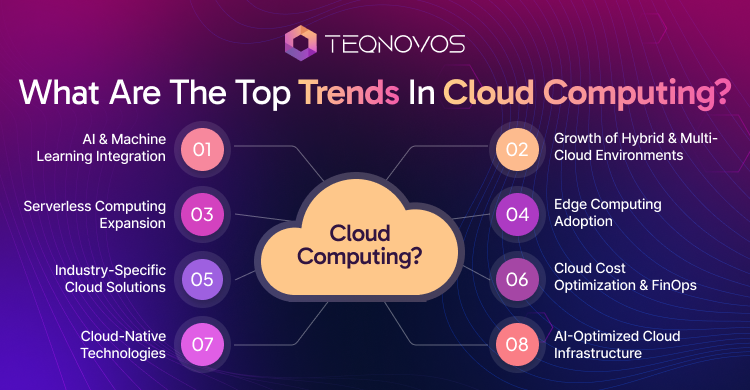
Below are some top trends of cloud computing software driving businesses towards innovations. Let’s discuss.
-
AI and Machine Learning Integration
Cloud platforms consist of AI and machine learning tools. They help businesses automate tasks, provide insights, and improve decisions.
-
Growth of Hybrid and Multi-Cloud Environments
Businesses are blending public and private clouds. They are even selecting multiple service providers. This results in increased flexibility and meets compliance demands.
-
Serverless Computing Expansion
This model allows engineers to execute code without the need to manage infrastructure. Thus, they gain speed, reduce cost, and become capable of supporting event-driven applications.
-
Edge Computing Adoption
Edge computing executes the data closer to the source. This drops reaction time and promotes functioning for real-time applications.
-
Industry-Specific Cloud Solutions
Cloud providers are creating tailored solutions for industries such as healthcare. These industries are the most demanding about regulatory and performance needs.
-
Cloud Cost Optimization and FinOps
Businesses are here to take full advantage of the FinOps practices. They use the platform to track, manage budgets, and maximize the benefits.
-
Cloud-Native Technologies
Cloud-native tools are the enablers for faster and more efficient development and deployment. These tools include containers, microservices, and Kubernetes.
-
AI-Optimized Cloud Infrastructure
Cloud providers are improving their infrastructure with AI chips and models. This allows businesses to run innovative AI workloads with better speed and proficiency.
Build Future-Ready Cloud Infrastructure — Start With the Right Development Team Today
Schedule a CallConclusion
Cloud computing services are the driving force behind businesses. They are growing at an exponential rate and implementing new ideas.
Cloud computing has become a central element of digital success. With the increase in AI, instant access, and the necessity for secure data handling. It fuels expansion, energizes teamwork, and guarantees fortitude during fluctuations in the market. The decision to go green with cloud technology now is equal to future-proofing a business.
Collaborate with us to hire dedicated DevOps engineers. Get your project the technology required to scale and expand. Connect with us today!