
DevOps In SaaS Applications: The Ultimate Guide
DevOps has emerged as one of the most transformative digital practices in today’s tech landscape, and its influence continues to expand rapidly. By bridging the gap between development and operations, this approach empowers teams to deliver cloud-based software that is faster, more reliable, and seamlessly scalable.
This innovative method goes beyond accelerating the development speed. It ignites the entire DevOps cycle in SaaS applications. Starting from the initial concept to their introduction into the real world.
With expert DevOps solutions tailored for SaaS apps, businesses can unlock success. It allows for continuous integration and faster delivery of pipelines. These respond to the market demands while maintaining the standards. It gives businesses the edge they need to stand out in a competitive digital landscape.
Let’s explore and study the impact DevOps solutions have on SaaS applications.
What Is the Importance Of DevOps In SaaS Applications?
A practice that assists in integrating software development and IT operations. DevOps in SaaS aims to shorten the development cycle. But it delivers various advanced features and fixes. These align with the business objectives.
When asked about what DevOps is in SaaS, it refers to the initiation of automation and monitoring. This helps improve scalability and reduce downtime. The result? Faster releases with fewer errors.
Why DevOps is Crucial for SaaS Apps?
1. Accelerated Deployment
The incorporation of DevOps in software development ensures expedited deployment. It helps in developing features and testing, leading to a faster time to market.
2. Enhanced Teamwork
Mitigates the gap between developers and operations teams within the company. This partnership maintains a more focused ecosystem. It focuses on unified objectives rather than separate tasks.
3. Service Stability
DevOps is essential for SaaS apps in automating updates & testing code. Teams can detect any potential issues early on. This feature to respond right away maintains service reliability for users.
Boost Your SaaS Performance with Expert DevOps Solutions –Get Started Today!
Schedule a Call4. Seamless Scalability
Adjusting to the user requirements without compromising quality. It becomes smooth with infrastructure managed as code.
DevOps is crucial in SaaS apps to stay ahead. Businesses can leverage professional CI CD pipelines to achieve excellent operations. It also results in sustained customer satisfaction through high-performing apps.
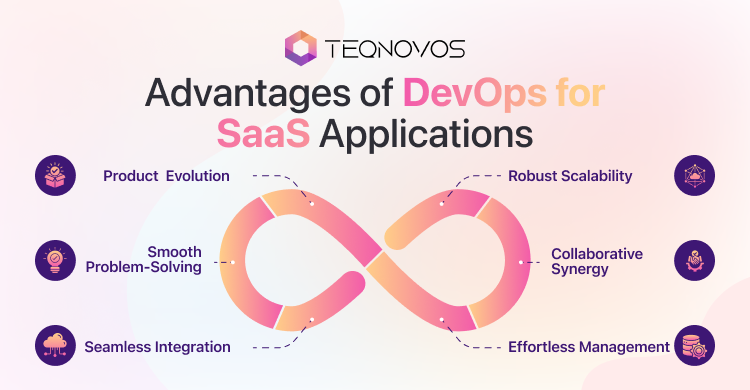
Advantages of DevOps for SaaS Applications
1. Product Evolution
With rapid iteration and continuous delivery, DevOps in SaaS apps evolves. It grows with customer demands and emerging market trends.
2. Smooth Problem-Solving
Quick identification of bugs and resolution with the smallest disruption. Thus, enhancing the user trust and delivering smooth services.
3. Seamless Integration
Implementing advanced technologies by DevOps helps keep SaaS apps innovative, adaptive, and ahead of evolving market trends.
4. Robust Scalability
A stable working ecosystem aided by automating tasks. This results in much reduced human error rates.
5. Collaborative Synergy
Cross-functional developers are able to collaborate effectively. This improves the outcomes through everyone’s shared insight.
6. Effortless Management
The complexities of project management become simplified with DevOps. It helps in a streamlined process, making overseeing projects straightforward.
The benefits of DevOps for SaaS applications help businesses aim high. It keeps them dependable, and scaling is easier.
Role Of DevOps In SaaS Applications
DevOps plays a major part in the development and maintenance of SaaS apps. The core components of SaaS DevOps are below. They help in building effortless solutions while maintaining quality.
1. Continuous Integration and Continuous Delivery
DevOps motivates close support between the teams. It focuses on seamless CI CD pipelines. This collaboration helps identify issues early and speeds up delivery cycles. It automates the development and testing of the code.
2. Containerization and Orchestration
Containers make applications weightless and portable. They package code and dependencies, ensuring uniformity across environments. Orchestration tools like Kubernetes manage these containers. They help to handle deployment and recovery.
3. Infrastructure as Code
Infrastructure as Code (IaC) allows teams to manage and provision infrastructure. The process follows through scripts instead of manual processes. It improves consistency and reduces human errors.
4. Monitoring and Observability
System monitoring is what helps teams know how their systems are performing. Observing system functionalities enables teams to detect irregularities and troubleshoot issues before they impact users. They maintain the service reliability.
5. Security Integration
Security integration, or DevSecOps, embeds security checks at every stage of the development process. It ensures addressing issues in the code early. It protects SaaS applications from potential threats.
Best Practices for DevOps in SaaS Development
1. Foster Collaborative Culture
DevOps works best when everyone’s thoughts align. In SaaS development, developers and operations teams should work together. Open communication helps solve problems faster and reduces friction between teams. When everyone shares the same goals, it becomes easy to fix issues.
2. Customer Satisfaction
DevOps is about delivering user satisfaction through solutions. Customer feedback helps to enhance the product further. Acting on it could help save time. Continuous delivery allows companies to rectify issues faster and add new features. It also helps build stronger relationships with users who see steady progress.
3. Integrate Agile Practices
Agile practices and DevOps make a powerful combination. Short cycles and quick iterations help teams stay flexible and adaptive. This results in faster releases and a continuous learning method for developers. Thus, it becomes possible to launch a product that changes with the market.
4. Embrace Test-Driven Development
TDD emphasizes writing tests before writing the actual code. Adopting this approach helps catch bugs early in the code. It ensures better code quality. It saves time, prevents major issues, and boosts confidence in every release.
5. Microservices Architecture
Microservices architecture makes SaaS applications more flexible. Each service runs independently. So teams can update one part without affecting the whole system. It becomes easy to manage the solutions.
6. Continuous Performance Monitoring
Constant monitoring keeps SaaS apps dependable. It helps detect slowdowns and maintain smooth performance. Continuous visibility ensures users always get the best experience. All these contribute to providing quality services aligned with business demands.
Accelerate Your SaaS Innovation with Teqnovos DevOps Services – Learn How!
Schedule a CallTop DevOps Services for SaaS To Know About
DevOps services play a major role in enhancing the speed and reliability of SaaS apps.
- CI/CD pipeline in SaaS apps setup ensures fast and safe deployments.
- IaC lets teams set up and manage their infrastructure. Teams can avoid manual work.
- Orchestration helps systems stay flexible and consistent throughout the entire environment.
- Continuous observability helps teams spot problems early. They can solve these issues and keep the system running.
- Security integration adds protection throughout the development process.
Together, these DevOps services enable SaaS businesses to deliver faster. This helps businesses to stay secure and scale faster with confidence.
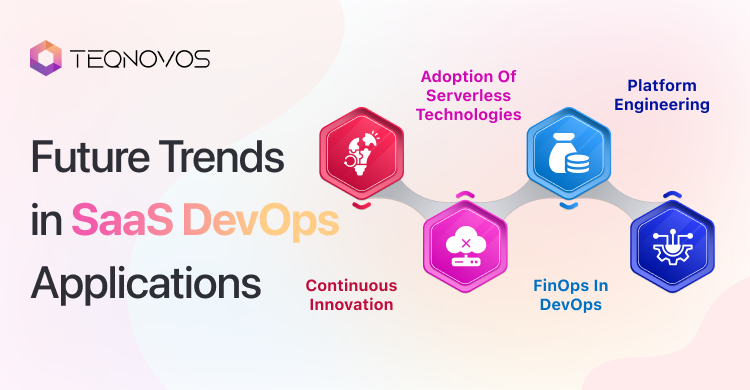
Future Trends in SaaS DevOps Applications
1. Continuous Innovation
With new tech, businesses need to change too. With this, the SaaS DevOps will keep evolving to keep up. This will drive the developers to experiment and do research. Automated testing and analytics could help in the situation for products to evolve.
The data insight will help them transform based on user behavior. This approach ensures that the solutions stay relevant. Thus, they align better with the growing customer needs.
2. Adoption Of Serverless Technologies
Adoption of serverless computing is becoming an essential part of new DevOps. It allows developers to focus on code without worrying about infrastructure handling.
In SaaS environments, this means faster release of solutions at lower costs. So, making scaling easy for businesses. Serverless frameworks help teams deliver new features while maintaining flexibility and control.
3. FinOps In DevOps
With the cloud usage growing, managing costs becomes critical. FinOps brings financial accountability to DevOps. It aligns spending with performance.
The development teams can keep track of resources used and make data-driven decisions. This integration ensures efficiency without overspending. It maintains a crucial balance for SaaS businesses operating at scale.
4. Platform Engineering
Platform engineering is changing how DevOps teams work. It focuses on creating self-service platforms that make infrastructure management easier for developers. These platforms make workflows more consistent and help teams deliver services faster.
In SaaS DevOps, platform engineering will become central to improving output. It ensures uniformity across teams and projects.
These future trends in SaaS DevOps apps will bring innovative solutions and lasting improvements. The use of these practices is crucial for businesses to move forward.
Accelerate SaaS Innovation with AI-Driven DevOps from Teqnovos
DevOps has become one of the most powerful forces driving modern SaaS development. It introduces automation and scalability to software solutions. DevOps helps companies achieve faster results and reliable solutions.
The use of AI and serverless computing will make SaaS operations smarter. Businesses that embrace DevOps for SaaS apps early gain a competitive edge. They get better performance on reduced costs and can improve user demands.
Speed up your SaaS innovation with AI-driven DevOps solutions from Teqnovos. Our experts help build scalable and high-performing apps. We help design apps to grow your business. Visit our website today!