How Will AI Take Over Cybersecurity In The Future?
Cybersecurity is no longer limited to firewalls and antivirus software. As the threats continue to grow stronger, the defense system must grow as well.
This is where generative AI security is introduced in project development.
The real force behind preventing these threats. AI can sniff through a massive amount of data in seconds. The speed of generative AI to examine data is faster than a human examiner.
AI could detect phishing emails, detect zero-day exploits, and identify issues. It adapts, learns, and evolves with every new threat that occurs. Businesses use AI to predict attacks before countering and stopping them in real-time.
This blog revolves around the fact of how generative AI is used in cybersecurity. Let’s discuss the tools leading this shift, the risks involved, and threat detection.
Keep reading!
The Rise of AI in Cybersecurity: A Paradigm Shift
AI in cybersecurity isn’t some other tech trend. It is a turning point, helping businesses detect threats. Cyberthreats are no longer typical. Invaders use automation and machine learning to break into systems faster. With the attackers evolving, traditional defense can’t keep up.
Using artificial intelligence in cybersecurity helps businesses remarkably. It moves from responsive defense to dynamic and prescient threat management. AI authorizes defense systems to study data, identify prototypes, and detect issues.
They can find any malicious activities that might be missed by human analysts. This enables faster and more effective responses to threats. It solves the question of how AI can be used in cybersecurity.
This shift is not a tech evolution but a change in how businesses approach cybersecurity.
How Can Generative AI Be Used in Cybersecurity
Generative AI in cybersecurity is transforming on both sides. It empowers businesses with automation and speed. On the other hand, it can be misused by attackers to release advanced threats.
Below are the points describing how AI is making an impact:
1. Defensive Applications:
- Automated Threat Detection and Analysis:
Generative AI in data security can inspect large amounts of information. They generate threat signatures and flag anomalies. This helps the security team identify unwanted activities and act faster with accuracy.
- Incident Response Acceleration:
AI can auto-complete incident reports and help with remedies. They create scripts for the containment and recovery of data. This reduces the response time and manual efforts.
- Vulnerability Assessment and Patching:
It assists in simulating potential exploit paths. They generate code snippets to patch up the vulnerabilities. Thus, AI could help prioritize the risk based on real-time threats.
- Security Awareness Training:
Gen AI data security generates realistic phishing emails and attack simulations. This helps with faster and proactive vulnerability management among employees. Thus, it enhances employee training.
- Enhanced Biometrics:
Generate a robust and improved biometric authentication system. Get synthetic data to enhance precision and reduce bias in recognition models.
- Simulating Zero-Day Exploits:
AI simulates novel attacks to help businesses test defenses against unknown exploits. Thus, they can develop AI cybersecurity software to prevent these issues.
2. Offensive Applications
- Malware Generation:
AI could generate polymorphic malware. This helps change the code often. Thus, it becomes more difficult to discover with conventional antivirus systems.
- Phishing and BEC Attacks:
AI can be used to generate phishing emails and business email compromise attacks. They use public data and natural language to increase the chance of an attack.
- Adversarial Content Generation:
Attackers can use it to generate misleading inputs. Thus, it creates confusion among machine learning models. This could lead to malicious behavior going undetected.
Which Risks are Associated with Using Generative AI Technologies
Artificial intelligence in cybersecurity offers powerful frameworks for businesses. But these strengths could become serious threats if left unchecked or misused.
Below are some of the concerns in cybersecurity and beyond:
1. Cybercriminals
Generative AI lowers the barricade for attackers. Cybercriminals can generate malicious code for ransomware attacks using AI systems. Hackers can leverage AI to launch false campaigns with minimal effort.
2. Impersonation Attacks
Impersonations are easier than ever. AI can generate deepfakes and voices. Cybercriminals can mimic these and deceive teams into stealing credentials or making transactions. This mainly happens in business email compromise attacks.
3. Loss of Human Oversight
Relying heavily on Gen AI could affect security, leading to blind spots. Loss of human supervision could lead the system to act unpredictably. It could misclassify threats and generate flawed responses. Manual validation is essential for AI from humans.
4. Data Privacy and Security Risks
Generative AI could unknowingly expose sensitive user data. If not secured, this could lead to data leaks and model theft.
5. Misinformation Amplification
Generative AI cybersecurity risks could increase misinformation. AI could produce pragmatic but fictitious content. It includes fake photos and videos, among other things. Thus, a risk of spreading false information and influencing public opinion could happen.
AI-Powered Threat Detection in Cybersecurity
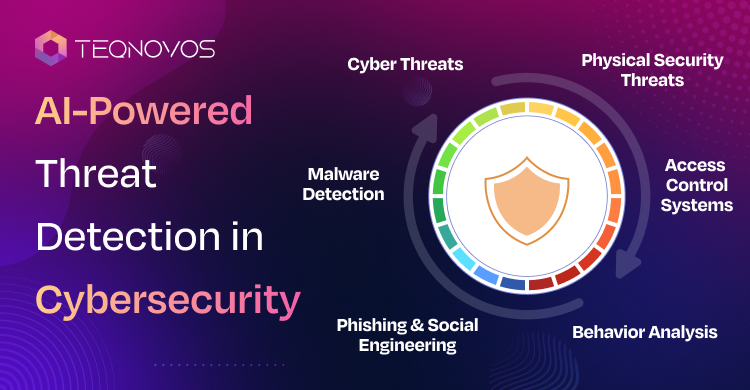
Generative AI security helps businesses detect and respond to different cyber threats. These tools have advanced and do not rely on static rules, unlike traditional tools. It identifies patterns, predicts attacks, and reacts accordingly. Modern threat detection is essential across many fronts.
1. Cyber Threats
AI threat intelligence uncovers and prohibits various cyber threats. These include ransomware, DDoS attacks, data offenses, and other insider coercion. It oversees the system 24*7 and detects malicious activity before it escalates.
2. Malware Detection
Analyzing system behavior and file activities helps AI detect known and unknown variants. It includes polymorphic and fileless malware. The Gen AI data security does not require a signature database to flag malicious code.
3. Phishing and Social Engineering
AI tools for cybersecurity can scan web content to detect phishing attempts. NLP helps identify manipulative language use and unusual sender behavior. This helps protect users from hidden attacks.
4. Physical Security Threats
AI in the surveillance team helps detect unauthorized access or other breaches. It recognized any anomalies in the feed or a badge to trigger security alerts.
5. Access Control Systems
Generative AI security enhances the verification system. It monitors login patterns and user behaviors. It flags any unusual behaviors, times, or locations to help prevent unauthorized entry.
6. Behavior Analysis
AI helps businesses track how users engage with the system. When the system detects a deviation in user behavior, it triggers alerts. Triggers could be due to access to restricted files or transferring those files. This helps detect any compromised accounts or insider threats.
How AI Tools Are Enhancing Cybersecurity Strategies
AI helps businesses defend against risks and threats. Here is how generative AI can be used in cybersecurity to help in faster and smarter security.
1. Faster Threat Detection and Response
Gen AI data security processes volumes of data in real time. It detects threats instantly and helps the teams respond. This leads to faster threat detection, action, and limits the damage.
2. Smarter Threat Intelligence
It gathers and analyzes data from different sources. It identifies the threat patterns and links across various attacks. This helps generative AI data security teams know the threat landscape better.
3. Automation of Repetitive Tasks
AI can handle daily tasks in an instant. It can automate redundant tasks, such as phishing sensing and patch management. This frees up the analyst’s job. Thus, they can focus more on high-priority issues and planning.
4. Adaptive Defense Through Machine Learning
Machine learning models are better learners. They learn better from past attacks. They adapt to the system over time and evolving threats. This makes the defense system robust and flexible.
Generative AI Security Best Practices
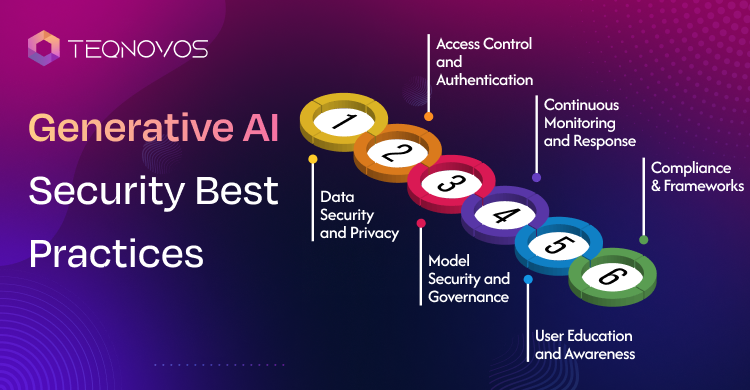
Generative AI can help produce relevant content, automate tasks, and boost efficiency. But introducing AI also involves some risks. These best practices help agencies use artificial intelligence in cybersecurity responsibly.
1. Data Security and Privacy:
Data Encryption: The data used to interact with generative AI models should be encrypted. This includes data stored on servers and data transferred between systems. Encryption helps guard sensitive user data from invaders.
Data Loss Prevention: DLP tools help identify and block the illegal sharing of personal data. This is essential in AI applications in cybersecurity. Models may unknowingly output sensitive data.
Data Retention and Disposal: Define how long AI-related data should be stored. Delete the data when it is no longer required. Thus, it reduces the risk of data loss. It also ensures compliance with data safeguard rules.
2. Access Control and Authentication
Role-Based Access Control: Not every user needs to have the same access to the system. Use RBAC to restrict access based on responsibilities. This limits the chance of misuse or accidental changes to the systems.
Strong Authentication: Allow access to tools with strong verification methods. 2FA and multi-factor authentication help protect data. It acts as an extra secure layer for the system.
Monitor User Behavior: Use monitoring tools to track how generative AI is used in cybersecurity systems. Alert the team if there’s strange or risky behavior, like large data downloads or model probing.
3. Model Security and Governance
Secure Model Artifacts: Protect AI models, weights, and training data in secure locations. Use access controls to preserve models from officiousness or embezzlement.
Regular Red Teaming: Simulate attacks on the systems using Gen AI data security experts. This helps uncover exposures like prompt injection or model poisoning before attackers do.
Establish Model Governance: Set clear ownership for each model. Define policies on who can train, deploy, or update AI models. Keep records of changes to models and their use cases.
4. Continuous Monitoring and Response
Incident Response Plan: Create a response plan fitted for AI systems. This includes steps to find, contain, and recover from AI attack incidents. These could be data leak threats, malicious activities, or harmful outputs.
Threat Detection: Use advanced tools to watch threats targeting AI cybersecurity software systems. These may include model handling or adversarial inputs.
Regular Audits: Review your AI systems regularly. Check for security breaches or bias in models. Audits help improve transparency and liability.
5. User Education and Awareness
Employee Training: Train employees to understand how generative AI is used in cybersecurity. Training should be ongoing as the technology evolves.
Promote Awareness: Keep users informed about the new threats and updates on the system. Make sure they understand how their behavior impacts AI security.
6. Compliance and Frameworks
Understand AI Laws and Regulations: AI laws change almost every day. Stay up to date on the local and global statutes. Check to follow the best data approach that aligns with these laws.
Establish an AI Data Governance Framework: Be sure to follow the guidelines for data collection, usage, and protection in an AI system. This way, you stay ethical and use legal data across the AI lifecycle.
Follow Industry Standards: Adopt artificial intelligence in cybersecurity frameworks. These standards guide safe and effective AI deployment.
Conclusion
Generative AI development is reshaping the future of cybersecurity. Get your hands on a faster and smarter detection system to protect your system. With a risk management system and smart defense strategies, AI becomes the best tool.
While it brings power to the system, it does introduce some risks. But pursuing the right tools and best approach helps diminish those. Leverage the power of AI to build a robust and more secure cyber ecosystem.
Book your free consultation with us and start your generative AI development today!