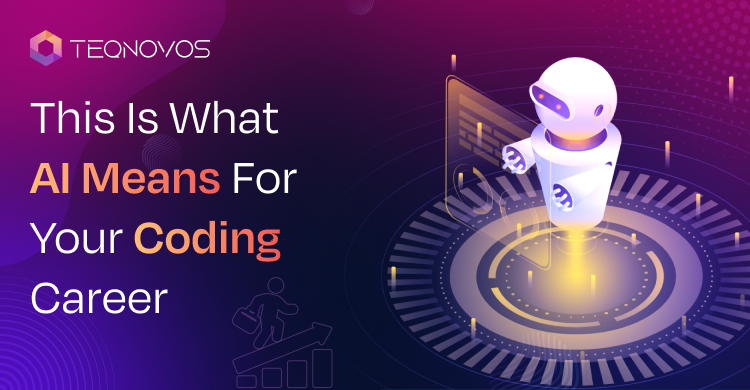
This Is What AI Means For Your Coding Career
The world of software development is entering a new era. The one where artificial intelligence isn’t just a lingo but a comrade in building the future. Clean and functional code to automate testing in seconds, project deployment, and security. AI can manage it all, every step of the software development cycle.
Major tech giants are using AI software development to push innovation a step ahead. Meanwhile, new paradigms like vibe coding and low-code are opening doors to innovation. Creators and developers from all backgrounds are using AI to bring new ideas.
But this transformation introduces a critical question: will artificial intelligence replace programmers?
This blog dives into the trends, tools, and truths behind AI in coding. Let’s read why the smartest developers are embracing it rather than resisting it.
Technology Shifts in Software Development
Custom AI software development services are changing faster than ever before. Smart developer teams use emerging tools, shrewd frameworks, and new delivery patterns. These shifts reshape the way developers work, build, and stay relevant to the market.
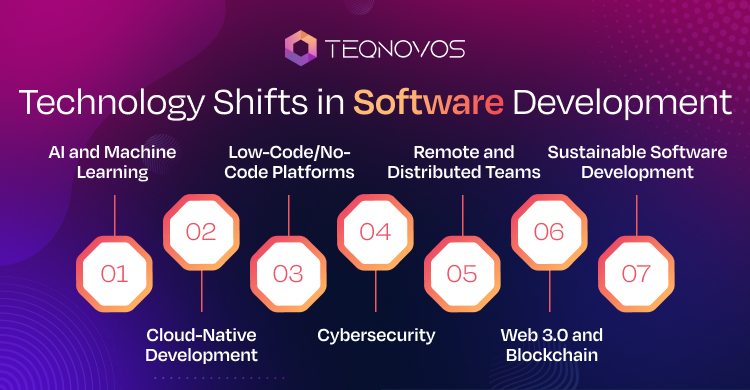
1. AI and Machine Learning
AI boosts the code-writing process. Not only this, but businesses get automated writing and DevOps. Big firms such as Microsoft and Google are already using artificial intelligence to develop new code. Many developers are approaching these methods to speed up their work. However, ensuring code quality and building trust remain top priorities.
2. Cloud-Native Development
Cloud-native services let developers scale faster and stay agile in the development cycle. It makes the system resilient while cutting the overhead costs. DevOps teams assist in leveraging features quickly and automating program services.
3. Low-Code/No-Code Platforms
Even non-techies could solve real difficulties through these platforms. With visual tools, they can build apps more easily. Thus, teams can innovate without having deep coding skills.
4. Cybersecurity
Security has become the need of the moment. Custom AI software development allows teams to integrate code reviews and check code for threats. Thus, shifting to zero-trust models helps safeguard from any bugs and hacking. AI also helps manage threats smartly.
5. Remote and Distributed Teams
Remote work has become the new norm. Teams leverage time zone differences to get global talent. Thus, businesses are adopting agile processes and a strong team culture.
6. Web 3.0 and Blockchain
Web 3.0 introduced decentralized finance and NFTs to the tech stack. On the other hand, blockchain provides transparency and trackability. Decentralized systems and smart contracts open new paths.
7. Sustainable Software Development
Green coding matters more than ever today. Teams are choosing energy-efficient languages and frameworks. The tech world is thinking about energy use and environmental impact. Clean infrastructure and green coding are becoming the top priorities.
Want to explore AI-driven solutions? Get a free consultation now.
Schedule a CallWhat is the Future of AI Software Development?
Artificial intelligence is no longer believed to be a knick-knack in the software development cycle. It goes on to become an integral part of the whole development process. AI is influencing the way projects are planned, built, designed, and maintained. The future will see how AI is moving from being just a code helper to a partner. Thus, delivering top-quality software at speed.
AI Today: Streamlining the Basics
The present situation of artificial intelligence showcases its supremacy in faster development. It is efficient in some specific areas:
Code generation: Helps autocomplete the code and provides context-aware code suggestions.
Bug detection: Scanning for issues in the code before and after its completion.
Automated Testing: Instant unit test creation
Documentation: Writes directly from the source code.
Legacy code analysis: Explain outdated systems.
These tools help developers in the custom development of AI software. It cuts the repetitive work, helping them focus on problem-solving. Thus, helping teams to save significant time.
Near Future AI as a Co-Developer
Over the next few years, AI is set to evolve as a true co-developer:
Module creation from prompts: Provide a detailed description, and AI will generate a fully functional code module. Get code for an entire feature with error handling and integration points.
Intelligent debugging: AI will proactively detect potential issues, suggest optimizations, and even rewrite portions of code. This will improve code performance.
Adaptive learning: These systems will learn from each project, understanding a team’s coding style, preferred frameworks, and architectural patterns. Thus, the suggestions will become more relevant over time.
End-to-end development support: Planning architecture diagrams and automating deployment scripts, AI will handle the full cycle. It enables faster iteration and reduced turnaround times.
Stay ahead in the AI era— let’s build your next big solution together.
Schedule a CallWill Software Engineers Be Replaced By AI?
The most asked question of the decade is, Is AI going to replace programmers? Well, AI sure is changing the traditional ways. It can write code, fix bugs, and suggest improvements at the same time. This sure does put routine coding tasks at risk. Even entry-level roles may shrink as companies automate the repetitive work.
But AI cannot replace human thinking. The fixing features and decision making process of human engineers are irreplaceable. Developers are still designing, selecting architectures, and making trade-offs. They get the context in ways AI can never.
The industry also agrees to this. The smartest companies will hire more engineers to get the best of AI tools, as quoted by Thomas Dohmke, the CEO of GitHub.
AI boosts productivity. It cuts the task time. Yet speed is only valuable when combined with quality, ethics, and strategies. Human expertise and oversight will always be there to ensure usability and trust.
In reality, AI replacing software engineers is not possible. It will change the job description, but it cannot erase human insight. Adapting AI quickly, mastering new tools, and guiding AI towards better software.
Impact of AI On Software Development
1. Increased Productivity and Efficiency
AI-integrated services speed up the launch process, with an automated coding and testing approach. Tools such as GitHub Copilot help developers finish tasks quickly. This allows developers to focus on solving complex problems instead of repeating routine work.
2. Improved Code Quality
Catch bugs and threats to the code at an early stage. Implement coding standards with AI to improve code practices. It suggests a cleaner and more secure code. It reduces the risk of costly errors later in production.
3. Enhanced User Experience
Analyzing user behavior helps AI build interfaces that feel instinctive. It personalizes features and adapts to the user’s demands in real time.
4. Faster Development Cycles
Automating testing, integration, and deployment cycles decreases the release time. Development teams could upgrade the code more frequently. Thus, accelerating the response time with the rising demands.
5. Data-Driven Decision Making
It processes massive datasets with custom AI development services. It also spots the trends and performance gaps. Developers could use these insights to guide designs and focus on work.
6. Democratization of Software Development
Low-code AI platforms allow non-techies to create apps. This opens software creation to entrepreneurs, designers, and small teams without coding skills.
7. Transformation of the DevOps Process
AI automates monitoring, incident response, and deployment pipelines. This helps DevOps streamline the process. Thus, improving authenticity and decreasing downtime.
Challenges and Considerations
1. Algorithmic Bias
AI can improve and inherit the algorithm and similarity from training data. This technique could lead to biased or imprecise outputs in the project.
2. Ethical Implications
Before deploying AI-generated solutions, one must consider all ethical effects. Questions around the project’s authorship, responsibility, and transparency need to be addressed ahead.
3. Integration Complexity
Not all AI tools can fit the existing workflow. Compatibility and scaling issues could lead to slow adoption of the tools.
4. Learning Curve
To be irreplaceable, developers need to master AI and its tools. Thus, they could adapt to the modern custom AI software development services.
5. Dependence on Data
Poor quality or outmoded data could lead to low performance. This could lead to huge losses in development and unreliable results.
Benefits of AI in Software Development
AI is revolutionizing software development, testing, and maintenance. It is not just about faster coding. It is about creating better products with less effort. AI in software development is not a replacement for human creativity. It is a powerful partner that helps teams deliver software with more confidence. Let’s discuss the different benefits that could help developers scale.
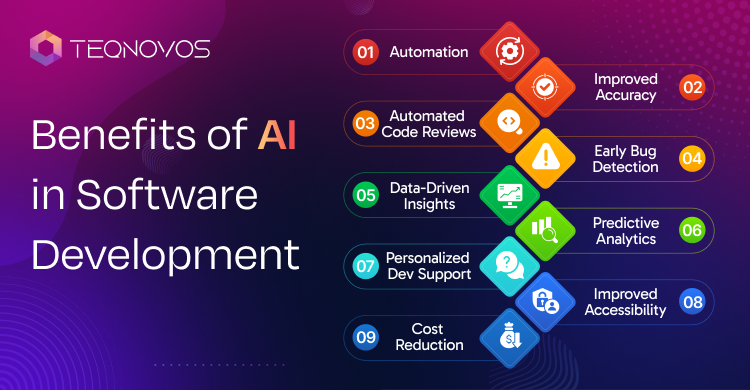
1. Automation
Custom AI development solutions handle repetitive tasks. Thus, developers could benefit from this and focus on being an innovator. They help automate day-to-day tasks. This includes formatting the codes, testing, and others.
2. Improved Accuracy
AI tools reduce human errors. They follow set rules without skipping steps. This ensures higher code quality from the start.
3. Automated Code Reviews
AI helps in reviewing code. They offer tools that help scan the code through pull requests in seconds. They highlight the incompetencies and suggest fixes. Hence, maintaining consistency in the coding standards.
4. Early Bug Detection
It can detect issues before they reach production. During the development, custom AI services scan the code patterns. Therefore, it flags out the possible issues in the code.
5. Data-Driven Insights
Uncover new trends in the market with an AI analysis tool. Analyze the project to get new updates on the project. Get insight into the data. This helps the team to see what works and what is slowing the production down. This supports better decision-making.
6. Predictive Analytics
Foresee the project timeline and the possible risk outcomes that you may confront. It helps to plan resources and avoid any delay that may occur during development.
7. Personalized Developer Support
Get instant coding suggestions with AI assistants. They adapt to the developer’s style and speed up troubleshooting.
8. Improved Accessibility
Both developers and end users could enjoy improved accessibility with AI tools. Voice-based coding and real-time translations are an upgrade to the industry. They open the door for more people to engage in the development cycle.
9. Cost Reduction
Increasing the speed of the tasks and detecting errors early helps cut costs. AI is an effective approach to resolving this. Thus, it makes it easier for teams to spend more time delivering value and less time focusing on errors.
What is the Future of Coding with AI
AI is revamping how developers develop and ship code. They help developers write code faster, smarter, and more conveniently.
In the future, AI will address more of the usual programming tasks. Developers will spend less time rectifying and focus more on being artistic. AI-assisted code will evolve into full code generation. This evolution opens up different key directions for the future of coding with AI:
1. AI Transformation
AI is not about replacing developers. It will help them evolve into their role more smoothly. AI oversight will help them in code generation, secure coding, and quality solutions.
This shift will transform the focus from boilerplate coding to creativity.
2. Vibe Coding
A new paradigm, “vibe coding”, allows developers to describe tasks to AI and get generated code. This emphasizes rapid experimentation over precise control.
Platforms such as Replit enable developers to build solo apps. It takes just hours to develop it, and it boosts availability.
However, it comes with certain risks. Using such tools or critical production systems may lead to limited oversight and security vulnerabilities.
3. Emerging Workflows
The future is likely to be hybrid systems. Combining the strengths of both vibe coding and agentic coding. Thus, a system that is intuitive prompting paired with autonomous execution loops.
4. Smarter Tools
We’ll explore different AI tools in the future. Among them are emerging tools, such as dashboards that synthesize inputs through conversational paradigms. Version control systems in AI help pursue prompts and test code.
AI will adapt to specific styles with hyper-personalized ecosystem development, different designs, and feedback.
5. Security & Transparency
With AI codes in the mainstream, transparency and safety are essential. Secure coding practices are enhanced via generative AI. Thus, it improves risk detection, compliance, and efficiency.
Investigators emphasize detecting AI code, managing intricacy, and system integrity as top preferences.
Conclusion
Thus, we conclude that AI will not swap developers but will reformulate their role. Custom AI development services will help accelerate coding and improve security.
The future of software development will see AI taking over repetitive tasks. Developers could focus on being more creative and innovative. Rather than fearing replacement, AI should be viewed as a powerful partner. It will help expand possibilities, boost efficiency, and raise standards.
Connect with us and get services for your software development. Visit our website to learn more.