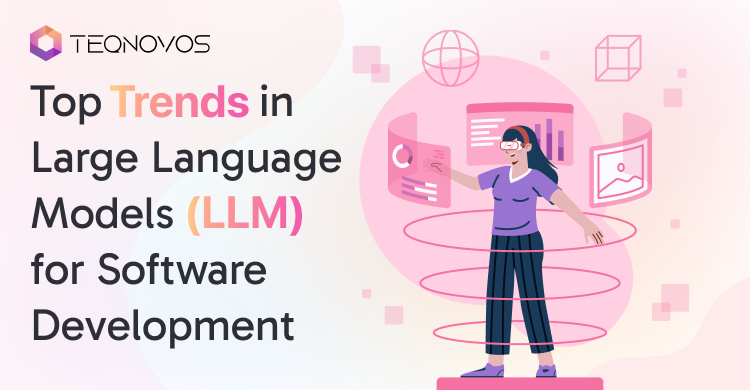
Top Trends in Large Language Models (LLMs) for Software Development in 2026
We see the technology evolving and newer trends being introduced. The year 2025 presented various new trends in technology. The launch of AI models helped various industrial niches. And they, too, have accepted it with open hands.
But what if by 2026 your AI could not only write code but also test it in real time and deploy it? Think about the possibility where AI could track the code in production. Well, it is a possibility. Large language model development already assists in various tasks of code generation. They have become crucial tools across industries.
Understanding their role and future is important. The evolution of LLMs is a sign of more than just some improved syntax or smart chats. It assists in reshaping the developer’s workflow, smoother product delivery, and business innovation.
In this article, we will explore the most popular trends shaping LLM-powered software. Learn how LLMs transform from being reactive responders to proactive business agents. Let’s see how these impact the tech landscape and the promises for the great shifts ahead.
The Future of LLMs in Software Development
Helpers to Coding Partners
LLMs have already become a great support to developers. They assist in generating code snippets, writing different documentation, and fixing bugs. Since the launch of AI, various models have shown how it reduces repetitive tasks. Tools such as ChatGPT improve the delivery speed by reducing manual work.
By 2026, LLMs will be able to evolve from assistants into true coding partners. From just responding to prompts, LLMs will plan tasks for developers and help with the code. They will be able to perform tests and deploy applications with minimal oversight.
- Smarter agents: A smarter agent capable of handling the complete workflow without supervision.
- Reduced manual effort: Developers will make strategic decisions and not spend time reviewing the code.
- Proactive support: AI agents may identify problems and fix them before developers intervene.
Shifting Roles in Development
With the increase in automation, the role of developers will shift. The focus will no longer be on writing every line of code but on guiding and validating AI-based work. This change in development will demand a new set of skills. From prompt engineering to systematic thinking. AI will be more than a passive tool; it will be more like a teammate.
- Design priority: Developers highlight architecture and long-term scalability.
- Oversight: Engineers ensure AI-generated changes maintain reliability and security.
- Human-AI teamwork: Collaboration becomes central to faster innovation.
New Demands for Reliability
With more automation, the need for data reliability also grows. Companies will need strong, secure methods. They need to check if the agents could be trusted. Continuous approval and transparency will be critical to upholding trust.
- Transparency: AI-generated code must be explainable.
- Quality checks: Automated testing pipelines become standard.
- Continuous monitoring: AI systems need surveillance to avoid any bugs and blunders in the code.
Major Trends in LLM Software Development
LLM development trends are already assisting developers in building, testing, and shipping apps. However, now their influence is moving beyond the simple automation. They are reviewing to update as well as support the software.
Ever since, developers have been gradually relying on LLMs. They not only rely on the coding part but also collaborate as an intelligent system. A system that could plan, act, and adapt to the new systems. These variations signal a new period in development. AI is supporting the comprehensive development of apps, reducing bottlenecks, and accelerating innovation.
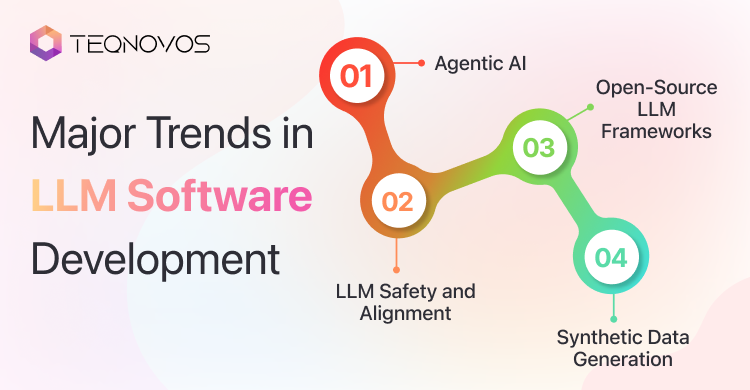
AI powered by large language models is changing the landscape faster than ever. AI has shifted from being an autonomous tool to open frameworks. Below are some sections that highlight the four key trends shaping LLM development.
1. The Rise of Agentic AI: From Reactive to Proactive Models
What is Agentic AI
The traditional LLMs only responded to prompts and provided answers accordingly. They remain reactive. But agentic AI is the next stage, where models act as autonomous agents. They can plan, execute, and adjust tasks with the least human interference. Instead of inactively generating code, agentic AI systems can manage complex workflows. This makes them proactive collaborators rather than simple assistants.
- Proactive behavior: AI can initiate actions without constant human input.
- Goal orientation: Systems pursue defined objectives step by step.
- Decision-making ability: AI agents can analyze situations and choose the best path forward.
How Agentic AI Works
Agentic AI combines an LLM “brain” with external tools. It uses APIs and memory elements to enhance its abilities.
Let’s understand it further. An LLM model might be able to analyze demands and write code for developers. It will run tests, debug errors, and deploy software autonomously. The system could also query APIs in real time. Since its capabilities are extended, it could update documents.
- Reasoning core: The LLM interprets goals and breaks them into steps.
- Tool use: APIs and plugins execute tasks beyond text generation.
- Memory integration: Long-term context allows continuity across projects.
- Feedback loops: Results fed back into the model for refinement.
Why Agentic AI is a Major Trend
The switch from being reactive to proactive is a significant one. AI represents a fundamental change in LLM development trends. Developers no longer need to guide every point.
Instead, they can rely on AI agents to handle standard or complex tasks, saving time and resources. By 2026, teams may shrink in size yet deliver faster. This will be possible with AI boosting productivity across the pipeline.
- Workflow automation: The complete coding cycles can be automated. Code writing for the deployment of the application.
- Improved efficiency: As a result of this, business productivity will improve. Developers’ emphasis on designing app patterns rather than tedious tasks.
- Enhanced collaboration: AI functions as a team member with experience. Thus, it complements the skills of humans.
- Business impact: Companies reduce costs, shorten timelines, and scale projects faster.
Outlook for 2026
No technology has the power to replace human intelligence. Agentic AI will not replace developers but help them move ahead. Human oversight always remains vital in every step.
It ensures security, reliability of the application, and goal alignment with project goals. Companies embracing agentic systems are likely to stay ahead of the competition. This leads to faster innovation and a strong will to stay ahead of the competition.
2. LLM Safety and Alignment: Building Trustworthy AI
Why Safety Matters
As large language models grow more capable, security risks also increase. In software development, incorrect code suggestions or biased outputs can cause failures. LLMs also face the problem of hallucinations—generating information with confidence, but falsely. This is where LLM safety and alignment play a vital role, helping reduce risks and build trust in AI systems.
- Bias and fairness: Outputs may, by accident, reflect harmful stereotypes.
- Factual errors: Hallucinated responses reduce reliability.
- Security risks: Unsafe code or misconfigurations can create vulnerabilities.
- Potential misuse: Model adoption could cause its potential misuse.
What Alignment Means
Alignment ensures that an LLM’s behavior matches human values and organizational goals. LLM safety and alignment focus on finding safe and ethical ways to move forward. In software development, this means generating secure, fair, and context-aware outputs.
- Human-centered results: Outputs support user needs.
- Ethical compliance: Models follow established guidelines.
- Context awareness: Responses adapt to specific business or industry settings.
How Developers Are Tackling It
Researchers and developers use specialized training and feedback techniques to make models safer. Reinforcement Learning from Human Feedback teaches models to prefer desirable responses. Direct Preference Optimization offers an efficient way to align outputs with user intent. Some labs also test Constitutional AI. In this process, they integrate ethical rules into the model during training.
- RLHF: Uses human feedback to refine answers.
- DPO: Aligns outputs with preferences efficiently.
- Constitutional AI: Embeds principles for safe behavior.
- Testing pipelines: Detect unsafe or low-quality responses.
- Regulation: Governments set standards for responsible AI.
- Industry frameworks: Ethical guidelines steer deployment.
Outlook
LLM safety and alignment are no longer optional. They are foundational for the future of LLMs. Partnership between developers, companies, and regulators will be essential.
3. Open-Source LLM Frameworks: Democratizing Development
What Are Open-Source Frameworks
Open-source LLM frameworks give developers free access to powerful AI tools. These advanced frameworks let teams build modern applications. They empower customization in apps. Allow transparency and local deployment advantages.
Open-source LLMs attract vibrant communities. These communities evolve rapidly and boost innovation.
Popular Frameworks Today
Several open-source large language models have gained traction for producing LLM-powered workflows:
- LangChain simplifies building chains of prompts, document loaders, and external integrations. It makes it easier to prototype and deploy LLM apps.
- LlamaIndex offers powerful indexing and retrieval over large document sets. It enables information-rich queries and summarization.
- Other emerging tools focus on chaining and orchestration. They help developers experiment faster and refine complex workflows.
Why Open-Source Frameworks Matter
These frameworks change the game by reducing barriers and accelerating innovation:
- Cost‑effective tools: No licensing fees mean startups and research teams can deploy LLMs affordably.
- Full control: Teams have complete control. They can host locally fine-tuned models.
- Rapid iteration: Active groups drive frequent enhancements, plugins, and shared knowledge.
- Interoperability: Most frameworks support multiple LLM backends.
- Innovation driver: Frameworks enable small teams to build powerful tools on par with larger platforms.
Outlook for Developers
Open-source large language models will continue to drive their adoption across industries. Their resilience and distinctness make them ideal for prototyping and research.
4. Synthetic Data Generation: Redefining AI Training
What Is Synthetic Data
Synthetic data is information generated that mimics authentic datasets. Rather than collecting and labelling massive raw data, developers use AI models. They generate structured, diverse, and high-quality training sets.
The synthetic version of data carries no privacy risks, unlike traditional data sources. Developers could tailor this data to specific scenarios.
How It Is Generated
Advances in generative AI enable models for synthetic data generation. Develop this data across words, pictures, and even multimodal formats. For LLMs, synthetic data can include code snippets, bug reports, or domain-specific text. This data can then help train and fine-tune models better.
- Text synthesis: LLMs generate conversations, documents, or Q&A pairs.
- Code creation: Models produce diverse programming samples for training.
- Scenario simulation: It could replicate rare or edge cases.
- Automated labeling: Generate data with structured annotations.
Why Synthetic Data Is a Game-Changer
Data has always been the duress in AI software evolution. Collecting data and annotating a real-world dataset is expensive and time-consuming. Synthetic data generation addresses this challenge by delivering an economical alternative. Developers can train models on vast datasets without depending on limited sources.
- Scalability: Create datasets as large as needed without manual collection.
- Privacy: Protects the personal and private data from exposure.
- Cost savings: Reduce reliance on expensive human annotation.
- Diversity: Capture rare or underrepresented cases for robust training.
- Speed: Speed up model development with prepared simulated datasets.
Outlook for Development
With LLM maturing, synthetic data will play an essential role in model training. By building custom datasets, developers can fine-tune AI for specialized industries. Companies where data is essential to secure could use this.
Synthetic pipelines will become standard practice, ensuring models are trained faster. Companies that master synthetic data generation will gain a significant edge.
Conclusion
Large language model development is reshaping software development. It assists businesses in revamping data through autonomy, open-source innovation, and synthetic data. These trends highlight a move from AI as a gadget to AI as a reliable partner. Teams that adapt early will gain innovation.
Collaborate with Teqnovos to stay ahead in this trend. Connect today!