Why Smart E-Commerce Brands Are Switching to Next.js Development
What does it take to sell products online? How do you make your brand shine? Building a store alone is not enough today.
Think about your experience as a shopper. The pages loaded fast, the layout was appealing, and the recommendations made shopping easy. That’s all a modern customer expects these days: speed and a hassle-free interface.
A few years ago, online shopping looked quite different. Websites were slow, took ages to load, and were mostly made for desktops. That’s no longer the case. Times have changed significantly.
E-commerce moves at lightning speed. People browse, see, and buy all within moments. The process has become easier ever since websites started optimizing for smartphones. The competition is so tough that if a site lags, the customer moves on.
To keep up with this change and stand out, stores need to be fast. They need to deliver an experience that keeps the purchaser coming back for more. The best way to achieve that is through Next.js development for e-commerce. It helps businesses to build modern stores with advanced SEO to stand out.
Let’s explore why smart e-commerce brands are switching to Next.js. We’ll discuss how it’s redefining digital commerce.
Change the Face of Online Shopping with Nextjs for E-Commerce
The face of buying has transformed significantly over the last decade. Consumers no longer browse through those slow websites. They want fast websites that have everything they need, a decluttered website that feels engaging.
A website taking time to load is already losing its customers. Buyers do not wait for it to load. They move on to the next store in a click. This is why businesses are constantly finding new strategies to target consumers. Brands are turning to Next.js to build faster and responsive online stores to meet their expectations.
Speed & Personalization
Modern consumers value convenience above all.
- Instant load times keep them interested.
- Tailored content makes shopping feel personal.
- Seamless navigation helps turn visitors into loyal customers.
E-commerce is no longer just about selling products. It is about creating a smooth, personalized experience for every shopper. This way, the platforms win user trust and loyalty.
Mobile & Voice
Shopping is now a multi-device experience.
- Mobile commerce drives most global online sales.
- Voice search helps users find products hands-free.
- Headless systems give brands flexibility and enable faster updates.
These new habits demand platforms that can instantly adapt to new technologies and user behaviors.
Performance & SEO
Speed now defines success.
- High performance improves visibility and conversions.
- Optimized SEO attracts organic traffic.
- Quick responses enhance user satisfaction.
A fast, search-friendly site is no longer optional; it’s essential.
Legacy Limitations
Older platforms like WooCommerce can’t meet today’s user requirements. They lack the speed and the flexibility required for the website.
That’s why modern brands are adopting Next.js Development. It has proven to be a powerful framework. It provides future-ready e-commerce experiences to shoppers.
Why the Next.js Framework Stands Out
E-commerce demands flexibility and flawless performance, and the Next.js framework for e-commerce delivers both. Unlike most frameworks, NextJS has become the preferred choice for brands. It helps online stores perform and scale better. It is a developer-friendly framework that meets the high-performance standards users expect.

1. Server Rendering
Next.js uses rendering on the server-side to load content quickly. Instead of relying on the browser, it loads data from the server. This approach:
- Enhances SEO performance since search engines can crawl content easily.
- Reduces initial load time, showing users relevant content almost immediately.
2. Static Generation
With static site generation, pages are pre-built and served instantly to visitors. This feature:
- Ensures faster product page loads and better user engagement.
- Decreases server load, improving reliability during high-traffic events.
3. API Integration
The NextJS framework makes it easy to integrate with headless commerce setups. It uses built-in API routes for seamless integration with third-party apps. This allows brands to:
- Connect payment gateways or CRMs with the website effortlessly.
- Keep the front-end experience light and consistent. This makes it easy for the consumer to use the site.
4. Visual Optimization
Optimized visuals play a vital role in e-commerce. Next.js includes:
- Automatic image compression and resizing for faster rendering.
- Built-in caching to minimize repetitive loads across devices.
5. Edge Scalability
The NextJS framework for e-commerce supports edge deployment and CDN integration, which makes global scalability simple. The store stays fast and reliable even during major sales or product launches.
Major players in online stores rely on Next.js. They aim to deliver lightning-fast and engaging shopping experiences.
Next.js blends flexibility and developer efficiency, which are the pillars that power the modern growth of e-commerce platforms.
The Role of Web Development Services in Modern Nextjs for E-Commerce
Behind every successful e-commerce store is an expert development team. This team has the knowledge and skill to bring technology and business goals together.
Frameworks like Next.js offer immense potential, but unlocking that power requires true expertise. This is where professional custom web development in e-commerce plays a vital role.
Experienced development partners do more than write code. They tailor solutions to fit each brand’s specific needs. They ensure:
- Scalability helps manage customer needs with website growth.
- Smooth integrations with external apps and tools.
- UI/UX keeps shoppers hooked for a long time.
- Closed security to protect transactions and data.
Choosing the right partner means building more than just a website. Next.js development for e-commerce strengthens website SEO. It works in harmony with the brand strategy. This works as the foundation for modern e-commerce success.
Struggling with Store Speed or SEO? Discover What Next.js Can Do for You!
Schedule a CallWhy Next.js Is Future-Proof for E-Commerce
Technology evolves at a high speed, and e-commerce keeps changing. Frameworks that can’t adapt quickly soon become outdated. However, the Next.js framework for e-commerce evolves effortlessly and aligns perfectly with the future of online retail.
1. Headless & API-First
Next.js supports headless commerce and API-first architectures. This allows brands to connect any front-end with powerful back-end systems. This approach enables seamless integration with various external apps without compromising performance.
2. Progressive & Scalable
The framework easily supports Progressive Web Apps. It gives users a shopping experience like never before across all devices. Combined with edge computing, it ensures global scalability and consistent performance.
3. Intelligent & Agile
Next.js also adapts to the growing use of AI and automated workflows. Businesses can deploy updates and test features at incredible speed.
4. Community & Longevity
The framework is backed by Vercel and a thriving open-source community. Next.js evolves continuously. Regular updates and new features ensure it stays ahead of the industry requirements.
Older frameworks used to battle with speed and integrations. But NextJS keeps improving itself. Therefore, it is considered the solution of the future.
Comparison of Next.js with Other Popular Frameworks and Platforms
The e-commerce environment is filled with different frameworks. However, not all of them are built for modern online shopping.
Traditional solutions focus on simplicity, but NextJS frameworks focus on both. Bits of simplicity combined with speed and flexibility for modern shoppers. Let’s see how it is different from other platforms.
| Framework | Speed | Flexibility | SEO Performance | Scalability | Best For |
| Shopify | Offers fast setup and decent load times. Limits the control over backend optimization. | Provides minimal customization. | Good for basic SEO needs but lacks technical depth. | Scales well for small to medium businesses. The cost can rise during high volumes. | Entrepreneurs and small stores want an easy setup. |
| Magento | Delivers stable performance but needs heavy server resources. | Highly customizable but tough to handle. | SEO-friendly with the right setup, but not optimized by default. | Built for enterprise-level. | Large enterprises need advanced features and integrations. |
| WooCommerce | Moderate performance; depends on WordPress hosting quality. | Flexible with plugins, but it can slow down with too many add-ons. | Basic SEO tools are available through plugins. | Tough to scale without technical optimization. | Small to mid-size stores using WordPress. |
| React | Exceptional speed with optimization. | Extremely flexible for front-end builds. | Requires manual configuration for SEO and routing. | Scales well but needs additional backend setup. | Developers who want custom front-end control. |
| NextJS | Achieve splendid speed through server-side rendering and static generation. | Get custom front-end and backend integrations. | Built-in SEO optimization with fast rendering. | Easily scales globally with CDN and edge deployment. | Modern e-commerce brands that focus on speed and SEO. |
Weaknesses of Next.js E-Commerce Sites
While NextJS emerges as the next best solution, it brings some challenges, too. Understanding them helps brands plan better and make informed decisions.
1. Learning Curve
Next.js has a steeper learning curve compared to plug-and-play platforms. Developers need familiarity with React and modern JavaScript concepts to use it effectively.
2. Setup Complexity
Unlike pre-built platforms and initial setup, Next.js requires technical expertise. Building custom routes and connecting backend systems. It takes proper time and planning to handle APIs.
3. Backend Integration
Next.js is not a fully self-operating e-commerce solution. It requires backend integrations for third-party apps, which can expand development scope.
For brands with the right support, the benefits of Next.js far outweigh these hurdles. Thus, it results in a faster and more progressive online store.
How to Overcome Weaknesses of Next.js E-Commerce Sites
Every technology comes with some challenges. However, the limitations of Next.js can be easily handled with the right approach. Here’s how e-commerce brands can turn these hurdles into opportunities.
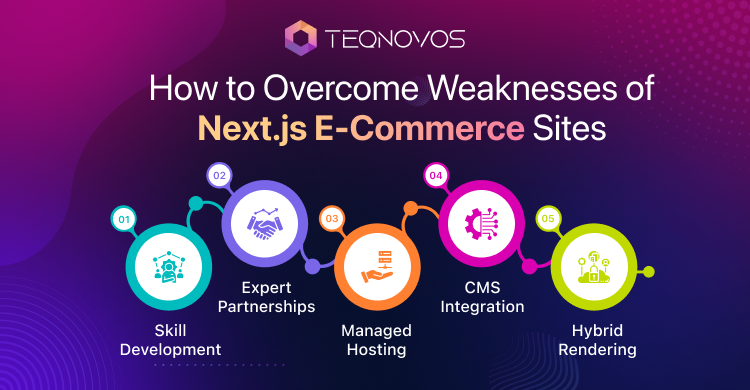
1. Skill Development
Invest in training or hiring experienced React/Next.js developers. Skilled professionals streamline setup by leveraging advanced features. A well-trained team reduces delays and ensures maintainability.
2. Expert Partnerships
Collaborate with development partners holding headless commerce expertise. Established agencies bring proven workflows and best practices for scaling e-commerce operations efficiently.
3. Managed Hosting
Leverage managed hosting platforms like Vercel. These services simplify deployment and handle performance optimization. This saves time and reduces infrastructure overhead.
4. CMS Integration
Integrate a headless CMS into the website. This combination makes content updates faster and more efficient. It empowers marketing teams without constant developer input.
5. Hybrid Rendering
Adopt hybrid rendering strategies that combine static and dynamic pages. Static pages load for most users, while dynamic pages update content in real time. This offers both speed and flexibility for the site.
With the right approach and team, brands can easily overcome these limitations. Next.js empowers e-commerce businesses to deliver scalable shopping experiences to stay ahead of the competition.
Conclusion
E-commerce success today depends on almost three key factors: performance, personalization, and site adaptability.
Shoppers expect websites and stores to move faster and adapt to their priorities. Traditional platforms can no longer keep up with these modern demands. However, Next.js development for e-commerce provides it all.
Now is the time for brands to explore this technology. Connect with Teqnovos to invest in innovation, and let’s shape the future of online shopping. Book a free consultation today!