
A Complete Guide to AI Workflow Automation Software Development
Traditional workflow automation tools are helpful but struggle with different issues. Businesses handling routine tasks each day manually slow down in terms of growth and productivity.
An AI workflow automation service allows organizations to automate tasks with intelligent decision-making. These tools analyze data and trigger actions without constant human input. Many organizations create AI automation platform tools to improve operations. Businesses also add AI guardrails to protect sensitive data and control how AI agents operate inside automated workflows.
Automation is not static but an evolved process from simple scripts and tasks. Intelligent automation systems also integrate technologies such as AI voice agents to automate communication tasks and customer interactions. This guide explains how businesses create AI workflow automation software. It also explores the technologies behind AI workflow software development.
What is AI Workflow Automation Software?
Manage digital tasks using artificial intelligence. This system studies different data patterns to decide the next action in the workflow. It eliminates the need for constant manual supervision. Businesses use these systems to automate approvals and service operations across platforms.
An AI automation platform connects different business tools and manages process execution. This intelligent platform allows the system to learn from data and improve decisions over time. These systems support faster operations and consistent workflow management.
Automation tools built through AI workflow software development help companies manage complex processes across departments. Modern businesses also look to build AI workflow automation like n8n so teams can design flexible workflows that adapt to changing business needs.
Boost productivity and reduce errors with powerful AI Workflow Automation Software. Let our experts design your solution.
Schedule a CallAI Workflow Automation vs Traditional Automation
Traditional automation and AI workflow automation aim to improve business processes. The difference lies in how these systems manage decisions and adapt to changing conditions.
Traditional Automation
Follows predefined rules to perform repetitive digital tasks. These systems execute actions when specific conditions are met. Businesses use traditional automation to transfer data nd form processing. These workflows remain fixed and cannot adjust when business conditions change.
AI Workflow Automation
Introduces intelligent automation into digital operations. The system studies operational data and identifies patterns in workflow activity. It then selects the next action based on the context of the process. Organizations create AI workflow automation systems when workflows require adaptive decisions and flexible task execution.
| Feature | Traditional Automation | AI Workflow Automation |
| Decision Logic | Fixed rules | Data-driven intelligence |
| Workflow Flexibility | Limited | Adaptive processes |
| Process Complexity | Repetitive tasks | Complex operations |
| Learning Capability | No learning | Improves with data |
How AI Workflow Automation Boosts Operational Efficiency?
Organizations depend on many operational tasks each day. Teams process and coordinate activities across multiple systems. Businesses are adopting automation to improve process management.
1. Faster Task Execution
AI systems guide tasks through structured workflows. The system analyzes the activity patterns and triggers the next action in a process. This reduces the delay that occurs during manual coordination. Teams complete operational tasks with speed and consistency.
2. Reduced Manual Work
Routine activities require constant human involvement. These tasks include data approvals and requests. Organizations create AI workflow automation to manage repetitive tasks. This allows teams to focus on strategic work instead of routine tasks.
3. Smarter Decisions
AI systems study operational data and detect patterns in workflow activity. These insights help make informed decisions during process execution. Businesses strengthen their generative AI development capabilities to support intelligent decision-driven automation.
4. Improved Visibility
An AI workflow automation platform provides clear insight into workflow performance. Teams monitor process activity and identify delays or inefficiencies. This transparency helps organizations improve workflow design and maintain operational control across departments.
5. Scalable Operations
Automation platforms allow companies to expand operations without increasing manual workload. Businesses that aim to build AI workflow automation like n8n often focus on creating flexible automation systems. These solutions support the growing operational demand.
Real World Use Cases of AI Workflow Automation
The platform supports many operational activities across modern organizations. Businesses apply intelligent automation to improve service delivery and reduce manual effort.
1. Customer Support Automation
Companies use AI systems to manage customer service workflows. Financial institutions also adopt AI voice assistants for fintech services to automate customer interactions. The platform receives support requests and analyzes customer queries. This process improves response speed and service quality.
2. Sales Process Management
Sales teams handle lead information across multiple platforms. AI workflow systems analyze incoming leads and guide them through the sales pipeline. The automation platform assigns tasks to sales representatives and tracks deal progress.
3. Document Processing
Organizations process many documents each day. AI automation systems analyze digital documents and extract key information. The workflow platform then routes the document to the correct department for approval or action.
4. HR Process Automation
Human resource teams manage recruitment and employee records. AI workflow systems automate candidate screening and interview scheduling. This reduces administrative workload and improves recruitment efficiency.
5. Financial Operations
Finance departments manage invoice approvals and reporting workflows. Many financial organizations adopt AI solutions for fintech platforms to automate compliance checks and fraud monitoring. This helps improve financial operations.
Core Technologies Behind AI Workflow Automation
AI workflow automation relies on several technologies that allow systems to analyze data and manage complex digital processes. These technologies form the foundation of modern AI workflow software development services and enable organizations to create intelligent automation platforms.
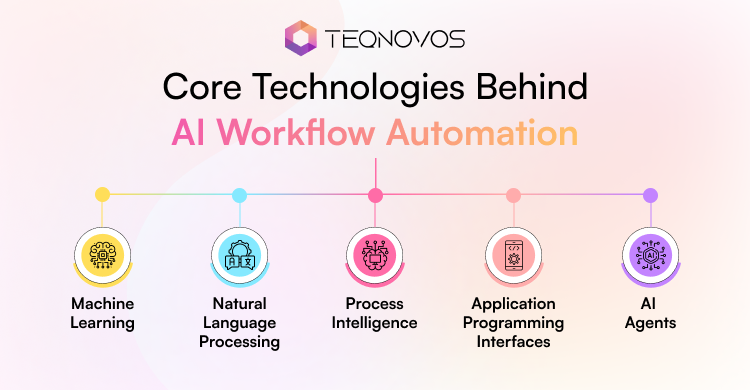
1. Machine Learning
ML allows systems to study historical data and identify operational patterns. The models learn how tasks move through workflows and predict the next action. This capability helps organizations create AI workflow automation that improves with continuous usage.
2. Natural Language Processing
NLP enables systems to understand human language used in service tickets and documents. The technology allows automation platforms to interpret requests and trigger workflows based on written instructions.
3. Process Intelligence
Analyze workflow activity across business systems through process intelligence technologies. The system studies how tasks move through operations and identifies inefficiencies. These insights help organizations refine automation strategies and improve operational performance.
4. Application Programming Interfaces
APIs connect different software platforms inside an automation environment. These connections allow workflow systems to exchange data with external applications such as customer platforms, analytics tools, and enterprise software.
5. AI Agents
AI agents act as intelligent units that perform tasks within automated workflows. These agents observe workflow activity and execute tasks across digital systems. Organizations increasingly use AI agents to support advanced workflow orchestration and autonomous task management.
Upgrade your digital infrastructure with enterprise-grade AI Workflow Automation Software. Get started now.
Schedule a CallHow Does An AI Workflow Automation Platform Work?
The platform observes workflow activity and evaluates operational data before moving a task forward. An AI automation platform manages digital processes through intelligent system coordination. The system reduces manual supervision and improves workflow reliability.
1. Data Input Layer
The process begins when the platform receives data from connected systems. These systems include business applications or service platforms. The workflow engine reads this information and prepares it for analysis. Clean data allows the platform to understand operational context.
2. AI Decision Engine
AI models study workflow data and detect patterns within business activities. The system evaluates conditions and determines the next step in a process. Intelligent decision logic allows organizations to create AI workflow automation that adapts to real operational needs.
3. Workflow Orchestration
Control how tasks move between the system. Tasks move across departments or applications without manual coordination. Many organizations invest in AI workflow software development services to build platforms that support flexible workflow orchestration.
4. System Integration
Connected software tools exchange information through integration layers. These connections allow the workflow platform to operate across multiple business applications. Data flows between systems so tasks can progress through the automation process.
5. Performance Monitoring
The platform observes workflow activity and system performance. Monitoring tools track execution results and identify areas that need improvement. This feedback helps organizations maintain stable automation systems and refine operational processes.
Key Components of AI Agentic Workflows
They rely on specialized components that allow intelligent automation to operate independently. These components enable the system to understand tasks and execute processes across digital environments.
1. Data Collection Layer
The workflow system first interprets the task that needs execution. AI models study workflow conditions and operational goals. This step allows the system to understand the objective of the workflow before performing any action.
2. Planning Mechanism
Agentic systems create an execution plan before starting a workflow. The planning mechanism breaks a task into smaller actions. Each action follows a logical order so the system can complete complex operations without human guidance.
3. Autonomous Execution
Once the plan is prepared, the system performs each step automatically. The workflow engine executes tasks based on defined objectives and workflow logic. This component enables the system to operate independently across multiple digital environments.
4. Context Awareness
Agentic workflows continuously evaluate the context of the task. The system studies operational signals and adjusts its behavior when conditions change. This capability allows workflows to remain flexible during execution.
5. Feedback Adaptation
Agentic systems improve performance through feedback signals. The system observes outcomes and refines workflow behavior over time. This allows organizations to maintain automation systems that improve through operational experience.
Benefits of AI Agentic Workflows for Modern Businesses
AI agentic workflows provide strategic advantages for organizations to rely on complex digital operations. These systems allow businesses to manage processes and ensure adaptability. Companies using AI workflow software development services gain automation systems to improve operational reliability and support growth.
1. Adaptive Process Management
Agentic workflows adjust actions based on real operational signals. The system studies workflow conditions and modifies task execution when necessary. This capability allows organizations to maintain flexible process management without constant human supervision.
2. Higher Decision Accuracy
AI-driven workflows analyze operational information before executing tasks. The system evaluates multiple conditions and selects the most appropriate action. This improves decision quality across complex business processes.
3. Stronger Operational Control
An AI workflow automation platform provides structured process governance. Business leaders gain visibility into how tasks move through operational workflows. This control allows organizations to maintain compliance and process consistency.
4. Faster Innovation Cycles
Automation systems allow companies to experiment with new operational models. Teams design and test digital workflows with minimal disruption to existing processes. Organizations create AI workflow automation platforms to improve operational strategies rapidly.
5. Scalable Digital Operations
Agentic automation supports business growth without increasing operational complexity. Intelligent workflows manage higher process volumes while maintaining consistent execution quality. This scalability allows organizations to expand digital operations.
Step-by-Step to Build AI-Powered Workflow Automation Software?
Organizations follow a structured process to create intelligent workflow systems. The goal is to design automation to manage and analyze data, guiding decisions across digital operations. Strong planning and system architecture are essential during AI workflow software development.
Identify
The first step is to study existing workflows across departments. Teams review tasks that require repeated manual effort. These processes often include approval data and service requests. Organizations create AI workflow automation to manage activities through intelligent automation.
Design
The next step is to design the workflow structure. This stage defines how tasks move across systems and teams. Developers plan data flow system triggers and automation rules. A strong architecture creates a stable AI workflow automation platform to support complex business processes.
AI Model
Artificial intelligence models analyze operational data and support automated decision-making. Developers select models to match the business requirements. Machine learning models help systems detect patterns and improve workflow outcomes during AI software development.
Automation Platform
Development teams build the automation system using modern software frameworks. The platform connects workflows with AI services and business applications. Building an AI workflow automation like n8n allows teams to visually design workflows and automate digital operations.
Integrate
APIs connect different software tools inside the workflow platform. Integration allows the automation system to exchange data between business applications. This step ensures the AI workflow platform operates across the full technology environment.
Deploy
After development, the system moves to production. Teams monitor workflow activity and system performance. Continuous evaluation improves automation quality and system reliability. Businesses expand features over time to strengthen their AI workflow software development strategy.
Technical Challenges in AI Workflow Automation Platforms
AI workflow automation implementation in organizations improves digital operations. However, it presents various challenges during system development and deployment. Businesses need to address these factors to ensure stable and effective automation systems.
System Integration Complexity
Many organizations operate across multiple digital platforms. Each system stores data in different formats and structures. Integrating these systems into a single automation workflow requires careful planning. Strong integration architecture ensures smooth communication between applications.
Data Quality and Availability
AI automation systems rely on operational data. Inconsistent or incomplete data reduces automation performance. Organizations must establish reliable data pipelines before implementing workflow automation solutions.
Governance and Control
Automation platforms require governance frameworks to maintain operational control. Businesses must define rules to guide workflow behavior and system permissions. Proper governance ensures that automation systems follow organizational policies.
Change Management
Workflow automation transforms existing operational procedures. Employees may need training to understand how automation systems operate. Organizations must support developers and teams during this transition to ensure successful adoption.
Security and Compliance
Automation systems interact with sensitive business data. Companies must implement security controls to protect information during workflow execution. Compliance frameworks also ensure automation platforms operate within regulatory requirements.
Future of AI Agentic Workflow Automation
AI agents continue to evolve as organizations adopt intelligent systems for digital operations. Businesses no longer rely only on rule-based automation. Modern platforms combine data analysis and autonomous systems to manage complex workflows.
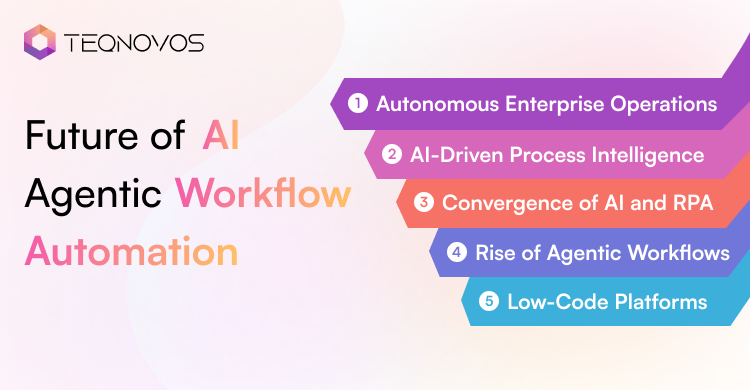
Convergence of AI and RPA
RPA automates repetitive digital tasks through predefined rules. Many organizations combine RPA with artificial intelligence to support automation. This integration allows workflows to analyze operational signals and adjust task execution when conditions change.
Rise of Agentic Workflows
Agentic systems allow AI agents to plan tasks and execute workflows independently. These systems analyze operational context and determine the most appropriate action during workflow execution. Organizations increasingly adopt agentic automation to manage complex business operations.
Low Code Platforms
These tools reduce the need for extensive programming knowledge. Businesses use these platforms to create automation systems quickly and scale digital operations efficiently.
Read this blog: Low-code automation platforms allow teams to design workflows through visual interfaces.
AI-Driven Process Intelligence
Process intelligence platforms analyze workflow activity across business systems. These tools identify inefficiencies and recommend improvements in operational processes. Organizations use these insights to refine automation strategies and improve workflow performance.
Autonomous Enterprise Operations
Future automation platforms will support autonomous business operations. Smart systems will manage workflows and optimize processes with minimal human supervision. This shift will allow organizations to operate with greater efficiency and responsiveness in digital environments.
Conclusion
AI workflow automation helps organizations manage digital processes with intelligence and efficiency. Businesses adopt these systems to reduce manual work and improve operational decisions.
Modern platforms combine artificial intelligence and system integration to support complex workflows. AI workflow software development services assist businesses in building scalable automation systems to support growth.
Teqnovos helps businesses design and develop scalable AI workflow automation platforms tailored to complex operational needs. Don’t stop here. Book a free consultation with us and build AI Workflow Automation like n8n!