How to Build AI SDR Tool: Guide for Scalable Sales Growth
Sales development representatives are the main engine, playing a crucial role in bringing opportunities to many businesses. They assist in engaging with potential customers and qualifying leads. However, sometimes these representatives find themselves overwhelmed with repetitive tasks.
This is where the AI SDR tool development transforms your sales. These tools assist in achieving better results and making connections with qualified buyers. AI workflow software development leverages artificial intelligence to enhance outbound sales processes.
These automation tools focus more on high-value prospects, improving speed and output. This guide explores how intelligent workflows improve sales performance. Let us see how these structured systems turn efforts into real results.
What Is An AI SDR?
An AI SDR tool supports sales outreach and lead qualification. It works as a digital assistant that supports sales outreach and lead qualification. It helps businesses handle large volumes of data and initial interactions without increasing manual effort.
Develop SDR using machine learning and natural language processing to understand data and respond to prospects. This allows the system to communicate in a natural and relevant way. AI SDR identifies potential leads based on behavior and intent. The system analyzes interactions and improves responses over time. Personalized messages and real-time replies improve engagement.
The platform also manages meeting scheduling and updates sales workflows. Integration with existing tools keeps data organized and accessible. This approach aligns with innovative AI solutions for banking automation, where efficiency and precision drive better outcomes. The system reduces manual effort and improves response speed across operations.
Unlike traditional processes, the system adapts based on user behavior and engagement patterns. This approach helps businesses maintain steady outreach while improving lead quality and conversion potential.
Get started with AI SDR tool development using ML and build a smarter, automated outreach system. Ready to scale your sales?
Schedule a CallWhy Are Businesses Moving to AI SDR?
Sales teams face growing pressure to deliver faster results. High outreach demand makes manual processes difficult to manage. Repetitive tasks reduce focus on meaningful conversations. This slows down overall growth.
1. Need for Speed and Scale
Modern sales require fast outreach. Teams need to connect with more prospects in less time. AI SDR helps handle large volumes without increasing workload. This keeps outreach consistent and efficient.
2. Faster Response Time
Prospects expect quick replies during early interactions. Delays often lead to lost opportunities. AI SDR enables instant engagement, which improves timing and response quality.
3. Data-Driven Sales Approach
Traditional sales depend on assumptions. AI SDR uses real-time behavior and intent signals. This helps teams focus on potential prospects and improve conversion rates.
4. Improved Team Efficiency
Manual tasks reduce productivity. AI SDR automates repetitive activities. Thus, sales teams can focus more on closing deals instead of managing workflows.
5. Scalability Without Complexity
As businesses grow, outreach becomes difficult to manage. AI SDR supports large-scale communication while maintaining relevance. This creates a more predictable sales process.
How Does AI SDR Work?
AI SDR follows a structured process that manages outreach and lead qualification with precision. The system handles each stage of the sales journey in a logical flow. This approach reduces manual effort and improves consistency across interactions.
This process shows how businesses develop SDR using machine learning and natural language processing to create intelligent sales systems that adapt and improve over time.
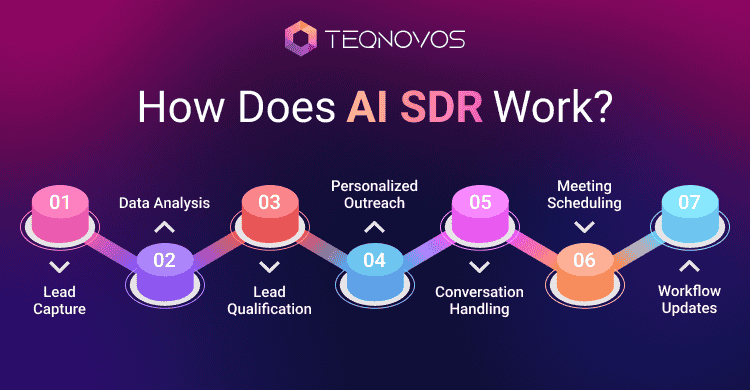
1. Lead Capture
The process begins with collecting data from multiple sources. AI SDR gathers information from various CRM platforms and marketing channels. It tracks form page visits and campaign interactions. This builds a strong base of potential prospects with relevant data points.
2. Data Analysis
The system then analyzes user behavior and engagement signals. It studies how prospects interact with content emails and landing pages. This helps identify intent and interest level. The system recognizes patterns that indicate readiness to engage.
3. Lead Qualification
AI SDR evaluates each lead using predefined rules and behavior signals. The system assigns scores based on engagement and profile data. This helps filter out low-quality leads. Sales teams then maintain focus only on prospects that show higher potential.
4. Personalized Outreach
The system creates tailored messages based on user data and interaction history. Each message reflects the prospect’s needs and interests. This improves relevance and builds stronger connections. Outreach happens across email chat and other communication channels.
5. Conversation Handling
AI SDR manages ongoing conversations in real time. It understands queries and provides accurate responses. The system maintains context during interactions, which keeps communication smooth. This helps build trust during early engagement.
6. Meeting Scheduling
When a prospect shows interest, the system moves to scheduling. AI SDR checks availability and books meetings without delays. This removes friction and speeds up the transition from outreach to sales discussion.
7. Workflow Updates
The system records every interaction and automatically updates CRM platforms. This keeps data accurate and organized. Sales teams gain full visibility into prospect activity and engagement history.
This entire process reflects how SDR accelerates business growth through a clear working model. Each step supports better engagement and improved conversion. Businesses scale outreach without losing control over quality.
Automate outreach and improve engagement using AI SDR tool development using ML Start your journey toward smarter sales today.
Schedule a CallAI SDR Working Model for Business Growth
The model follows a structured working model that connects data outreach and conversion into a continuous flow. Each stage builds on the previous step and ensures that the system does not miss any opportunity. This model assists businesses in creating a predictable and scalable sales process.
1. Lead Identification
The process begins by identifying potential prospects. AI SDR scans multiple data sources and tracks user activity. It captures signals such as content interaction and inquiry behavior. This helps in building a pool of relevant leads.
2. Intent Recognition
The system analyzes behavior to understand intent. It studies engagement patterns and interaction frequency. This allows the system to identify prospects who are actively researching solutions. Strong intent signals support prioritizing outreach.
3. Lead Scoring
AI SDR assigns scores based on behavior and profile data. The system evaluates each lead against defined criteria. High-scoring prospects move forward in this process. It ensures the effort focuses on opportunities with better conversion potential.
4. Targeted Outreach
The system initiates communication with personalized messaging. Each interaction reflects the prospect’s interest and stage in the journey. This improves engagement and increases the chances of a response.
5. Real-Time Engagement
AI SDR manages conversations as they happen. It responds instantly and maintains context. This keeps communication smooth and relevant. Prospects receive timely answers without delays.
6. Conversion Trigger
When a prospect shows strong interest, the system moves toward its conversion. It initiates actions such as booking a meeting or requesting more details. This reduces friction and speeds up the process of making decisions.
7. Pipeline Integration
All interactions are recorded and updated in sales systems. This keeps the pipeline organized and transparent. Sales teams gain full visibility into lead progress and engagement history.
This working model demonstrates how SDR accelerates business growth through a structured approach. Each stage improves efficiency and ensures consistent movement across the sales funnel. Businesses scale outreach while maintaining quality and control.
Key Technologies Behind AI SDR
The model relies on a combination of advanced technologies to enable smart decision-making and real-time interactions. These technologies work to enhance accuracy and sales performance.
1. Machine Learning
The system studies past interactions and identifies patterns to refine lead scoring and outreach strategies. This helps businesses develop SDR using machine learning and natural language processing for better results.
2. Data Processing Systems
AI SDR depends on strong data processing capabilities. The system collects and analyzes large volumes of data from multiple sources. This includes customer behavior and engagement signals. Accurate data processing helps in identifying high-value prospects.
3. Streamlined Workflows
Connect different stages of the sales process to manage tasks such as outreach follow ups and scheduling. This ensures smooth execution without manual intervention, leading sales teams to focus on closing deals.
4. Natural Language Processing
This assists the system in understanding and responding in human language. The AI SDR interprets messages and generates meaningful replies for them. Thus, improving the conversation quality. This makes communication feel natural and engaging.
5. Integration Systems
Integrate the system with CRM platforms and marketing tools to keep all data in one place. This ensures consistency across systems. This improves visibility and helps teams track every interaction.
6. Prediction Model
Predict user behavior and engagement using historical data to identify which prospects are more likely to convert. This improves targeting and increases conversion rates.
These technologies form the foundation of AI SDR tool development. Each component supports a smarter and more efficient sales process. They enable businesses to scale outreach while maintaining quality and precision.
AI SDR Tool Development Process for Scalable Sales Systems
The system follows a structured approach to turn business goals into a functional sales system. Each stage focuses on building a solution to improve outreach efficiency and lead conversion. A clear process ensures the system performs reliably at scale.
1. Requirement Analysis
The cycle begins with defining objectives and use cases. Businesses identify a target audience and outreach channels. This step sets the direction for the entire system. Clear requirements help avoid gaps during development.
2. Data Collection
The system requires quality data to perform effectively. Data is gathered from CRM platforms and customer interactions. This includes behavioral signals and user profiles. Clean and organized data improves accuracy in decision-making.
3. Model Development
This stage trains the model using machine learning and natural language processing. They are built to understand the user intent and generate responses based on that. The system learns from past interactions and continues to improve over time. This step plays a key role in building an intelligent AI sales system.
4. System Design and Workflow Setup
The dedicated development team defines how the system will operate across different stages. Workflows are created for lead capture and scheduling. Each workflow ensures smooth movement of prospects through the sales funnel.
5. Integration with Tools
The system connects with the CRM platforms and communication tools. It connects seamlessly with marketing systems. This ensures the data flows seamlessly across platforms. Integration improves visibility and keeps the sales process aligned.
6. Optimization
The system undergoes testing to evaluate performance and accuracy. Developers analyze response quality and workflow execution. Constant optimization improves the efficiency of the platform and ensures reliable output.
7. Deployment
After the testing, the system is launched into the live environment. Performance is monitored closely to identify improvements. Regular updates keep the system aligned with changing business needs and user behavior.
This development process helps businesses build AI SDR solutions that are efficient and reliable. It ensures the sales teams gain a system to support growth without increasing operational complexity.
Develop an AI Sales Person for Multilingual and Scalable Outreach
Modern sales teams need to connect with global audiences. Language barriers limit outreach and reduce engagement. AI SDR systems solve this challenge by enabling multilingual communication at scale. Develop AI salesperson solutions to interact with prospects across different regions.
AI systems support scalable outreach with strong adaptability:
- Communicate with prospects in multiple languages with contextual accuracy
- Adapt tone and messaging based on user behavior and region
- Maintain consistent outreach across different markets
- Handle large volumes of conversations without losing personalization
- Support both voice and text-based communication channels
This approach improves global reach and engagement. Businesses enter new markets without building large local teams. AI SDR manages early-stage communication and lead qualification across regions.
Scalability remains a key advantage. The system handles thousands of interactions at the same time. Each conversation stays relevant and aligned with user intent. This helps maintain quality while increasing outreach.
Thus, build a top-performing AI salesperson who can speak any language. This creates a strong foundation for global sales growth. It supports faster engagement and improved conversion across markets.
AI-Driven Activation for Fintech and eCommerce
Businesses across industries are adopting AI SDR to improve engagement and conversion. Fintech companies, including banks and eCommerce brands, see a strong impact. It helps manage this scale with precision and consistency.
Banks and Fintech
Financial services require accuracy and timely communication. AI SDR supports lead qualification and customer engagement across multiple touchpoints. AI-driven banking software development helps identify high-intent users and guide them through early interactions.
Key applications include:
- Qualify leads for financial products based on behavior and interest
- Engage users with timely follow-ups and relevant communication
- Support onboarding journeys with guided interactions
- Improve response speed for customer inquiries
- AI-Driven activation for banks and fintech to enhance operational efficiency
AI voice assistant development for FinTech and banks enhances engagement while maintaining structured communication.
eCommerce
These businesses operate in a hasty ecosystem where timing plays a critical role. AI-Driven activation for eCommerce helps capture user interest and convert it into action through consistent engagement.
Key applications include:
- Engage users based on browsing and purchase behavior
- Recover abandoned carts with timely outreach
- Recommend products based on user preferences
- Respond to customer queries in real time
- Support upselling and cross-selling through communication
Simplify the shopping experience with generative AI and manage large-scale interactions. This improves customer experience and increases conversion potential.
Real Use Cases of AI SDR in Sales
AI SDR systems support multiple sales scenarios. Businesses use these systems to improve outreach efficiency and maintain consistent engagement across the funnel. Each use case focuses on solving a specific challenge in the sales process.
Outbound Prospecting
Identify and reach new prospects at scale. The system analyzes data and selects potential leads. It sends personalized outreach messages to match the user intent. This improves response rates and reduces manual effort.
Lead Qualification
Businesses receive large volumes of inbound inquiries. The model evaluates each lead based on behavior and engagement. The system filters and prioritizes prospects who show real interest. It ensures the sales teams focus on value opportunities.
Follow-Up Management
Timely tracking plays a key role in conversion. AI SDR manages these sequences without delays. The system sends reminders and responses based on user interaction. This keeps prospects engaged throughout the journey.
Lead Nurturing
Not every prospect is ready to convert immediately. AI SDR supports engagement through relevant communication. The system shares information and maintains contact until the prospect shows intent. This improves the longer conversion potential.
Booking and Qualification
The model recognizes when a prospect is ready for the next stage. Based on their availability and interest, it schedules meetings. The system ensures only qualified leads reach the sales team. This improves efficiency and reduces wasted effort.
These use cases show how AI SDR supports different stages of the sales process. Businesses automate routine tasks while enhancing business engagement and conversion. This creates a more structured and effective sales system.
Benefits of AI SDR Tool Development
Develop an AI salesperson tool to deliver measurable improvements across the sales process. This assists in gaining better control over outreach while reducing manual effort. The system supports consistent performance and scalable growth.
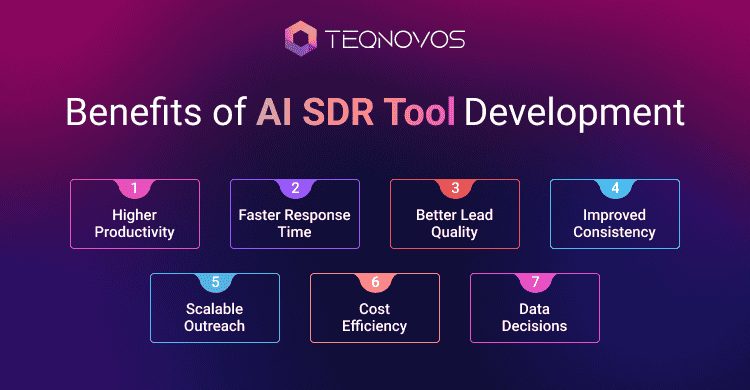
1. Higher Productivity
Handles repetitive tasks such as outreach and follow-ups. Sales teams spend less time on manual work. This allows teams to focus on closing deals and building relationships.
2. Faster Response Time
Speed plays a critical role in early engagement. AI SDR responds instantly to prospect queries and interactions. This helps capture interest at the right moment and improves engagement.
3. Better Lead Quality
AI SDR evaluates leads based on behavior and intent signals. The system filters out low-quality prospects. Sales teams receive leads that have higher conversion potential.
4. Improved Consistency
Manual outreach leads to inconsistent communication. AI SDR ensures every interaction follows a structured approach. This maintains quality across all touchpoints.
5. Scalable Outreach
As businesses grow, outreach becomes difficult to manage. The model supports large-scale communication without compromising relevance. This helps maintain performance even with increasing demand.
6. Cost Efficiency
The system reduces the need for large sales teams to handle early-stage tasks. Businesses optimize resources and lower operational costs while maintaining output.
7. Data Decisions
The system gains understanding from the data available and user behavior. This helps businesses refine their techniques and improve targeting over time.
These benefits show how AI SDR tool development supports an efficient and predictable sales process. This assists businesses in improving performance and maintaining control over growth.
Implementation Challenges in AI-Powered Sales Development
These tools bring strong advantages, but execution requires careful planning. Businesses face difficulties during setup and adoption. Addressing these early helps ensure better performance and success.
1. Data Quality Issues
AI SDR depends on accurate and structured data. Incomplete or outdated data affects lead scoring and outreach quality. Businesses need clean and well-organized data to get reliable results.
2. System Integration Complexity
AI SDR must connect with CRM platforms and communication tools. Integration becomes complex if systems are not aligned. Poor integration may lead to data gaps and workflow issues.
3. Model Training
AI systems require proper training to perform effectively. Poor training leads to irrelevant responses and incorrect lead qualification. Continuous improvement is necessary to maintain accuracy.
4. User Adoption
Sales teams may take time to adapt to new systems. Lack of understanding reduces usage and impacts performance. Proper training and onboarding help teams use AI SDR effectively.
5. Maintaining Personalization
Scaling outreach risks losing personalization. AI SDR must balance automation with relevant communication. Businesses need to ensure that messages remain aligned with user intent.
These challenges highlight the importance of a structured implementation approach. Businesses that address these factors early build reliable and effective AI SDR systems.
Future of AI SDR and Sales Automation
Sales development continues to evolve with advancements in AI. Businesses focus on building systems that go beyond basic automation. The future of AI SDR will center on faster response and more adaptive communication.
1. Voice-Based Interaction
AI SDR systems will move beyond text. Voice interaction will become common in initial conversations. Businesses will use conversational AI voice development to help handle calls and voice responses with natural tone and clarity. This will improve accessibility and engagement.
2. Hyper Personalization
Future systems will deliver personalized communication. AI will analyze deeper behavioral patterns and preferences. Each interaction will reflect the exact needs of the prospect. This will improve engagement and increase conversion potential.
3. Autonomous Sales Agents
AI SDR will evolve into more independent systems. These agents will manage outreach qualification and engagement without constant human input. Businesses will rely on autonomous workflows to handle large sales operations.
4. Predictive Sales Intelligence
AI will move from reactive to predictive models. Systems will predict user behavior and identify high-intent prospects in advance. This will help sales teams act earlier and improve success rates.
5. Deeper System Integration
AI SDR will integrate more closely with business systems. This will create a unified flow of data in sales and customer platforms. Better integration will improve visibility and decision-making.
Conclusion
Sales development continues to shift toward intelligent automation. Businesses need systems to handle scale without losing quality. AI SDR provides a structured approach to managing outreach qualification and engagement more efficiently.
This guide explained how AI SDR tool development supports modern sales workflows. It showed how structured processes improve response and lead quality. It also highlighted how businesses develop AI salesperson solutions for scalable outreach.
Businesses adopting AI SDR early build stronger engagement strategies and improve conversion outcomes. Connect with Teqnovos to transform your sales process with advanced automation. Book a free call with us today!